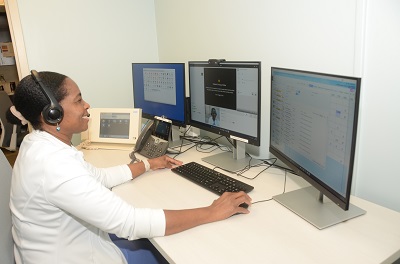
Virtual Nurse Lucienne Morency Saint Cyr at a workstation
By Daniel Casciato
The healthcare landscape is evolving with innovative care models that redefine patient engagement and professional nursing practices. At the vanguard of this evolution is Holy Cross Health’s Virtual Nursing program, known as the “Together Team.” This program enhances patient care and broadens career prospects for nurses. Taren O’Brien, Vice President and Chief Nursing Officer at Holy Cross Health, provides insights into this cutting-edge initiative.
The Virtual Nursing Model
The Together Team is a collaborative care model integrating bedside RNs, PCTs or LPNs, and a virtual nurse operating remotely. This trio operates with the virtual nurse stationed within the hospital but on a different floor.
“The virtual nurses connect with the patient via the TV in their room and the camera, which is fixed on the walls,” explains O’Brien.
This innovative approach allows for high-resolution monitoring and immediate medical interventions, such as stroke alerts, enhancing patient safety and care.
The virtual nursing program at Holy Cross Health is a fresh addition, implemented early in November.
“Holy Cross is the fifth cohort in Trinity Health to go live,” O’Brien remarks, indicating the program’s recent inception and its broader adoption across the Trinity Health system.
Observed Benefits
Significant benefits have been observed since the program’s inception across Trinity Health. O’Brien notes, “The RN at the bedside interacts more with the patient and the family. This allows the nurse more time to spend with the patient.”
According to O’Brien, virtual nurses at other locations across Trinity have been able to pick up neurological changes.
“For instance, they can zoom in to see the pupils on the patient and see that the pupils aren’t reacting to light, and they were able to call a stroke alert or a stroke team so they could intervene,” she says. “They can also call code blues and code rescues as well. This is a transformational change for us. It’s going from a primary care model to a team nursing model. So we’re taking care of a team of patients with more resources to take care of the patient.”
The redistribution of tasks to virtual nurses has also improved patient experience scores and enhanced the efficiency of bedside care. It enhances patient surveillance and meets patient needs more swiftly, maintaining the personal touch with the added advantage of technological assistance.
In addition, the virtual nursing model complements traditional in-person care by providing experienced virtual nurses as mentors to less experienced bedside nurses.
“The virtual nurses are more experienced and can help serve as a mentor to that bedside nurse,” says O’Brien, highlighting the supportive role of virtual nurses.
Career Expansion and Training
The program has expanded career options for nurses, providing alternatives to traditional bedside roles. The virtual nursing program has also expanded career options within Holy Cross Health itself, offering a reprieve to nurses facing physical and mental fatigue. It has re-engaged nurses who might have left the bedside, providing them with rewarding virtual roles.
“This has been able to give them an opportunity to not really need to be at the bedside, but also be that mentor and that support for the newer nurses,” says O’Brien highlighting the career flexibility offered by the program.
Training for virtual nurses is robust, involving classes and hands-on computer training, ensuring a smooth transition into this new care delivery model.
Adopting the virtual nursing program has not been without its challenges. O’Brien acknowledges the difficulties in staffing, particularly for PCT roles, and the organization’s proactive approach to training and onboarding new staff.
“Holy Cross Health has addressed this by offering comprehensive onboarding and training, even to individuals with less acute care experience,” she says.
Patient and Family Response
All 112 beds across two floors at Holy Cross are equipped with the necessary technology for virtual nursing. “It’s usually three or four virtual nurses working per shift,” O’Brien states. “it’s been more of a team-based approach over traditional patient-nurse ratios.”
O’Brien notes that patients and families have responded positively to the virtual nursing model, impressed by its quick access to care and enhanced communication. The program also aims to improve discharge processes, potentially reducing readmission rates.
“The response from patients and families has been overwhelmingly positive,” she adds. “We have been impressed with the transformational technology.”
Holy Cross Health’s virtual nursing program is a testament to the evolving landscape of healthcare delivery. It improves patient care and provides a sustainable and fulfilling career path for nurses. As the program grows, it promises to be a beacon of innovation and a model for other healthcare institutions.
O’Brien concludes by reflecting on the importance of teamwork and delegation within the nursing model. “That’s really when we see that the model is going to be beneficial,” she says, emphasizing the collective effort required to make the virtual nursing program successful.
For more information, please visit www.holy-cross.com.