
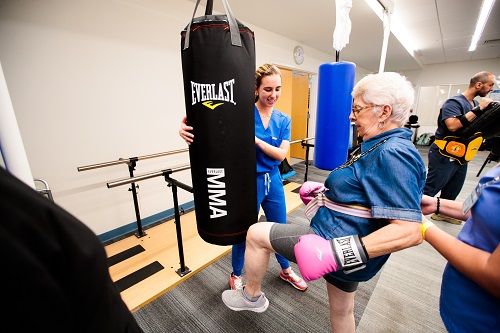
Faculty and students at the University of St. Augustine for Health Sciences (USAHS) in Miami, are helping individuals with Parkinson’s Disease improve their balance, coordination, and quality of life through Rock Steady Boxing (RSB) classes, a non-contact boxing-inspired routine, that attacks Parkinson’s Disease and attempts to limit the effects of the disease process. Initial research by faculty at USAHS in Miami found the classes had a positive impact on quality of life after six months.
“Rock Steady Boxing helps people with Parkinson’s because it involves aerobic exercise, rotational movements, and power generation,” says associate professor Miguel Garcia, PT, DPT, EdD, who spearheaded the initiative at USAHS in Miami and continues to lead research initiatives along with Dr. Gabriel Somarriba, PT, DPT, EdD. Study participants reported improved emotional well-being and less physical discomfort. Dr. Garcia says the research indicates that attending Rock Steady Boxing classes at a regular frequency could help individuals with Parkinson’s Disease maintain their current level of function and possibly slow the progression of the disease when combined with appropriate medical management initiatives.
“Each class consists of an active warm-up, followed by strengthening and functional mobility exercises, and culminates with boxing exercises and drills,” Dr. Garcia says. “The boxers are getting a good exercise class, and the students are learning how to communicate and work with patients. This isn’t simulation—it’s real people.”
Dr. Garcia collaborates with The Brain Center in Coral Gables, a non-profit comprehensive outpatient neurological program, who send participants that could benefit from this pro bono clinic. The participants vary in physical capabilities, but the program allows for modifications to be made to fit each boxer and their limitations. Some have to sit in a chair, while others have no visible form of impairment.
“They love that they’re not being treated as fragile. They are interactive with the students and always have positive feedback about their engagement with the student body. It truly is a positive experience for all involved, our boxers, students and faculty,” said Dr. Garcia.



















