November 23, 2026 – When Gianna, a 9-year-old girl from Hialeah Gardens, was just 6 months old, her family took her to the nearest ER after weeks of hospital visits in search of answers to her trouble breathing. After being diagnosed with Respiratory Syncytial Virus (RSV), an infection of the lungs and respiratory tract, that later caused Bronchiolitis, an inflammation of the small airway passages entering the lungs, Gianna was intubated. When patients are intubated a breathing tube is placed through the mouth into the windpipe to help deliver oxygen. After that initial intubation, Gianna repeatedly returned to the hospital with continued breathing difficulties and often needed to be intubated again.
As doctors investigated the cause of her ongoing problems, they discovered that Gianna had Grade 3 Subglottic Stenosis, a significant narrowing of the airway below the vocal cords, along with bilateral vocal cord immobility, a condition in which both vocal cords have limited or no movement. To help her breathe, doctors performed a tracheotomy. During this procedure, a hole is made through the front of the neck and into the windpipe (trachea). Surgeons place a tracheostomy tube into the hole to keep it open for breathing.
“At first I was super scared,” her mother, Tabatha, recalls. “I was worried that she would never leave the hospital but found support through an online group of mothers who also had children with a trach.”
Her family had initially been told that Gianna would only need the tracheostomy for three to five months. Instead, the tube became part of her daily life for nearly five years.
Caring for a child with a tracheostomy requires extensive preparation and round-the-clock attention. Gianna’s family learned how to manage her daughter’s airway, recognize potential complications and provide the care she needed at home.
After a routine visit with Gianna’s initial Otolaryngologists (ENT doctor), she was told that removing the tracheostomy was not a realistic option and that she would likely need it for the rest of her life.
Unwilling to stop searching for answers, her mother turned to the online tracheostomy community and asked whether anyone knew a doctor that could offer a second opinion and be willing to evaluate Gianna. Very shortly after, a fellow community member recommended Dr. Brian Ho, Nicklaus Children’s Hospital pediatric otolaryngologist and airway specialist who was more than willing to remove Gianna’s trach.
“When we finally met Dr. Ho, I remember I kept telling him, I wish I would have met you earlier,” says Tabatha. “I knew from that appointment that Dr. Ho would be able to change Gianna’s life.”
After evaluating Gianna’s condition, Dr. Ho alongside the Nicklaus Children’s Airway Program team developed a surgical plan to reconstruct her airway with the goal of eventually removing her tracheostomy.
In July 2021, when Gianna was 3, she underwent a laryngotracheoplasty, a complex procedure designed to widen and support a narrowed airway. The reconstruction required two stages. During the first surgery, the surgical team carefully took a small piece of cartilage from one of her ribs and used it as a graft to expand and support the narrowed portion of her airway. Following the procedure, Gianna remained in the hospital for a few days with a stent to support the reconstructed airway and a drain to help manage postoperative fluid.
After her airway had healed sufficiently, Gianna underwent a capping trial. During this process, her tracheostomy tube was temporarily capped so her care team could assess whether she could breathe comfortably through her reconstructed airway.
Just before her 4th birthday, Gianna returned to the hospital for the second stage of treatment. Her tracheostomy tube was removed, a milestone known as decannulation. Finally, after nearly five years with a tracheostomy, Gianna was breathing without the tube.
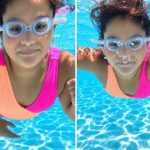
One of the first things Gianna wanted to do after her tracheostomy was removed was jump into a swimming pool and finally “swim like a mermaid” as she describes. Water had always been one of her favorite things, and now she could look forward to going underwater, an activity she was not able to do with a breathing tube.
Since her surgery, Gianna has continued to progress and returns to Nicklaus Children’s where her care team ensures her airway remains healthy.
Today, Gianna is an active, joyful 9-year-old who loves swimming, singing songs from her favorite band, KATSEYE, and spending time enjoying the things that make her happy.
For her mother, seeing Gianna embrace these experiences is a powerful reminder of how far her daughter has come. “I am so thankful to Dr. Ho and his team who have given Gianna and our family a new outcome on life,” says Tabatha.