|
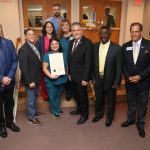
Dr. Barry T. Katzen (second from left), founder and medical director of Baptist Cardiac & Vascular Institute in Miami, and Dr. Dittmar Böckler (second from right), medical director and chairman of the Department for Vascular and Endovascular Surgery at Heidelberg University Hospital in Germany, announce their affiliation agreement at The International Symposium on Endovascular Therapy. Baptist Health South Florida president and CEO Brian Keeley (left) and Baptist Hospital CEO Bo Boulenger (right) attend the announcement for a longstanding commitment to the exchange of knowledge and innovation that will result in better patient care both in the United States and Germany. Photo credit: Gort Productions.
|

Baptist Cardiac & Vascular Institute of Miami recently announced its partnership with the University of Heidelberg, one of the largest and most important centers for patient care, medical research and teaching in Europe, for hands-on access to the latest medical innovations.
“Our Institute has set the agenda in South Florida for cardiac and vascular procedures and treatment, but a lot of medical innovations are happening outside the United States. Our affiliation with the University of Heidelberg will bring a new line of knowledge in clinical medicine and broaden our perspective about new developments in patient care,” Barry T. Katzen, M.D., founder and medical director of the Institute, said.
The relationship will benefit South Florida patients, who will have access to the most advanced treatments available for cardiac and vascular systems performed by heart surgeons, interventional radiologists and vascular surgeons.
“In our regulatory environment, it takes three to four years for innovations to be approved here. Our doctors, by traveling to Heidelberg, will already have been involved in early-stage technology. As a byproduct of this partnership, over time it will have significant implications in patient care,” Dr. Katzen said.
Both organizations are internationally renowned as groundbreakers in cardiovascular care, involved in dozens of clinical trials and sophisticated diagnostic, treatment and rehabilitation services. In addition, they share a goal of searching for the least invasive treatments, particularly important for an aging population that isn’t always eligible for traditional surgery due to high risk factors. Teams of interventional radiologists, clinical and interventional cardiologists, cardiothoracic surgeons, vascular surgeons, electrophysiologists, and neuroradiologists work together to provide a spectrum of care ranging from wellness to the most complex endovascular and open surgical procedures for heart and circulatory problems.