
By Sue MacDonald
At Jupiter Medical Center, an adult male patient named Hal, a labor-delivery patient who goes by Vickie, a cute little full-term newborn named Tori, and a geriatric patient everyone calls Terry are providing valuable lessons for staff nurses, physicians and other healthcare professionals interested in practicing, refining and enhancing their clinical skills.
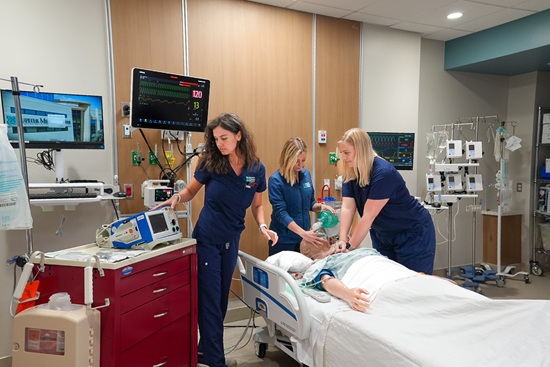
But when treatment decisions go wrong, the results don’t matter except for the incredible teaching moments they provide … because Hal, Tori, Vickie and Terry aren’t real.
They’re medical simulators – technologically enhanced, lifelike, functional models of the human body that are vital components of Jupiter’s newly opened Center for Clinical Simulation, a cutting-edge training hub for staff nurses, physicians and other team members.
On these lifelike patient simulators, staff members can practice and refine their clinical-technical skills, learn new equipment and technologies, hone their decision-making prowess, improve their communication and teamwork skills – and learn from their mistakes.
Immediate feedback … and medical learning
Stephanie Little, MSN, RNC-OB, C-EFM, Jupiter’s Director of Nursing Professional Practice & Clinical Education, says the simulation lab includes three separate rooms designed to look and function exactly like hospital treatment areas: medical-surgical, intensive care, and labor-delivery with a neonatal intensive care unit.
Unique to other area hospital training programs, Jupiter’s training mannequins and state-of-the-art simulation lab allow staff members to gain valuable experience without putting actual patients at risk.
“As staff members are doing chest compressions on one of the adult simulators experiencing a heart attack, for example, they can see on a monitor how effective their chest compressions are,” Little explains. “They get immediate feedback on how quickly they’re doing compressions and if they’re doing them with enough pressure.”
Likewise, an obstetrics-gynecology simulation room can present trainees with a normal delivery or a complicated delivery, including scenarios involving hemorrhage, high-risk childbirth, neonatal care and an infant cardiopulmonary resuscitation scenario.
“It’s very cool, because if you’re doing all the things you’re supposed to do as part of the simulation exercise, the baby automatically improves, her color changes and she starts moving,” Little points out.
A unique, medical training resource
“Jupiter Medical Center is already an incredible place work, but the fact that our newly opened patient tower includes a simulation department is amazing,” she adds with pride. “We’ve had the simulators for some time, but we just didn’t have the rooms until now. At our January ribbon-cutting ceremony (for the new Patient Tower), one of the architects pulled me aside and said, ‘Do you know how many of these labs we’ve built? Two. You’re lucky to work at a hospital that values staff education.’”
Jupiter’s unique-to-the-region training lab includes three high-fidelity simulation suites and a 30-person classroom. Training is offered in nursing, emergency medicine, pediatrics, obstetrics-gynecology and other specialties like geriatrics. Terry, the geriatric simulator, features typical weight distribution features and life-like skin for training on skin care, wound care, positioning and other elements of elder care. Each suite includes the same equipment and technology that professionals use in everyday care: beds, monitors, defibrillators, medication prep areas and more.
During each session, in-suite technologies allow instructors to observe and debrief trainees in real time, and Little says the training’s impact is often immediate for staff members.
“For one of my early novice classes for a labor-delivery nurse and a postpartum nurse, I did a hemorrhage simulation for a post-partum mother,” she recalls. “That weekend, two novice nurses cared for a real hemorrhage patient together, and they texted me, ‘You did this scenario with us! We just did the real thing! Thank you…we felt so prepared!’
“The great thing about the simulations is that the participants get to work through these health challenges, complications and problems in a safe place where they can make mistakes,” Little points out. “They feel more confident when they get out into the hospital with real patents.”
The newly opened simulation lab received financial support from Alta and Peter Hamilton, The Booth Foundation, and the Uihelein Family.
For information about training opportunities and the Simulation Lab, contact Jupiter Medical Center at (561) 243-2234.