
By Ben Assad Mirza, Esq., LLM, CPA, MPHA, CHC

At some point in their career, physicians will wonder how to go in-house to work for a large sized system, and how to get privileges inside a hospital. Here is what to expect:

The process to apply for privileges in a hospital is as follows:

1. Request – Send the medical staff office (MSO) for the facility a letter, along with a CV requesting an application packet for your specialty.

2. Application – The medical staff office will then send you an application packet with instructions and forms, including an application, a conflict of interest form, a release of information form, a form where you agree to abide by the hospitals rules and regulations, maybe even a confidentiality agreement, and there will be questions about your license(s) such as: the specialty certification, DEA #, Tax ID, Board Certifications, professional liability insurance.
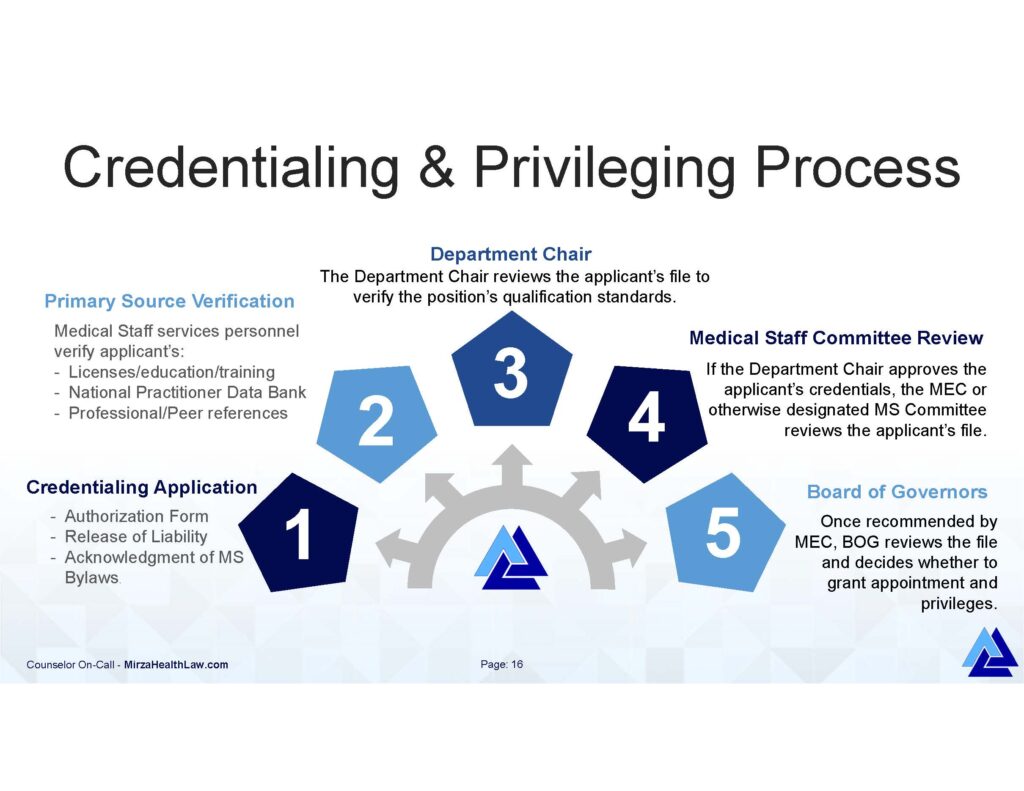
3. Full and Complete Information is Required – Next you will complete the requested information. Important: if you have issues in your history, such as a: prior law suit, licensing complaints, a potential conflict of interest, a pending law suit or a pending complaint, or any other certification or licensing issue like something that shows up on the National Provider Data Bank (NPDB), or issues where your privileges were reduced or revoked due to behavior or competency issues; you should probably consult an attorney to help you frame the application truthfully and accurately, and to help you maximize your chances of getting approved. Remember, if this information is not accurate, it means that the institution can terminate your privileges at any time. You will likely have to attach a copy of your graduation certificates and licenses with the application.

4. Application Verification – Your application will then be verified by the medical staff office, all licenses, certifications, and prior work history will be checked. The MSO will inquire into your state license, National Practitioners’ Data Bank, Medicare/Medicaid Fraud and Abuse Lists, and all sources where a physician’s disciplinary actions and claims are reported.

5. Department Chair Review – Next your application will go to the Department Chair for review of the file to see if it meets the qualification standards. Important: The approval or disapproval at this step is key. Most applications that are denied are denied at this stage, and the reason stated is “incomplete record or file”; however, if the application proceeds to the next level and is then denied it is a reportable event that you were “denied privileges”. So be very deliberate and careful in the application process. If the application goes bad, it will likely have other professional ramifications.

6. Medical Staff Committee or Credentialing Committee or the Medical Executive Committee will then review your application for its approval.

7. Board of Governors or Board of Trustees or the presiding governing body of the hospital system will then have the last opportunity to review the file and decide whether to grant the appointment and privileges.

If and once you are approved, you will receive a written confirmation letter, and you may be placed on the “Call” schedule; you may also be asked to serve on a medical staff committee. Roughly every 2 years after this appointment, you will likely have to go through a similar disclosure and verification process.

If you would like to find out more about what the power, role, and obligations of a Medical Executive Committee are, or if you would like to find out more about how the peer review process works, please visit www.mirzahealthlaw.com.

If you have questions or issues you need answered by an attorney, please reach out to your select healthcare hospital attorney who has experience in handling these issues; if you don’t, then feel free to call us for we have the experience to guide you through this process.

If you have a unique scenario, email Ben Assad Mirza, Esq., Healthcare Law Partners, LLC, at BAM@MirzaHealthLaw.com.


By Jay Juffre

No matter if a member of your team has been with you for a decade or just started ten months ago, they have something in common. Both have been working through the COVID-19 pandemic and therefore have needed to alter their approach to patient care. A recent Harvard Business Review article on this subject speaks about the incredible change that has occurred in the workplace for both new and veteran employees. The fundamentals which organizations took for granted as part of the culture (and the way business was done) in many areas has eroded. This is very true when it comes to patient care. It is nobody’s fault, but let’s face it, when folks needed even routine medical care over the past 18 months, the atmosphere was just plain different. Between the masks, the temperature checks, the questionnaires, the social distancing, and everything else, even a trip to the dentist for a routine cleaning felt more like going in for a root canal. There is a big need to get back to basics when it comes to how we approach patients and their families. Our people either have trouble remembering a time before COVID-19 or were not even part of the team when it started. When you add the stress that they (and everyone) have been under, clearly there is an opportunity to reset things. So, meet as a team. This is nobody’s fault but gain agreement on the path forward as it relates to creating alignment on the ground rules. What will be the plan to get everyone in a great place when it comes to execution and consistency? How can we get everybody trained (or retrained) the right way? The organization and health systems that deliver the best patient experience complimented by high staff engagement will win. Others will struggle or worse so make a commitment today to execute the fundamentals. Your patients and teams will thank you.

Jay Juffre is Executive Vice President, ImageFIRST. For more information on ImageFIRST, call 1-800-932-7472 or visit www.imagefirst.com.


By Daniel Casciato

On August 23, Jackson Health System began new COVID-19 vaccine rules for all employees, physicians, students, and on-site vendors, with several restrictions for anyone who isn’t vaccinated.

“We were looking at the numbers growing and the challenges that we had—which are different from last year where we didn’t have the vaccine as an option,” explains Jackson CEO Carlos Migoya. “We felt that everybody has civil rights, including patients, in the healthcare business. But we have to live to a different and higher standard, because the number one thing that we have to do is protect our patients, and having our employees vaccinated is important for us to protect our patients.”

Carlos Migoya – Jackson Health System CEO

As an incentive, eligible employees who are fully vaccinated by September 30th, will receive a $150 one-time bonus.

“People who got vaccinated last December would also get the $150 bonus,” says Migoya. “I believe that this bonus is a good motivator to get others vaccinated.”

These are the restrictions that unvaccinated employees face:

• An N95 respirator mask must be worn at all times inside of all Jackson facilities, including clinical buildings and non-clinical areas, such as Jackson Medical Towers and the Park Plaza West garage on the Jackson Memorial campus. This mandate will continue throughout all risk levels until the end of the pandemic period. Fit-tested N95s will be provided by Jackson.

• In order to avoid the risk of spreading this highly contagious virus when eating or drinking – and potentially passing it on to patients – unvaccinated employees and physicians will not be allowed to eat or drink in any Jackson cafeteria, dining room, or coffee shop, nor will they be able to remove their N95 mask to eat or drink inside of any of its facilities. Meals and snacks may be purchased inside but must be eaten outside of a Jackson facility. Outdoor open-air tents have been added at all campuses.

• Unvaccinated employees and physicians will not be allowed to remove their N95 mask in any area, including employee and physician break rooms/lounges.

• During all risk levels, unvaccinated employees and physicians will be restricted from attending in-person meetings, other than staff huddles on patient units. All other meetings must be attended virtually via Zoom.

• A mandatory virtual educational course will be required, including an attestation of completion of the course.

To identify which employees are vaccinated, Migoya says their badge will have a sticker that says “COVID-19 Vaccinated.”

“As people walk around with their badge, that’s easy enough to see if they’ve been vaccinated or not,” he adds.

In addition to the bonus and the restrictions in place, Migoya says that the hospital is planning to educate employees who are still resisting getting a vaccine.

“We’re trying to fight a lot of misinformation around vaccination, and we’re discussing all different kinds of alternatives at this point in time,” he says.

Nearly 69% of Jackson’s 13,000+ employees have been vaccinated so far, according to Migoya. “We think we’ll exceed 75%, and hopefully, it goes to 80.”

To help increase those numbers, Jackson has been conducting vaccination pop-ups for its employees at all of its main campuses: Jackson Memorial Hospital, Jackson North Medical Center, Jackson South Medical Center, and Jackson West Medical Center, which is the new hospital that opened in the City of Doral.

The big challenges that Jackson faces, along with other hospital systems in South Florida, were several-fold, notes Migoya.

“One was the fear of losing nurses and doctors who would go to another health system that would not be mandating the vaccine,” he says. “Obviously, we’re short-staffed at this point, so that’s an issue. But I would tell you that my decision was based on this—if I had to lose 10 employees to another health system versus losing a life because people are vaccinated, I choose a life.”

Another challenge was employees who wanted to wait until the FDA formally approves the vaccination, which took place August 23.

“My answer to that is, we’ve already vaccinated 1.7 billion people in the world, and there hasn’t been any real negative outcomes from anything, or otherwise the media would have already taken care of that,” Migoya says. “I think we have enough formal approval of the vaccination by having that number of people vaccinated in the world.”

For more information, visit jacksonhealth.org.


By Wayne Brackin

If you are over 40, we likely have something in common, namely a small, faded scar on our upper arm, a relic of the war on smallpox. Our children haven’t had to face this menace because we grew up in a society that trusted science and our leaders to guide us toward the elimination of crippling diseases. There were lamentable exceptions such as the Tuskegee Study. And yet, many childhood diseases including measles, diphtheria and rubella were eradicated. Even polio’s twisted limbs are part of the past, not our future.

Today, we relive the tragic scenes of a surge, the anguish and the exhaustion of healthcare workers. Both adult and pediatric cases are at an alarmingly high volume, and infants with COVID-19 are filling our NICUs. Too many of us have been influenced by the unending bombardment of health misinformation on the internet. The Surgeon General of the United States, Vivek Murthy, M.D., had to issue a report titled “Confronting Health Misinformation.” Given this reality, I find that a core of people in every organization are in decision paralysis about the COVID-19 vaccine. Among the oft-repeated comments are these, “If my job requires it, as they do the flu shot, then I’ll get it.”

You see, in healthcare, rules and procedures keep the patients and us safe. Any wishy-washy language is a red flag. Unfortunately, market interests have an impact here, too. What healthcare executives and lay leaders are most worried about is losing employees during a time of staffing shortages and burn-out brought on by COVID-19-related exhaustion. That could compromise the fundamental mission of care.

Furthermore, in south Florida, hospitals and medical practices compete for nurses, doctors, technologists, and social workers. The pandemic disruption has also created demand for medical assistants, environmental service techs, and patient transporters. These support workers are opting for jobs in the hospitality and food service industries, which have been compelled to escalate starting salaries.

This human resource shortage has created a pervasive fear that mandating vaccines will cause an exodus of staff to healthcare organizations that don’t require them. Yet there is a huge corollary risk of the unvaccinated healthcare staff falling acutely ill and exacerbating both the staffing and capacity problems, which is already happening in Louisiana and other states. In addition, hospital care and elective procedures are already limited due to bed and staff shortages.

KIDZ Medical Services, which serves children in seven South Florida counties, implemented a mandatory vaccine policy in August. We believe this decision reflects our commitment to our patients, respect for our dedicated – and stressed – caregivers, and our role in protecting the public health. We join several local healthcare organizations and renowned institutions such as Yale-New Haven, Mayo Clinic, Children’s Hospital of Philadelphia and St. Jude in adopting this mandatory COVID-19 vaccine.

There is a saying, often attributed to Winston Churchill, that describes how we as a culture behave, “Americans can always be counted on to do the right thing, after they have exhausted all other possibilities.” Antibacterial wipes, extended social isolation, masks, etc. We breathed a collective sigh of relief when the vaccines were created and proven effective without compromising safety. The fix was in – until it wasn’t.

We had – and have – a pathway to take the power away from this virus. As with most types of combat, allies win together. If we do not lead, the community will not have an example to follow. We need the whole healthcare village engaged and vaccinated to win the war on COVID-19.

Wayne Brackin is President and CEO of KIDZ Medical.


By Lois Thomson

“If a college doesn’t change the way they taught a year or two ago, I don’t think they’re going to make it,” stated Dr. Bryan Stewart, president of Miami Dade College’s Medical Campus.  “We have to reinvent ourselves as a campus and make sure we respond to how our students are learning, and how the world has changed with the pandemic.”  If that’s true, the Medical Campus doesn’t have anything to worry about. 

A year ago, Dr. Stewart and his staff were making adjustments to place the campus in a good position during the pandemic.  He explained they worked on how to get students caught up on clinical rotation.  “A year ago, our nursing students were doing everything virtually.  The governor of Florida had approved for all their clinicals to be virtual so we purchased a software package that allowed us to do online clinical rotations.  It’s been really great.  But now, the governor’s order ended, so all of my nursing students have to be back on campus this fall.”

Dr. Bryan Stewart, President of Miami Dade College’s Medical Campus

Dr. Stewart said the College also continues using a new teaching modality called MDC Live that started this past year and provides for virtual teaching.  He described it as a flexible environment where the class is scheduled for a specific time, and the student can either be in the classroom or be virtual with their faculty.

He also talked about two new programs that are starting at the school.  One is a surgical technology Associate in Science degree that he said has been in the making for a couple of years.  “I’ve met with leadership at several hospitals and they tell me how desperate they are for surgical technicians.  It’s a two-year degree and it’s going to be one of our most popular programs in the fall.”  Dr. Stewart said the technician is essential to executing a successful surgery – they maintain a sterile field, and handle all the equipment, instruments, supplies, medications, and anything else a physician needs during a surgical procedure.  “They really play a vital role.”

The second program is a one-year certificate to become a central sterile processor, which is a stackable credential for the surgical technician degree.  “Those are the individuals who clean the instruments, so they can start as a central sterile processor and work their way up.  There’s just as much need for that, and some students may want to start in that position and gain confidence before they get into surgical technician,” he said.

With all of this in place, Dr. Stewart said not only is the overall application pool up 81%, but even more impressive is that the quality of the pool is also up.  In past years, about half of the applications didn’t meet qualifications or weren’t ready to be taken into the program, whereas this year more than 80% of the pool could be selected.  “You can tell we have a really strong group of students who will start here in the fall.”

Unfortunately, as is happening everywhere, the College may be facing a new challenge in coming months:  the delta variant of the coronavirus.  Dr. Stewart said that as part of the planning process, “We’re trying to be creative on how to deal with this delta variant.  We’re still going to be open 100%, but we’re going to be careful to follow the CDC guidelines.”  In addition, he said that certain hospitals have a policy requiring all students in their clinical rotations to be vaccinated.

Baptist and Jackson Health System have both expressed how valuable the students are.  “Both told us that when the pandemic happened, they weren’t sure what to do, so they took no students on the hospital campus,” Dr. Stewart said. They realized, though, that the students do many things that allow the hospital employees to work in other areas.  “The pandemic can be a strategic teaching opportunity, and I think we all learned a lot.  I don’t think we’re going to follow the same traditions that we did with this one, by saying the doors are closed.  I think the hospitals have realized how valuable our students can be to support the network of the hospitals.”

In summarizing the past year, Dr. Stewart said, “The campus is looking really strong for fall; I think it’s an exciting time.  People who want to help are able to see the medical field as a great opportunity, and jobs are plentiful.

“I think we figured it out pretty well.”

For more information, call (305) 237-4141 or visit mdc.edu.