
By Gueorgui Petrov, PT, rehabilitation services coordinator at Broward Health North Rehabilitation Institute

As students get ready for school, each year brings a growing list of required supplies and books, which increases the amount of weight students are carrying on their backs.

According to the American Occupational Therapy Association, more than 79 million students in the United States carry a backpack and an estimated 55% are carrying a backpack that is too heavy. That’s more than 43 million students who may be doing damage to their bodies with heavy books, electronic devices, and other school supplies.

Incorrect wear of backpacks and bookbags can also contribute to health problems, including pain in the back, neck, and shoulders, or the development of poor posture. Making sure that your children wear their backpacks properly can help prevent pain and posture problems.

Here are five tips on correct backpack wear:

  1. Invest in an ergonomic backpack to help your student safely and effectively carry their books and supplies. These have padded backs, waist and chest straps, compression straps to keep contents in place. Shoulder straps should be two inches wide.
  2. Test Before Your Purchase. Bring a few personal items that you would normally carry in your backpack to the store with you. Slip them into the backpack as you try them on to get a better sense of weight distribution, etc.
  3. Use a backpack with multiple compartments to distribute the weight better. The American Association of Orthopedic Surgeons advises placing heavier items, such as books, near the center of the backpack to prevent uneven placement of weight. Have students pack what they need for the day, if possible, to lighten the load.
  4. Pack lightly. The American Chiropractic Association recommends that children carry about five to 10% of their bodyweight in their backpacks. Anything over 10% can contribute to straining muscles and improper posture.
  5. Don’t wear the backpack too low. The bottom of the backpack should be no more than two inches below the waist.

When it comes to wearing a backpack, the combined effects of heavy load, position of the load on the body, size and shape of the load, and time spent carrying can be associated with different soft tissue, joint and postural issues. However, by implementing these five key tips we can significantly reduce the chance of strain/ injury to joints and soft tissue and improve our children’s posture.

If you need a pediatric physician to get your child’s health on track, find a doctor near you by visiting BrowardHealth.org/Find-Doctor.


Trial will assess antibody response in people who did not respond to two-dose regimen.

What

A pilot study has begun to assess the antibody response to a third dose of an authorized COVID-19 mRNA vaccine in kidney transplant recipients who did not respond to two doses of the Moderna or Pfizer-BioNTech COVID-19 vaccine. The Phase 2 trial is sponsored and funded by the National Institute of Allergy and Infectious Diseases (NIAID), part of the National Institutes of Health.

The lifelong immunosuppressive therapy that organ transplant recipients must take to prevent organ rejection blunts their immune response to both pathogens and vaccines. Research has shown that many organ transplant recipients do not develop antibodies against SARS-CoV-2, the virus that causes COVID-19, after receiving an authorized COVID-19 vaccine regimen. The purpose of the new study is to determine whether a third dose of one of the mRNA COVID-19 vaccines could overcome this problem for at least some kidney transplant recipients. This is particularly important because this population has a high prevalence of conditions that are risk factors for severe COVID-19, such as cardiovascular disease and diabetes.

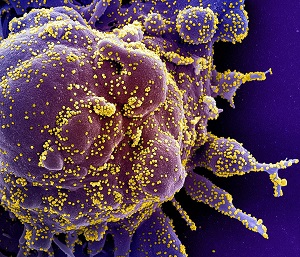
Colorized scanning electron micrograph of a cell (purple) heavily infected with SARS-COV-2 virus particles (yellow), isolated from a patient sample. Image captured at the NIAID Integrated Research Facility (IRF) in Fort Detrick, Maryland.NIAID

The pilot study also aims to identify characteristics that could help distinguish those kidney transplant recipients who would benefit from a third dose of an mRNA vaccine from those who will require a different approach to achieve protection. The pilot study findings will inform a subsequent, larger phase of the trial that includes higher-risk strategies to induce a protective immune response against SARS-CoV-2 in solid organ transplant recipients who do not respond to a third dose of an mRNA vaccine.

The third-dose vaccine intervention was chosen because of the demonstrated safety of the two-dose mRNA vaccine regimen in solid organ transplant recipients as well as the efficacy of additional doses of other vaccines, such as those for hepatitis and influenza, in immunocompromised people.

The pilot study, called COVID Protection After Transplant (CPAT), is being conducted at Johns Hopkins University in Baltimore under the leadership of Dorry Segev, M.D., Ph.D. Dr. Segev is the Marjory K. and Thomas Pozefsky professor of surgery and epidemiology, associate vice chair of the department of surgery, and director of the Epidemiology Research Group in Organ Transplantation at Johns Hopkins University. 

The CPAT study team will enroll up to 200 adults ages 18 years or older who received a kidney transplant a year or more prior to enrollment and have had no recent organ rejection or change in immunosuppression. Between 50 and 100 participants will have had no detectable antibody response to two doses of an mRNA COVID-19 vaccine, and 50 to 100 participants will have had a low response. All participants will receive a third dose of the same COVID-19 vaccine that they received previously. Thirty days later, investigators will measure participants’ antibody response to the third dose. The goal is to determine the proportion of participants who achieve a designated antibody response at the 30-day mark. The study team will follow participants for one year after enrollment. Preliminary results are expected in September 2021.

People who would like to enroll in the CPAT pilot study should contact Johns Hopkins University using the email address dose3@jhu.edu(link sends e-mail). More information about the trial is available at ClinicalTrials.gov under study identifier NCT04C969263.

Who

NIAID Director Anthony S. Fauci, M.D., and Daniel Rotrosen, M.D., director of the NIAID Division of Allergy, Immunology, and Transplantation, are available to discuss the CPAT pilot study.

Contact

To schedule interviews, please contact the NIAID News & Science Writing Branch, (301) 402-1663, niaidnews@niaid.nih.gov(link sends e-mail).

NIAID conducts and supports research—at NIH, throughout the United States, and worldwide—to study the causes of infectious and immune-mediated diseases, and to develop better means of preventing, diagnosing and treating these illnesses. News releases, fact sheets and other NIAID-related materials are available on the NIAID website.

About the National Institutes of Health (NIH): NIH, the nation’s medical research agency, includes 27 Institutes and Centers and is a component of the U.S. Department of Health and Human Services. NIH is the primary federal agency conducting and supporting basic, clinical, and translational medical research, and is investigating the causes, treatments, and cures for both common and rare diseases. For more information about NIH and its programs, visit www.nih.gov.

NIH…Turning Discovery Into Health®


 August 12, 2021 — With more than two decades of extensive and dedicated oncology experience, Debra Wilson, RN, MSN, OCN, has been tapped to serve as Lee Health’s vice president of oncology.

In her new role, Wilson will be responsible for establishing the vision and strategic direction for cancer services at Lee Health. She will collaborate with key medical leadership in evaluating new technology, innovations in the delivery of patient care, and opportunities to change the delivery of care to be more progressive and effective.

Wilson comes to Lee Health from Roper St. Francis Healthcare in Charleston, South Carolina, where she served as system associate vice president of oncology services and chief administrative officer for Roper St. Francis Mt. Pleasant Hospital.

She also worked at Deaconess Health System in Evansville, Indiana, for 19 years, five of which she served as the director of oncology services.

“Debra’s vast experience in oncology and her ability to understand the clinical, operational and strategic components of this service line make her uniquely qualified and the perfect person to hold this position,” said Kris Fay, Lee Health’s chief officer of population health and physician services. “I have no doubt she will be an exceptional addition to Lee Health.”

Wilson attended the University of Southern Indiana where she earned her bachelor’s degree in Nursing and her master’s degree in Nursing Management and Leadership.

She is a member of the American Society of Clinical Oncology and the Oncology Nursing Society.

Wilson began her role with Lee Health on August 2.

About Lee Health

Since the opening of the first hospital in 1916, Lee Health has been a health care leader in Southwest Florida, constantly evolving to meet the needs of the community. A non-profit, integrated health care services organization, Lee Health is committed to the well-being of every individual served, focused on healthy living and maintaining good health. Staffed by caring people, inspiring health, services are conveniently located throughout the community in four acute care hospitals, two specialty hospitals, outpatient centers, walk-in medical centers, primary care and specialty physician practices and other services across the continuum of care. Learn more at www.LeeHealth.org.


Formation of external advisory group creates unique opportunity to center marginalized communities in health innovation

August 12 2021 – Building on its commitment to advance equity in health care innovation, the American Medical Association (AMA) today announced the creation of an external committee of experts dedicated to advising the organization on equitable structures and opportunities in health innovation that would benefit historically marginalized people and communities.

The Equity and Innovation Advisory Group will provide guidance and support for the AMA to ensure equitable innovation in health care, an approach outlined in the AMA’s three-year strategic plan dedicated to embedding racial justice and advancing health equity. The advisors are tasked with providing direction on a shared vision for a U.S. health care innovation sector that: (1) prioritizes resource allocation for meaningful solutions to advance health, racial, and social justice; and (2) ensures that the race, ethnicity, sexual orientation, and gender identity of innovators and investors mirror that of the nation.

“Convening this advisory group is a major step forward in expanding the AMA’s ongoing work toward equitable innovation in health care,” said AMA President Gerald E. Harmon, M.D. “Through the combined expertise of physicians and innovators, we can continue to drive the future of medicine by promoting innovation and digital health solutions designed to tackle one of the biggest challenges in health care – improving health for our most marginalized patients and communities.”

Data shows that Black, Latinx, women, LGBTQ+, and other innovators from historically marginalized communities have been drastically under-funded and under-represented in solution design efforts, contributing to a health solution landscape that neglects and often harms these patient populations – exacerbating and perpetuating health inequities. Investing in solutions designed by and for marginalized communities is not just the right thing to do; research indicates that it’s a wise investment. Economic opportunity associated with increased investment in women and minoritized founder–led companies is estimated to be over $4 trillion, while reducing racial health inequities is estimated to generate economic gains of $135 billion per year, according to research from Morgan Stanley and by the W.K. Kellogg Foundation and Altarum.

The advisory group plans to recommend strategies that will help drive equitable resources to health solutions created by marginalized innovators and include marginalized patients’ voices in health innovation development processes – with a target of ultimately reaching a measurable improvement in health outcomes and reduction of health inequities within marginalized populations.

Comprised of 14 industry leaders with a vast array of expertise at the intersection of health equity and health innovation, the group’s newly announced members include: 

  • Abner Mason – Founder and CEO, ConsejoSano
  • Andrey Ostrovsky, M.D. – Managing Partner, Social Innovation Ventures
  • Chris Gibbons, M.D., M.P.H. – Founder and CEO, The Greystone Group
  • Courtney D. Cogburn, PhD – Associate Professor, Columbia University School of Social Work
  • Ivelyse Andino – CEO and Founder, Radical Health
  • Ivor Braden Horn, M.D., M.P.H. – Director of Health Equity & Product Inclusion, Google
  • Katie Drasser – CEO, RockHealth.org
  • Lisa Fitzpatrick, M.D., M.P.H, M.P.A. – Founder and CEO, Grapevine Health
  • Michael Penn, M.D., PhD – Founding Partner, Health Equity Ventures
  • Monique Smith, M.D., M.S. – Founding Director, Health DesignED, Emory University
  • Nathalie Molina Niño – Managing Director, Known Holdings
  • Sandee Kastrul – President and Co-Founder, i.c.stars
  • Shantanu Nundy, M.D., M.B.A. – Primary Care Physician and Technologist, Accolade Health
  • Urmimala Sarkar, M.D., M.P.H. – Professor of Medicine, University of California San Francisco

“The health innovation sector has incredible potential to advance health equity, but most industry models do not incorporate an equity lens – risking automation, scaling, and exacerbation of health, racial, and social inequities,” said AMA Chief Health Equity Officer Aletha Maybank, M.D., M.P.H. “The external Equity and Innovation Advisory Group exists to hold us accountable in meaningful ways to ensure that historically marginalized communities have equitable access to health innovation design, start-up development, and investment opportunities, as we laid out in AMA’s Strategic Plan to Embed Racial Justice and Advance Equity.”

In addition to advising on embedding racial justice and health equity within AMA’s existing health care innovation work, the group will also bolster efforts on the following equity objectives:

  • Equipping the health care innovation sector to advance equity and justice
  • Centering, integrating, and amplifying historically marginalized and minoritized patients, innovators, and investors in health innovation
  • Engaging in cross-sector collaboration and advocacy efforts

Through research, collaborations, advocacy, and leadership, the AMA believes in supporting system-level solutions and identifying and addressing root causes of inequities while elevating their importance to patients, communities, and stakeholders. The External Equity and Innovation Advisory Group is one example of that commitment created and executed by the AMA’s Center for Health Equity, which works to strengthen, amplify, and sustain the AMA’s work to eliminate health inequities – improving health outcomes and closing inequities gaps – rooted in historical and contemporary injustices and discrimination.


August 11, 2021 – In an effort to protect the safety of patients and team members from the recent surge of COVID-19 cases in our community, Lee Health has reinstated its visitation restrictions.

Effective Thursday, Aug. 12, visitation at Lee Health’s adult acute care hospital campuses will be limited to one person at a time per patient, except in cases of compassionate care. Patients do not need to specify or limit who visits; the new guideline is that they can only have one visitor at a time in their room.

At Golisano Children’s Hospital, patients will be allowed two designated visitors (over 12 years of age) noted upon admission who can be with the patient, in their room, at all times.

Several days ago, due to the current COVID-19 surge, Lee Health implemented other visitation restrictions, which are still in place. They include:

  • Visitation in the emergency departments is restricted. Visitors are only granted access in the emergency departments at the adult acute care hospitals for compassionate care or if they are needed to gather information related to providing care (and thus allowed in the emergency department at the discretion of our staff). At Golisano’s emergency department, visitation is limited to two people.
  • At Lee Convenient Care, visitors are only granted access to the clinics if they are needed to gather information related to providing care, or in the event of a special circumstance, which would be at the discretion of the clinic staff.
  • For adult ambulatory surgical patients, one visitor is allowed to accompany the patient for any appointment registration process. This one visitor may stay with the patient during pre-op and is allowed to wait in the facility waiting area during the procedure. For pediatric patients, one parent or guardian may stay with their child, plus one guest over 12 years-old.
  • Contact the Skilled Nursing Units at Gulf Coast Medical Center, Lee Memorial Hospital and HealthPark Care and Rehabilitation Hospital for visitation policies at the facilities.

All visitors must be over 12 years-old and should practice social distancing. Visitors will be required to complete a screening process and sanitize their hands with alcohol-based gel before visitation. All visitors are required to provide their own mask and wear it at all times. Visitors who violate this policy may be asked to leave the facility. Ventilated masks are not allowed as they let expelled breath into the air. Visitors are required to wear masks in patient rooms, and should put their mask back on if someone else enters room while they are eating and/or drinking. Visitors are not allowed to eat in the cafeteria.

During the COVID-19 pandemic, Lee Health continues to collaborate with and follow the guidance of local, state and government officials. Visitation plans are developed in consideration of patient, staff and public safety but also to meet the emotional and care needs of patients.

General hospital visitation hours are 8 a.m. to 8 p.m.

For more information and a complete list of all visitation restrictions, please visit www.leehealth.org.

About Lee Health

Since the opening of the first hospital in 1916, Lee Health has been a health care leader in Southwest Florida, constantly evolving to meet the needs of the community. A non-profit, integrated health care services organization, Lee Health is committed to the well-being of every individual served, focused on healthy living and maintaining good health. Staffed by caring people, inspiring health, services are conveniently located throughout the community in four acute care hospitals, two specialty hospitals, outpatient centers, walk-in medical centers, primary care and specialty physician practices and other services across the continuum of care. Learn more at www.LeeHealth.org.