August 2021 – SFHN&HR Newspaper PDF
Interactive Flip Book of August 2021 – SFHN&HR FlipBook

August 2021 – SFHN&HR Newspaper PDF
Interactive Flip Book of August 2021 – SFHN&HR FlipBook
Watch, like, comment, share and follow for chance to win family fun prizes!
August 2, 2021 – Tykes & Teens, a leading provider of the highest quality, evidence-based mental health services and programs for children and adolescents for 25 years, invites you to join us for August Family Fun Month!
Each week during August, Tykes & Teens will be posting videos on Facebook and Instagram showing how our families (and families of our partners) enjoy quality time with their families. Join us for everything from family game night, to story time with our littles, cooking favorite recipes, outdoor activities and more.
“As we dedicate August as Family Month Month, we look forward to sharing ideas for families to connect in meaningful ways,” said Tykes & Teens Director of Prevention Services Dorothy Oppenheiser.
To participate, simply follow Tykes & Teens on Facebook at @TykesTeens or Instagram at @tykesteens. Then like, comment and share for a chance to win family fun prizes.
For more information, email monique@tykesandteen.org.
Thank you to our prevention program supporters Children’s Services Council of Martin County and C.O.R.E. (Comprehensive Offender Rehabilitation and Education Program).
About Tykes & Teens
Tykes & Teens has been a leading mental health provider for children and adolescent evidence-based programs and services for 25 years. Our passion and commitment are to empowering children and strengthening families by ensuring that all children have access to high quality counseling and mental health services, regardless of financial status. Our mission is prioritizing children’s mental health in our families, schools and communities through a wide range of prevention, education, and treatment programs and services. We also advocate for increased awareness of mental health to remove the stigma and shame often associated with seeking mental health treatment. Since our inception, we have provided affordable quality mental health services for more than 60,000 children in need across the Treasure Coast from more than 50 service locations, including outpatient offices in Palm City, Jensen Beach, Hobe Sound, Port St. Lucie, and Vero Beach, on-site services in all Martin County schools, and in schools in Okeechobee and Indian River counties, as well as collaboration with numerous community partners, in addition to virtual telehealth services. We have continued to offer our services and programs throughout the COVID-19 pandemic, including virtual telehealth care. We accept most insurance, private payments, and we are a Medicaid-approved provider. We have successfully administered a sliding fee scale for those in need when necessary for more than 20 years. As a 501(c)(3) nonprofit agency, we also provide $750,000 in unreimbursed services to the communities we serve each year. Follow us on Facebook, Instagram and LinkedIn.
July 31 2021 – The University’s coronavirus sequencing effort uncovered that there are several variants present in its patient population, but Delta is chief among them and easily transmitted. And its presence is likely triggering a local surge in the infectious disease.
University of Miami researchers and physicians are seeing firsthand how rapidly the Delta variant of COVID-19 is spreading through the local population.
While just a month ago University researchers had identified just two cases of the Delta variant in Miami-Dade County, new sequencing data from the second week of July reveals that 63 percent of a sampling of COVID-19 patients in Jackson Memorial Health System and at University of Miami’s UHealth Tower had the highly transmissible form of the virus. This sequencing data also revealed that 20 percent of patients had the Brazilian variant (now known as Gamma), 9 percent had the Colombian variant (B.1.621), which is dominating that country, and 3 percent had the Lambda variant that is currently the dominant COVID-19 strain in Peru.
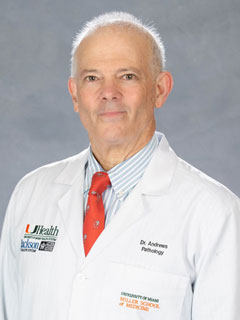
“The Colombian variant and the Lambda variant share many of the properties of the other bad players we have seen emerging—like Delta—such as increased transmissibility and a potential to escape the immunity provided by vaccines,” said Dr. David Andrews, associate professor in the Department of Pathology and Laboratory Medicine, who is leading the University’s effort to sequence COVID-19 positive samples.
Dr. Lilian Abbo, a professor in the Miller School of Medicine’s Division of Infectious Diseases, said the data affirms recent case spikes she has noticed at Jackson Memorial Hospital, but suspects that the number of patients with the Delta variant today is much higher. In short order, the Delta variant has permeated the United States, pushing the nation into another COVID-19 surge, particularly among the unvaccinated. It now accounts for at least 83 percent of COVID-19 cases nationally, the U.S. Centers for Disease Control and Prevention (CDC) estimated last week.
“I’m seeing a more than 350 percent increase in COVID-19 hospitalizations,” said Abbo, who is also chief of infection prevention and microbial stewardship at Jackson Memorial Health System. “At Jackson Memorial Hospital, I suspect we are seeing more than 80 percent Delta already.”
Andrews, who gathered a team this past January to sequence COVID-19 samples, agreed.
“It’s obvious to me we will be at 80 to 90 percent Delta by next week,” said Andrews, who is also vice chief of pathology for Jackson Health System.
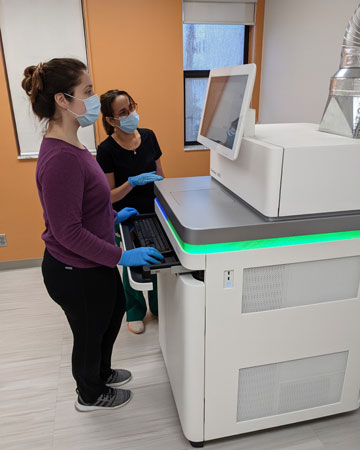
Since the Delta variant is much more easily transmitted than earlier variants, the Miller School is ramping up its sequencing efforts and will now be gathering samples weekly to survey the variants circulating locally, according to Andrews. While the Florida Department of Health is doing some COVID-19 sequencing that they share with the CDC, reports indicate that only 2,688 positive COVID-19 samples have been sequenced in Florida since the pandemic began, or about 0.1 percent of cases.
Through the sequencing process, researchers can determine the genetic origins of each positive COVID-19 sample, but the process is time-consuming and costly. So, only a fraction of the samples is sequenced. University researchers want to contribute to the effort to monitor the variants in South Florida because this knowledge could help guide medical treatment. Andrews is also working with researchers at the Miller School to develop a rapid test that could determine if a positive COVID-19 sample contains the Delta variant.
Meanwhile, Abbo is observing the severity of the Delta variant firsthand. She said that in UHealth and Jackson Health System urgent care clinics, Jackson Health System emergency rooms, hospitals, and the correctional facilities, she is seeing a spike in COVID-19 positive rates. She attributes this to the more contagious Delta variant, along with people working closely together at the tragic building collapse in Surfside, many gathering for massive demonstrations in support of protesters in Cuba, and the Miami heat keeping residents indoors.
As an example of the Delta variant’s contagious nature, Abbo cited a recent study out of China where researchers swabbed COVID-19 patients with the Delta variant and found that the amount of virus in each sample was on average 1,000 times higher than the original Wuhan strain of COVID-19. “Therefore, the Delta variant is highly infectious and infected people are spreading a lot more virus,” she warned.
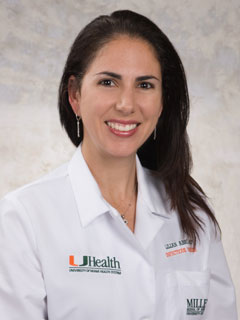
Abbo also described the type of COVID-19 patients she is seeing at Jackson Health System’s three hospitals. First of all, Abbo noted, 90 percent of them are unvaccinated. And of those in the intensive care unit, 95 percent are unvaccinated. She has also noticed that this summer’s COVID-19 patients are typically younger than those infected before and often fall within the age range of 30 to 60.
“Vaccinated people with good immune systems are typically able to neutralize the virus, so they aren’t getting as sick as people who are not vaccinated,” she said. “But we are also noticing that unvaccinated people with the Delta variant seem to deteriorate much faster, even with treatment.”
However, in what are called breakthrough cases, people who are vaccinated are still able to get COVID-19, particularly the Delta variant. Even though most of these people are not hospitalized, up to 15 percent of the COVID-19 cases in Miami-Dade County now are breakthrough cases, according to a Miami-Dade division of the Florida Department of Health report. While only about 10 percent of the COVID-19 patients in Jackson Health System are vaccinated, Abbo explained that these patients are typically elderly, immunocompromised, diabetic, or have another preexisting medical condition.
All of the unfortunate outcomes she is seeing right now point to one solution, Abbo said. “For anyone right now who is not vaccinated, I urge you to go and get vaccinated and believe in science,” she urged. “We need to control the pandemic and we will be able to control it with science and by taking responsible actions.”
Abbo also pointed out that she is seeing reinfection cases among unvaccinated young adults who had COVID-19 once. Because previous infection is not providing a lasting immunity in most people who had “mild COVID-19″ before, it is extremely important to get vaccinated because it is the most powerful form of protection for everyone and prevents severe disease or death, she added.
According to the CDC, Miami-Dade County is now at 12.6 percent positivity rate for COVID-19 and Broward County is at 14.8 percent. The Florida Department of Health reports that last week 73,199 Floridians were infected with COVID-19. Of those, 9.5 percent of COVID-19 cases were found in children younger than 12 and 19.6 percent of the state’s caseload contains people younger than 19 years old. Adults between 20 and 49 made up the bulk of the COVID-19 cases, or 53 percent. Just 14 percent of cases occurred in people older than 60.
For South Florida’s entire population—vaccinated or not—Abbo recommends wearing a mask any time you are indoors and not at home. She also suggests dining outdoors only at restaurants and avoiding crowded, cramped settings like bars.
“We are at very high numbers of infection in our community, and you can no longer trust who is vaccinated or not,” she said. “Everyone is infected until proven otherwise.”
July 30 2021 – The Florida Department of Health in Miami-Dade County (DOH-Miami-Dade) is offering appointments for the Pfizer-BioNTech and Johnson & Johnson’s Jannsen COVID-19 vaccine. The Pfizer BioNTech vaccine is available to individuals 12 years of age and older while the Johnson & Johnson’s Jannsen vaccine is available to individuals 18 years of age and older. The vaccines will be offered by appointment at the following locations:
• Health District Center – DOH-Miami-Dade site 1350 NW 14 Street, Miami Florida 33125
• Little Haiti Clinic – DOH-Miami-Dade site 300 NE 80 Terrace, Miami Florida 33138
• West Perrine Clinic – DOH-Miami-Dade site 18255 Homestead Avenue, Miami Florida 33157
• West Dade Clinic – DOH-Miami-Dade site 11865 SW 26th Street, Miami, Florida 33175
• City of Sweetwater
250 SW 114th Avenue, Sweetwater, Florida 33174
• Hialeah Gardens Library
13451 NW 107th Avenue, Hialeah Gardens, Florida 33018
To schedule an appointment, follow the attached link on google chrome
https://public.domo.com/cards/v2mAg
All individuals under the age of 18 receiving a vaccine must be accompanied by a parent or guardian and must complete the COVID-19 vaccine screening and consent form.
As per State Surgeon General Dr. Scott Rivkees’ Public Health Advisory issued on April 29, 2021, vaccine access and eligibility is expanded to any individual in Florida who is present in Florida for the purpose of providing goods or services for the benefit of residents and visitors of the state.
About the Florida Department of Health
The department works to protect, promote and improve the health of all people in Florida through integrated state, county and community efforts.
Follow us on Twitter at @HealthyFla and on Facebook. For more information about the Florida Department of Health please visit www.FloridaHealth.gov.
The COVID-19 Provider Relief Fund has been a lifeline for hospitals, health systems and health care providers, allowing them to continue to put the health and safety of patients and health care personnel first. In many cases, the funds ensured they were able to keep their doors open.

So, some good news this week on the PRF: It appears that the bipartisan Senate infrastructure package will not use as an offset to pay for the bill previously appropriated PRF funding for hospitals, health systems, physicians, nurses and other health care providers providing heroic care during a global pandemic.
Diverting these funds in order to offset the costs of an infrastructure proposal while the COVID-19 pandemic surges would have been incredibly shortsighted and misguided since once again we are seeing an alarming rise in COVID-19 cases and hospitalizations in many areas of the country. And health experts worry that the more contagious delta variant, combined with lower vaccination rates in certain parts of the country, could spur an even larger surge in COVID-19 cases during the fall and winter.
Hospitals, health systems and other care providers must remain equipped to battle COVID-19. The Department of Health and Human Services has not begun a PRF distribution in nearly seven months, and Congress should encourage the Administration to distribute the remaining PRF funds without further delay.
That’s why we were pleased that lawmakers negotiating the infrastructure compromise listened to the concerns of the AHA, which were strongly reinforced by our members and state hospital association partners.
However, we continue to oppose an extension of the Medicare sequestration cuts that expire on Sept. 30, 2030, and would be extended into 2031, which is reportedly currently included as a pay-for in the infrastructure bill. We do not believe that Medicare funds should be used to finance non-health care programs, and providers cannot sustain additional cuts to the Medicare program. Our efforts to change this provision will continue as this legislation evolves, with many steps ahead.
In addition, we were pleased to see the Provider Relief Fund Deadline Extension Act introduced this week. The bipartisan, bicameral bill would allow providers that received COVID-19 PRF payments prior to June 30, 2020, to use their payments through Dec. 31, 2021, or the end of the COVID-19 public health emergency, whichever is later. The deadline to use those funds was June 30, 2021. We’ll continue working to secure support for this legislation with the goal of including it as part of a larger legislative package.
America’s hospitals and health systems continue to care for patients and battle the effects of the pandemic every day. Be certain, we will continue to work aggressively to make sure Congress provides hospitals with the resources and support they need to confront the continuing COVID-19 public health emergency.
BY: Rick Pollack
President and CEO