Multispectral imaging of oral squamous cell carcinomas with nuclei stained blue, shows CD8+ T cells (Cyan) and T-BET+ T cells (Red) infiltration. Image courtesy of Yu Leo Lei, D.D.S., Ph.D.

  • Researchers identified immune changes in a subset of oral precancerous lesions that may be at higher risk for cancer progression
  • Cells with high SOX2 expression release a signal that recruits immunosuppressive cells before invasive cancer develops
  • Blocking the signal delayed cancer development in preclinical models, suggesting its potential for cancer prevention

July 16, 2026 – Researchers at The University of Texas MD Anderson Cancer Center identified an immune pathway that may promote the progression of oral precancerous lesions into head and neck squamous cell carcinoma. These results provide insights into how precancers gradually establish an immune tolerance to allow for cancer development.

The study, published in Cancer Research, was led by Yu Leo Lei, D.D.S., Ph.D., associate professor of Head & Neck SurgeryCancer Biology and Translational Molecular Pathology; along with co-first authors Wang Gong, Ph.D., research scientist in Cancer Biology, and Hülya Taner, D.D.S., Ph.D., at the University of Michigan School of Dentistry.

The findings highlight potential biomarkers for high-risk precancerous lesions and suggest that targeting a key inflammation signal known as interleukin-1 alpha (IL-1α) could help restore immune surveillance and prevent high-risk lesions from becoming invasive.

“Identifying immune shifts in the precancerous stage provides an opportunity to intervene earlier and prevent high-risk lesions from progressing into cancer,” Lei said. “These results suggest that IL-1α may actively create an immunosuppressive environment and that blocking this signal early on could give the immune system an opportunity to regain control, ultimately improving patient outcomes and quality of life.”

Why are oral precancers difficult to manage?

Some abnormal precancerous growths in the lining of the mouth can become cancerous, despite preventive surgical removal and constant monitoring. Tools to identify which lesions pose the greatest risk are limited. Therefore, the researchers developed preclinical models to explore the underlying immune changes that could help identify lesions with a higher risk of progression.

What early immune changes happen in lesions before they become invasive?

The researchers identified suppressive myeloid cells that appear early on and have higher levels of IL-1α, SLC2A1 and SPP1 activity but have weak interferon signaling, which normally supports immune defense. They also noticed these similar changes in human lesions that later became cancerous.

Specifically, they found that cells with SOX2 amplification release CCL2, an inflammatory signal that recruits myeloid cells and pushes them toward an immunosuppressive state. This state is marked by high levels of IL-1α, SLC2A1 and SPP1, but low levels of type-I interferon target genes. IL-1α also weakens the STING pathway, which normally helps the immune system recognize abnormal cells.

Blocking the IL-1α receptor reduced the amount of immunosuppressive cells, delayed tumor development and improved survival in preclinical models, suggesting that this approach could be a potential therapeutic strategy for oral cancer prevention.

What does this mean for patients with oral precancerous lesions?

The current WHO histology grading system does not reliably predict whether oral precancerous lesions will develop into cancer. This study identified a set of novel biomarkers that can aid in more effective risk stratification for patients with these lesions.

Future studies will evaluate this particular set of biomarkers in larger patient groups and validate its specificity and sensitivity. This study also provides a rationale for future testing of interventions that inhibit the IL-1α pathway as a preventive treatment in clinical trials. Similarly, a Phase 1 trial led by Moran Amit, M.D., Ph.D., assistant professor of Head & Neck Surgery, showed promising results through immunoprevention for precancerous oral lesions.

This study was supported in part by the National Institutes of Health and the National Cancer Institute. Lei is a co-founder of Saros Therapeutics and serves on its scientific advisory board. For a full list of collaborating authors, disclosures and funding sources, see the full paper in Cancer Research.



CMS Proposes Transformational Medicare Reforms to Expand Accountable Care, Modernize Physician Payment, and Shift from Sick Care to Healthcare

July 14, 2026 – The Centers for Medicare & Medicaid Services (CMS) is proposing transformational reforms to Medicare’s physician payment and value-based care programs that would expand accountable care, modernize physician payment, reduce administrative burden, and help shift the healthcare system’s focus from treating illness to preventing it.

The proposals would make Medicare accountable care organizations (ACOs) easier to join and more rewarding to participate in, transition clinicians away from traditional Merit-based Incentive Payment System (MIPS) reporting toward more meaningful value-based care pathways, and update physician payment policies to better reflect modern clinical practice. Together, these reforms would strengthen primary care, improve patient outcomes, and support Medicare’s long-term sustainability.

“We’re proposing some of the most significant Medicare reforms in recent years to strengthen primary care, expand accountable care, and modernize physician payment,” said CMS Administrator Dr. Mehmet Oz. “These changes would make it easier for clinicians to focus on prevention, improve coordination for patients, and ensure Medicare rewards better outcomes rather than more services.”

“Expanding accountable care is a critical part of making the Medicare program work well for patients,” said John Brooks, CMS Deputy Administrator and Director of the Center for Medicare. “Our goal is simple: deliver better outcomes for patients by appropriately incentivizing providers, improving quality measurement, and reducing administrative burden.”

Strengthening Medicare ACO Participation and Accountability

CMS is proposing significant improvements to the Medicare Shared Savings Program (Shared Savings Program), the nation’s largest value-based payment program. The proposed changes would support continued participation and growth in accountable care, while strengthening incentives for high-quality, coordinated care.

ACOs are a key part of the Administration’s efforts to strengthen primary care, improve preventive services, and help people with Original Medicare live healthier lives through better coordinated care. ACOs are groups of doctors, hospitals, and other healthcare providers who work together to coordinate care for people with Original Medicare. Their focus on prevention, care management, and patient engagement has produced measurable results for patients and taxpayers alike.

Patients receiving care from ACO healthcare providers are more likely to receive preventive services and screenings and less likely to experience uncontrolled chronic conditions such as diabetes and high blood pressure. ACOs also help reduce unnecessary spending by incentivizing healthcare providers to use healthcare resources more efficiently.

The Shared Savings Program has already demonstrated strong financial results. In performance year 2024, 75% of the 476 participating ACOs earned shared savings payments totaling $4.1 billion. Even after those payments, net savings of approximately $2.5 billion compared to projected spending benchmarks were generated for the Medicare Trust Funds. The Shared Savings Program has now generated savings for the Medicare Trust Funds for eight consecutive performance years. The proposed rule would build on this record by improving benchmark accuracy, supporting continued and expanded participation, and reducing unnecessary administrative burden.

The Shared Savings Program proposals would:

  • Increase opportunities to share savings for certain participating ACOs.
  • Create new financial incentives for organizations joining the program for the first time.
  • Establish more predictable spending targets to improve planning and participation.
  • Reduce administrative burden by simplifying technology requirements and streamlining patient notices.
  • Allow ACOs with approved applications beginning April 1, 2027, to reduce or eliminate beneficiary out-of-pocket costs for certain items and services, expanding a successful approach already adopted by many participants in the ACO REACH Model.

Modernizing Medicare Physician Payments

CMS is also proposing updates to the Physician Fee Schedule (PFS) to better reflect modern medical practice and support the Trump administration’s goal of shifting from sick care to healthcare.

Over time, the PFS has accumulated layers of outdated payment policies and billing conventions that no longer fully reflect how healthcare services are delivered. CMS is proposing a targeted recalibration of payment rates to improve accuracy, transparency, and consistency.

The proposed changes would:

  • Better align payments with the time, resources, and complexity involved in delivering care.
  • Account for efficiencies that occur when multiple services are delivered during the same patient encounter.
  • Improve oversight of billing practices and address areas where claims may not accurately reflect services provided.
  • Increase transparency into how physician payment rates are calculated.

As CMS works to shift the health system’s focus from treating illness to preventing it, accurate payment policies are essential to supporting better patient outcomes. By ensuring payment incentives reflect modern clinical practice, the agency aims to encourage the right care at the right time while maintaining stewardship of Medicare resources.

Advancing the Next Generation of Quality Reporting and Value-Based Care

CMS is also proposing to sunset traditional Merit-based Incentive Payment System (MIPS) reporting in 2029 and transition clinicians toward more clinically meaningful specialty-focused MIPS Value Pathways (MVPs).

When MIPS was launched in 2017, its goal was to move Medicare away from a fragmented fee-for-service system toward one that rewards quality, outcomes, and value. Over the past decade, CMS has worked with clinicians to refine the program and reduce reporting burden. The proposed rule reflects that evolution by establishing MIPS Value Pathways (MVPs), as the primary reporting option in MIPS.

Beginning with the 2029 performance period, traditional MIPS would sunset, marking the next phase in Medicare’s transition toward value-based care. MIPS eligible clinicians would have until the end of 2028 to transition to an MVP unless they participate in a MIPS APM and report the APM Performance Pathway (APP).

CMS is proposing three new MVPs focused on diabetes, hypertension, and hospital-based care to further expand participation opportunities and promote prevention. If finalized, the MVPs inventory would provide a relevant reporting option for approximately 98% of specialties.

The proposal also would introduce new MIPS Core Measures beginning in 2027. Under this approach, every clinician would report at least one measure considered fundamental to their specialty and patient population. The goal is to improve consistency and generate more meaningful quality data for patients, providers, and policymakers.

In addition, CMS is proposing to reform how it pays the APM incentive payment to close a payment loophole that could otherwise result in an estimated $2.38 billion in windfall payments to clinicians who do not participate in APMs over the next decade, helping ensure incentives are directed to providers actively delivering value-based care and improving patient outcomes.

Putting Patients and Providers First

Together, these proposals represent one of the most significant Medicare modernization efforts in recent years, expanding accountable care, modernizing physician payment, reducing administrative burden, and helping Medicare deliver better outcomes for beneficiaries while preserving the program’s long-term sustainability.

The proposed rule is open for public comment, and CMS encourages stakeholders across the healthcare system to provide feedback.

To view the proposed rule, please visit: https://www.federalregister.gov/public-inspection/current

To view the related Quality Payment Program fact sheet, please visit: https://d2g5m5leph8kam.cloudfront.net/s3fs/s3fs-public/2026-06/2027-qpp-proposed-rule-factsheet.pdf

For a fact sheet on the CY 2027 Physician Fee Schedule proposed rule, please visit: https://www.cms.gov/newsroom/fact-sheets/calendar-year-cy-2027-medicare-physician-fee-schedule-proposed-rule

For a fact sheet on the proposed Medicare Shared Savings Program changes in the CY 2027 PFS proposed rule, please visit: https://www.cms.gov/newsroom/fact-sheets/calendar-year-cy-2027-medicare-physician-fee-schedule-proposed-rule-cms-1848-p-medicare-shared


Insurance approval delays and a lack of options for care after leaving the hospital are the most significant factors delaying patient recovery

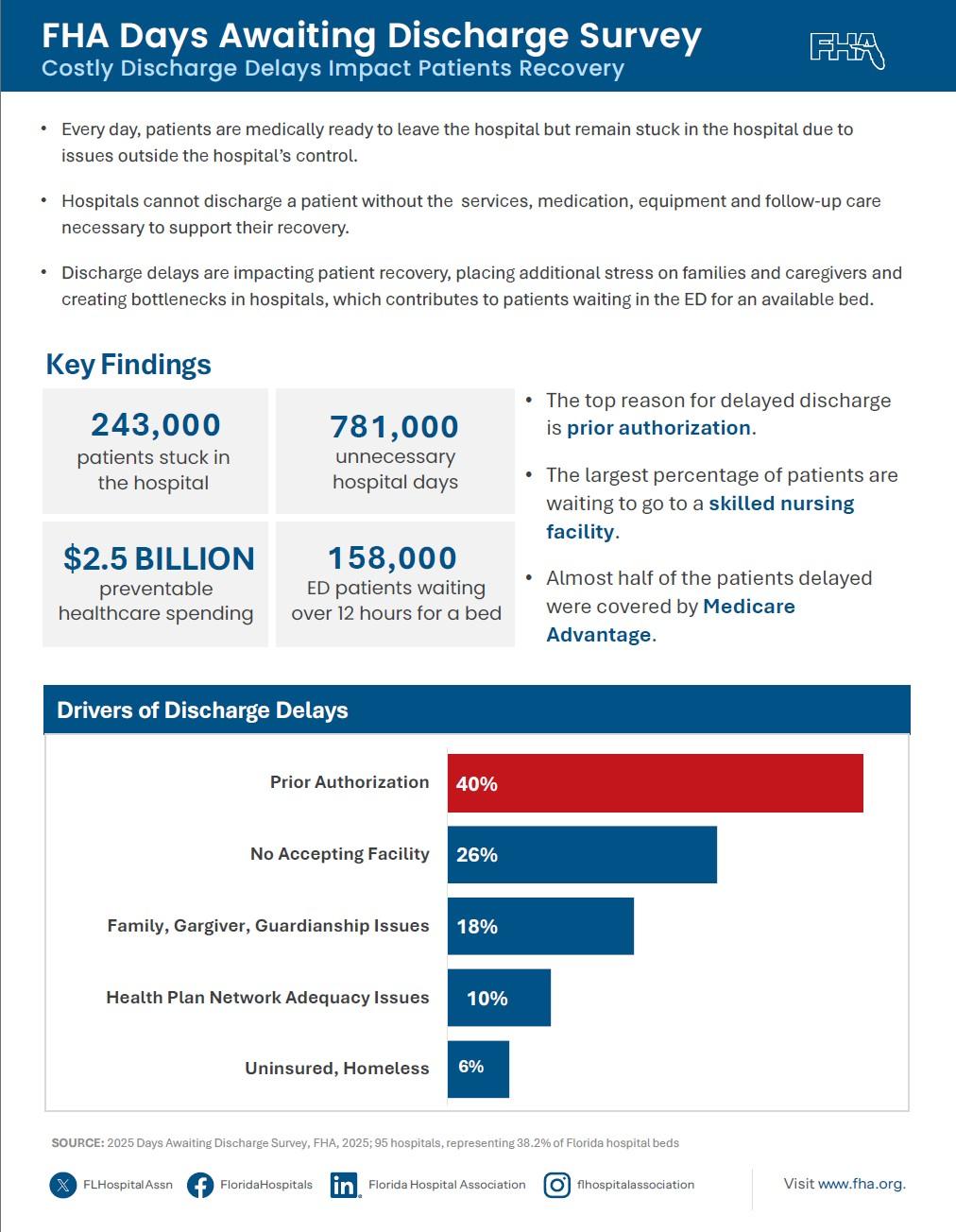
July 15, 2026   —  The Florida Hospital Association (FHA) today announced its most recent findings from the Survey on Days Waiting for Discharge, demonstrating the magnitude and impact of discharge delays on patients in Florida’s hospitals.  The report highlights more than 780,000 avoidable hospital days.  Almost one out of every 10 patients had to wait to be discharged, and 41% of these patients were waiting for their health plan to authorize their follow up care, according to the data.

The consequences of these delays are significantly impacting patients’ recovery, access to appropriate care, exacerbating stress on the family, and causing bottlenecks in the emergency departments (ED) for patients needing an inpatient hospital bed. These delays also generate additional costs to the system, with estimated preventable healthcare spending totaling $2.5 billion in 2025.

“No one should be in a hospital any longer than is appropriate for their medical care needs.  Patients deserve timely access to the next level of care or critical services and supports to aid in their recovery and healing.,” said Mary Mayhew, president and CEO of FHA. “Our data tells us that for many patients, they are delayed leaving the hospital because of a lack of timely insurance authorizations.

FHA surveyed FHA member hospitals on discharge delays between July 1, 2024, and June 30, 2025. Key findings from the Survey on Days Waiting for Discharge include:

  • 243,000 patients who were medically cleared had to remain in the hospital due to delays beyond the hospital’s control.
  • Delays in getting health plan prior authorization account for 41% of discharge delays.
  • Almost half of the patients who were delayed were covered by a Medicare Advantage plan, and 52% of their delays were tied to prior authorization, with nearly 4,000 of these patients waiting more than a week for placement.
  • These delays resulted in 781,000 unnecessary hospital days and $2.5 billion in preventable healthcare spending.
  • 158,000 or 7.4% of ED patients waited more than 12 hours for a bed; causing a downstream effect on other patients.
  • 41% of patients were waiting for a bed in a skilled nursing or rehabilitation facility.
  • Other factors affecting hospital discharge authorization include gaps in health plans’ provider networks.


“Floridians deserve timely access to care. By reducing discharge delays and freeing up hospital beds for other patients who need critical care, Florida’s health care delivery system can support patients’ swift recovery and optimal outcomes,” Mayhew added.

New OIG Audits on Medicare Advantage Plans Reinforce FHA Findings

In June, the U.S. Department of Health and Human Services Office of Inspector General (OIG), released the findings of two investigations into prior authorization practices for Medicare Advantage plans.  The studies identified widespread and concerning patterns in prior authorization practices, such as Medicare Advantage plans inappropriately denying or delaying approval for medically necessary post-acute care, creating barriers for patients transitioning out of hospitals.

According to the OIG, these denials can lead to:

  • Unnecessary extensions of hospital stays
  • Delayed access to rehabilitation or skilled nursing care
  • Increased administrative burden on providers

“These federal findings validate what Florida hospitals experience every day,” said Mayhew.

Call to Action

FHA calls on policymakers, regulators and health plans to support policies that accelerate insurers’ prior authorization processes for post-hospital care, increase transparency and accountability in denial and appeal decisions, and address gaps in provider networks while also increasing access to post-acute care facilities.  Find out more about what FHA is doing and how they are advocating on behalf of Florida hospitals here.

ABOUT FHA

Founded in 1927, the Florida Hospital Association (FHA) is the leading voice for health care in the State of Florida. Through representation and advocacy, education and informational services, the Florida Hospital Association supports the mission of over 260 hospitals and health care systems to provide the highest quality of care to the patients we serve. Led by President and CEO Mary Mayhew, the Florida Hospital Association is located in Tallahassee and is governed by a Board of Trustees and officers elected by the member institutions. To learn more, visit www.fha.org.


BY: Rebecca Bromelkamp

Research identifies subtype of `hungry gut’ obesity phenotype

July 16, 2026  — Why do some people lose substantial weight with GLP-1-based medications while others see more modest results? A Mayo Clinic study offers a potential answer by identifying a distinct biological subtype of obesity that responds especially well to tirzepatide, a medication that mimics two naturally occurring hormones involved in appetite and blood sugar regulation, moving the field closer to precision medicine for obesity.

The research, published in Gastroenterology, identified a subgroup of patients with obesity who produce lower levels of natural appetite-regulating hormones, experience faster stomach emptying and report greater hunger after meals. This is a subtype of the “hungry gut” obesity phenotype, characterized by an abnormal duration of fullness. People with hungry-gut obesity may eat normal portion sizes but snack more frequently.

These patients lost nearly twice as much weight after six months of tirzepatide treatment as patients with other obesity subtypes.

“Obesity is a complex disease driven by different biological mechanisms,” says senior author Andres Acosta, M.D., Ph.D., a gastroenterologist and the Delaney Family Director of the Nutrition Obesity Research Program at Mayo Clinic in Minnesota. “Our findings suggest we can begin identifying which patients are most likely to respond to specific therapies rather than treating obesity as a single disease.”

Researchers studied 483 adults with obesity and found three different biological types of the disease. About 1 in 4 participants produced lower levels of GLP-1 and other hormones that help people feel full after eating. Patients in this group lost an average of 21.5% of their body weight after six months of treatment with tirzepatide, compared with 11.7% for patients in the other groups.

The findings support growing efforts to personalize obesity treatment using an individual’s underlying biology rather than relying on a one-size-fits-all approach. Because obesity increases the risk of diabetes, heart disease, certain cancers and many other serious chronic conditions, identifying the right therapy sooner could improve long-term health outcomes.

The researchers also found that the reduced hormone levels were associated with decreased hormone production in the intestine rather than differences in the gut microbiome, providing new insight into the biology underlying this subtype of obesity.

The authors caution that prospective studies are needed before this approach can be incorporated into routine clinical practice, but these findings represent an important step toward more precise, individualized treatment for obesity.

For financial disclosures and other details, please see the paper.

###

About Mayo Clinic
Mayo Clinic is a nonprofit organization committed to innovation in clinical practice, education and research, and providing compassion, expertise and answers to everyone who needs healing. Visit the Mayo Clinic News Network for additional Mayo Clinic news.


July 15, 2026 – Cardiologist Alexander Kong, M.D., has joined Baptist Health Miami Cardiac & Vascular Institute, part of Baptist Health Heart & Vascular Care. Dr. Kong specializes in cardiovascular disease with clinical interests in both acute and preventive cardiovascular care, as well as in cardiovascular imaging, including echocardiography, cardiac CT and nuclear cardiology.

Dr. Kong recently completed a fellowship in cardiovascular diseases at Orlando Health Orlando Regional Medical Center, where he received training in interventional and structural echocardiography, cardiac CT, nuclear cardiology, vascular ultrasound, cardiac critical care and cardiac catheterization.

“We are pleased to welcome Dr. Kong to Baptist Health Heart & Vascular Care,” said Tom C. Nguyen, M.D., system chief executive of Baptist Health Heart & Vascular Care and chief medical executive of Baptist Health Miami Cardiac & Vascular Institute, as well as director of minimally invasive surgery and the Barry T. Katzen Endowed Chair at Baptist Health Miami Cardiac & Vascular Institute, and chair and professor of the Department of Cardiovascular Sciences at Florida International University Herbert Wertheim College of Medicine. “Dr. Kong brings strong clinical training, a passion for patient-centered care and a commitment to advancing cardiovascular medicine through education, quality improvement and innovation.”

Before completing his fellowship, Dr. Kong served as chief resident in quality improvement and patient safety for the Orlando VA Healthcare System and University of Central Florida/HCA Florida. He also worked as an academic hospitalist and assistant professor of medicine, mentoring residents and medical students while contributing to patient safety and quality improvement initiatives.

Dr. Kong has authored numerous peer-reviewed publications and presented research at national scientific meetings such as the American College of Cardiology Annual Scientific Session. His work has focused on cardiovascular imaging, arrhythmias, heart failure and quality improvement in patient care. He has also received several honors for his leadership and commitment to healthcare quality, including the Junior Cardiology Fellow of the Year award at Orlando Health and Lean Six Sigma certifications through the Veterans Health Administration.

“Dr. Kong’s background in cardiovascular imaging, quality improvement and academic medicine reflects a strong commitment to collaborative, evidence-based care,” said Ashford Denman, vice president of operations at Baptist Health Heart & Vascular Care. “His training and passion for patient-centered medicine will help strengthen the comprehensive cardiovascular services we provide to patients and referring physicians throughout South Florida.”

Dr. Kong is dedicated to providing thoughtful, evidence-based cardiovascular care tailored to each patient’s individual needs and goals. He values building collaborative relationships with patients and families and believes that clear communication, preventive care and a strong focus on education can help patients take an active role in improving and maintaining their heart health. He is fluent in English, Spanish, Portuguese and Catalan.

Dr. Kong will see patients at 7400 SW 87 Avenue, Suite 100, Miami, 33173. To schedule an appointment, call 786-204-4200.

About Baptist Health
Baptist Health is the largest healthcare organization in the region, with 12 hospitals, more than 29,000 employees, 4,500 physicians and 200 outpatient centers, urgent care facilities and physician practices spanning Miami-Dade, Monroe, Broward and Palm Beach counties. Baptist Health has internationally renowned institutes specializing in cancer care, brain and spine care, heart and vascular care and orthopedic care. In addition, it includes Baptist Health Medical Group, Baptist Health Quality Network and the Baptist Health PineApp, a virtual health platform. Baptist Health is an academic and clinical affiliate of Florida International University Herbert Wertheim College of Medicine. A not-for-profit organization supported by philanthropy and committed to its charitable mission of medical excellence, Baptist Health has been recognized by Fortune as one of the 100 Best Companies to Work For in America and is the most awarded healthcare system in South Florida by U.S. News & World Report. For more information, visit BaptistHealth.net/Newsroom and connect with us on FacebookX (formerly Twitter), InstagramTikTok and LinkedIn.