
By Daniel Casciato
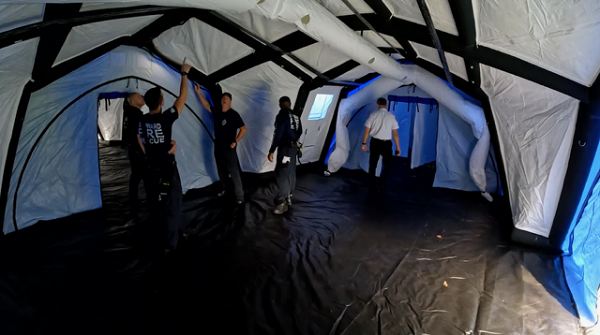
Broward Health has made significant strides in its emergency management capabilities to address the growing threats from natural disasters and health emergencies. Thanks to a substantial $1 million appropriation from the Florida legislature and Governor DeSantis and under the leadership of Broward Health President & CEO Shane Strum, the health system has added a new 8,100-square-foot inflatable field hospital to Broward Health’s arsenal of emergency response equipment. The temporary structure is fully equipped to handle a range of scenarios, from hurricanes to large community events.
Innovative Design for Rapid Response
The concept of the field hospital was born out of the urgent needs highlighted by recent natural disasters and the COVID-19 pandemic. Erick Pena, director of emergency management for Broward Health, explains the journey of conceptualizing and launching the field hospital, stating, “The demand for an adaptable hospital environment became clear through our experiences on both coasts of Florida with natural disasters.”
The field hospital, which consists of three trailers for command, medical facilities and equipment, can be deployed quickly to provide medical services outside of traditional hospital settings. With 50 beds available, this portable hospital is an essential asset for emergency situations. It ensures that emergency responders and physicians can offer help to the community right where and when it’s most needed.
“The design is very effective,” Pena says. “It inflates quickly and has built-in LED lighting, air conditioning hookups and generators. It can rapidly deploy, which is crucial early during a disaster when traditional medical facilities may be compromised.”
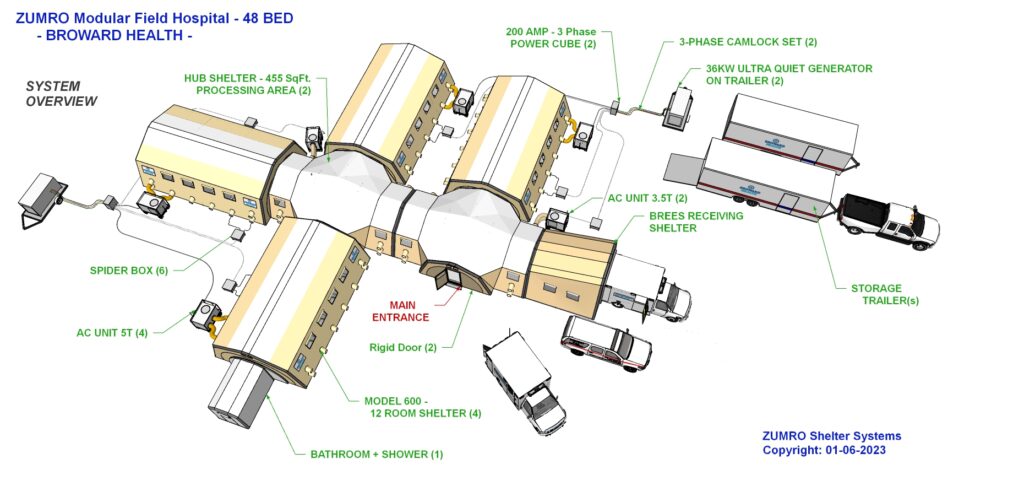
The field hospital is also built to withstand significant weather challenges. It can sustain winds up to 50 miles per hour, with gusts up to 70 miles per hour, making it a reliable asset in unpredictable conditions.
Funded by a generous state appropriation exceeding $1 million, the field hospital has advanced medical tools, generators and air conditioning systems spread across three trailers, including an incident command center.
Strum details the collaborative effort that made this initiative possible: “This was a cooperative effort with the Florida legislature, the Department of Emergency Management and the Governor’s office, which all saw the potential impact such a facility could have on our community.”
Broad Utility for Diverse Needs
Beyond disaster response, the field hospital is intended for use at community events, such as marathons and concerts, demonstrating Broward Health’s commitment to community engagement. Its modular design can be scaled up or down depending on the need of the event.
“Whether responding to a natural disaster or supporting a community event like the Tortuga Music Festival, this hospital can be rapidly deployed to provide essential services,” Strum says. “Its design allows for quick adaptation to different scenarios, from functioning as a temporary ICU to rendering basic medical care at public gatherings.”
Training and Preparedness
Preparation and training are key components of the field hospital’s success. James Roach, D.O., district chief of emergency medicine emphasizes the comprehensive training programs in place for handling hazardous materials, disaster management and infectious diseases, ensuring that the staff is well-prepared for various scenarios. “The field hospital builds upon decades of training initiatives,” he explains.
Integrated within Broward County’s broader emergency medical and trauma care networks, the field hospital enhances the region’s capacity to manage mass casualty events and other incidents where local hospitals may face overwhelming demands. “It extends our capacity to manage emergencies directly in the community or wherever the need arises,” Strum adds.
“In events like Hurricane Ian, where hospitals were damaged, this field hospital could be set up quickly in a parking lot to manage patient overflow,” Pena says.
Strum elaborated on the community’s involvement and collaborative efforts, adding, “We regularly engage in field exercises with local fire rescue services and health systems to ensure everyone is prepared and well-coordinated.”
Long-term Goals and Community Impact
Looking ahead, Broward Health aims to utilize the field hospital for emergency responses and as a proactive tool in community health initiatives. “Our goals are centered around disaster preparedness, infectious disease emergencies and positive community event support,” says Dr. Roach.
Strum agrees, “We aim to instill confidence in the community, knowing that comprehensive medical support is readily available in times of need.”
Conclusion
Broward Health’s new field hospital represents a forward-thinking approach to healthcare delivery, emphasizing rapid response, versatility and community integration. The focus of the new field hospital is clear: enhancing emergency response capabilities and improving overall community well-being. This innovative project positions Broward Health as a leader in emergency preparedness and solidifies its commitment to serving and safeguarding the community in times of need.