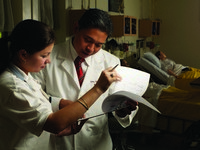
FIU professor teaches nursing students how to intubate an infant through clinical instruction on a pediatric patient simulator in the College of Nursing & Health Sciences’ SimulationCenter.

Florida International University (FIU) is one of only ten schools in the country chosen by the National Council of State Boards of Nursing (NCSBN®) to participate in a landmark, national, multi-site study that will determine the optimal use of simulation education scenarios by pre-licensure nursing education programs. Beginning in the fall of 2011, the NCSBN Simulation Study will evaluate 100 incoming nursing students to the FIU College of Nursing & Health Sciences (CNHS) from their first day of class through their first year of practice, to determine how and to what extent simulated clinical education enhances nursing comprehension, competence and clinical judgment compared to traditional clinical instruction.

“Having inaugurated a state-of-the-art Simulation Center last year, and with national simulated education experts on our staff as faculty members, the FIU nursing program has already been leading this movement in alternative, cutting-edge preparation for nursing practice and development,” said Dr. Sharon Pontious, interim dean of the FIU CNHS. “We are excited to have been selected for this groundbreaking study as valuable contributors in an effort that will have a bearing on the future of nursing education and instruction in this country.”
 
The NCSBN Simulation Study aims to:
. Highlight currently known best practices in simulation use;
. Evaluate the learning that occur with various amounts of simulation substituting for clinical hours;
. Establish key simulation standards and learning experiences in each core clinical course during the study; and
. Evaluate new graduates’ ability to translate educational experiences into the workplace


As the need for more trained medical workers continues to grow in Florida, Florida Career College (FCC) announces the addition of a new program to its School of Allied Health. FCC now is offering a two-year associate’s degree program in Health Services Administration designed to prepare students for administrative positions in physicians’ offices, hospitals and other healthcare facilities. Past and future graduates of FCC’s Medical Assistant Technician, Medical Coding & Billing and Patient Care Technician diploma programs can transfer into this associate degree program receiving full credit for successfully completed courses.

"This valued addition to our comprehensive School of Allied Health curriculum allows us to offer even more extensive training to those who seek allied health careers," said Ilia Martin, vice president of academic operations for Florida Career College. "Part of our mission is to offer courses of study that train students for careers that are in demand so they can move directly from the classroom into the workforce."
 
The Florida Agency for Workforce Innovation cited healthcare as the top field for employment in Florida from August 2009 through August 2010 as more than 22,000 new jobs were added, the largest single block of the state’s general employment gain of nearly 37,000 new jobs.
 
"This new degree program allows students who have completed their primary program of interest to continue their education with an advanced course of study," added Martin. "There are tremendous job opportunities in healthcare in South Florida and it is very gratifying to have the opportunity to add an academic program that will provide our students with the high level of training they need to help them succeed."
 
Florida Career College identifies the skills needed for today’s job market by working closely with industry experts, professional associations and employers to continually develop and update programs and courses according to industry needs. Classrooms, computer and medical labs and clinics are designed with real-world equipment and software programs to give students the advantage of "hands-on" training. Known as the "College that Cares," FCC’s goal is for students to build on their strengths and to study what specifically interests them in an environment designed to foster individual goals and learning styles.
 
Eight academic starts allow for year-round study. Small classes and programs are designed to create a positive learning environment where student individuality is recognized enabling students to meet their unique educational goals. Morning and evening sessions allow students to maintain jobs and attend classes.
 
FCC has South Florida campuses in Miami, Hialeah, Pembroke Pines, Lauderdale Lakes, Boynton Beach and West Palm Beach, which are accredited by the Council for Independent Colleges and Schools (ACICS) to offer diploma, associate of science degree and bachelor of science degree programs. The newest campus in Margate is now enrolling for classes scheduled to begin on April 4.
 
Along with an array of allied healthcare fields, programs at FCC are available in business administration, cosmetology and clinical skin care, information technology, HVAC and nursing.


Dr. Robert J. Snyder, a podiatric physician and surgeon for more than 30 years and leading wound care specialist, joins the faculty at Barry University’s School of Podiatric Medicine. Snyder began his new role as a professor and director of clinical research this January.

Snyder joins Barry from private practice at University Hospital in Tamarac, FL, where he is director of the Wound Healing Center. Snyder, who serves on the editorial advisory boards of Ostomy Wound Management and WOUNDS and reviews articles for the New England Journal of Medicine, will teach student doctors about wound management, limb preservation and research at Barry.


Barry University’s College of Health Sciences in Miami Shores offers a bachelor’s degree program for professionals who are interested in nursing but who may have received their undergraduate degree in another field of study. The highly regarded Division of Nursing at Barry University makes it possible for you to earn your second bachelor’s degree and focus on becoming a registered nurse through its innovative accelerated program. As a Barry nursing student, you are assigned a faculty mentor who helps you plan your program of study, taking into consideration your academic and career backgrounds and your professional goals. At the end of the program, you will be able to take the licensure exam to become a registered nurse.

Prerequisite courses in the natural and behavioral sciences may be accepted from previous academic study or may be completed full or part time at Barry University. These courses include anatomy, physiology, psychology, chemistry, mathematics, and more. The nursing portion of the program, including courses in theory and clinical practice, is from January to May of the following year and must be taken full time.
 
Barry University’s nursing program has a more than 50-year tradition of excellence in health care education. Our nurses graduate with a firm grounding in nursing theory, develop exceptional clinical abilities, focus on the well-being of multicultural communities, and are dedicated to ethical practice and treatment. Barry’s experienced nursing educators are there with you every step of the way, providing caring support and student services. For more information on this and other nursing programs at Barry University, please visit www.barry.edu/nursing.
 
Graduate Degrees in Health Services Administration
The College of Health Sciences also houses one of the top master’s programs in Health Services Administration. It has been recognized by Modern Healthcare magazine as one of the top 10 graduate programs nationwide for training physician-executives.
 
This program is designed for health care professionals and provides you with the knowledge and skills required for leadership positions amid the constant changes in health care delivery, managed care, policy regulation, and a diversified consumer environment. The program empowers you in the critical evaluation of theoretical and research perspectives in health administration and the practical application of these insights into your daily professional work.
 
Barry also offers a dual master’s degree in health services administration and public health, which prepares students to assume leadership roles and develop, implement, and assess programs related to the public’s well-being. There are also graduate certificates in health services administration to advance knowledge in certain areas or prepare you for the master’s program. For more information on Health Services Administration at Barry University, please visit www.barry.edu/hsa.
 
Barry’s Health Care Programs
Barry University in Miami Shores is the second-largest private, Catholic university in the Southeast. From certification courses to bachelor’s, master’s, and doctoral programs, Barry has health care covered. Barry prepares you for a career in health and medicine, with more than 50 programs in a variety of fields, including nursing, podiatric medicine, anesthesiology, physician assistant studies, biology, health services administration, emergency medical services, counseling, psychology, social work, occupational therapy, and exercise sciences for example. In addition, Barry also offers post-baccalaureate certificates and master of biomedical science programs that are designed for health care workers and students of high potential who are seeking a career change or pursuing pre-med and subsequent medical studies.
 
No matter which program you choose, you receive personal attention from distinguished faculty and learn in outstanding facilities that enhance your studies. You gain access to excellent internship, practicum, and externship opportunities that help you excel in the ever-changing health care field. And you learn the importance of serving your community with compassion and respect. Some programs are also designed for working professionals, offering evening, weekend, and part-time options.



The Federal Health Information Technology for Economic and Clinical Health (HITECH) Act, which is part of the American Recovery and Reinvestment Act (ARRA) of 2009, promulgates the meaningful use of health information technology to improve the quality of health care in the United States. According to the Department of Health and Human Services, Office of the National Coordinator (ONC) for Health Information Technology, the HITECH Act provides assistance to institutions of higher learning to establish or expand health information technology education programs to advance the deployment of the electronic health record within a very short time frame of five years. The Workforce Program provides approximately $70 million in assistance through cooperative agreements to five regional consortia consisting of 85 Community colleges across the nation. The focus of this funding is to develop short-term certificate programs to train 10,000 individuals per year in six workforce roles.

Broward College is one of three colleges in Florida awarded stimulus funding to provide training for the workforce roles. Broward College’s service area consists of Broward, Charlotte, Collier, Dade, Glades, Hendry, Lee, Sarasota, Monroe, and Palm Beach counties.
 
Qualified individuals must either have a health care background or an information technology background to be eligible for the workforce certificate programs. The training goals focus on bridging the knowledge gap for experienced health care or information technology practitioners who must complete their training of one or more of the workforce roles within a six-month period.
 
Training is funded until April 2, 2012 in six health/IT priority workforce roles, including:
– Practice workflow and information management redesign specialists
– Clinician/practitioner consultants
– Implementation support specialists
– Implementation managers
– Technical/software support staff
– Trainers
 
Every role consists of 9 to 13 courses. Tuition for each course is $50.00. Upon completion of their first certificate (only), students will receive 50% tuition reimbursement. There are no additional costs as all learning materials are contained in the courses. Training in each of these roles will take six months or less, are fully online, and are self-paced. Students who complete their initial certificate program may continue taking courses for another certificate at the cost of $50.00 per course. Since the core courses will have already been completed, it will be possible to obtain another certificate in a shorter amount of time.
 
This curriculum was developed through federal funding by five of the foremost academic centers in the country, including Oregon Health & Science University, Duke University, Columbia University, University of Alabama at Birmingham and Johns Hopkins University.