
By Miguel Garcia, PT, DPT, EdD
Juan is a 74-year-old male who was involved in a motorcycle accident approximately 10 years ago resulting in multiple fractures. Juan overcame his injuries and regained his overall independence at home and in his immediate community, ambulating without any assistive device.
Committed to his ongoing recovery, he registered for our community-based Falls Prevention Program at the University of St. Augustine for Health Sciences, Miami Campus (USAHS Miami.) The multi-faceted program challenges individuals at risk for falls to complete a functional obstacle course that mimics day to day mobility, view educational presentations on how to reduce the risks for falls, engage in dynamic gait training, and learn martial arts-based movements to facilitate falls. While Juan was relatively independent, he found significant challenge with all aspects of our program.
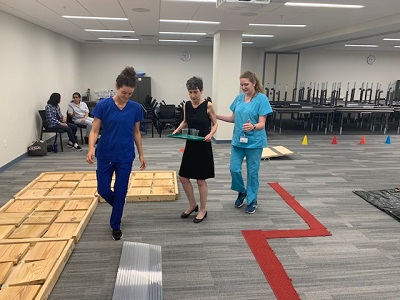
Patients present to the Falls Prevention Program at USAHS Miami with unique histories and varying clinical presentations. Some patients have neurological conditions that specifically impact their motor control and balance while others have medical conditions that have affected sensation in their limbs. Despite their differences, all our patients are seeking guidance and support to overcome two common themes: (1) decrease their risk for falling, and (2) decrease their risk of injury if they are to fall.
Falls are a significant public concern and there is an abundance of research pointing to the need for greater programming and solutions for those at risk for falls. Falls are more prevalent among adults over 65 years-old and are the leading cause of fatal and non-fatal injuries in this age-group. The most common injuries sustained include fractures of the hip, wrist, ribs, and humerus. The most common place where falls take place in this population is in the home setting, but other sites include residential living facilities, healthcare facilities and transportation areas.
According to the Centers for Disease Control and Prevention, falls among older adults result in $50 billion in medical costs annually. Falls account for 3 million emergency room visits every year and 1 million hospitalizations.
Bi-partisan legislation introduced earlier this year is counting on interventions by physical therapists to promote safety, help patients stay independent longer, and cut Medicare costs.
The Stopping Addiction and Falls for the Elderly (SAFE) Act would make no cost fall risk assessments from a physical or occupational therapist part of the Medicare wellness benefit. Many seniors don’t realize they are at risk until it’s too late, when they have had that first fall and are suffering the consequences. Making it part of the discussion with their physician at a wellness visit, changes the conversation about what causes falls and how to prevent them.
A report from The Moran Company found physical therapy is associated with significant reductions in hospitalizations, emergency room visits, and opioid use in the Medicare population when patients consult a PT after a fall.
A referral to a physical therapist who can effectively evaluate an individual’s risk for falling, identify intrinsic and extrinsic risk factors for falling, and provide a comprehensive plan of care to address these factors can significantly impact the individual’s quality of life and lead to a measurable reduction in total healthcare spending.
Our patient Juan offers good insight into the role of physical therapy. While Juan had attained his immediate independence following the motorcycle accident, he still lacked the confidence to effectively integrate with the community at large because of his fear of falls and ongoing balance deficits. We were able to educate Juan on the extrinsic factors in his home and immediate community that increased his risk for falls and how to mitigate such risks. We also provided extensive balance and gait training using our multi-modular obstacle course and walking exercises. With mass repetition, Juan learned how to create the balance strategies necessary to prevent a fall if he were to lose balance. While the program led to significant improvements in Juan’s balance and overall awareness, a risk for falls still existed. This risk was addressed by teaching Juan how to safely fall using martial arts-based techniques to decrease the risk of injuries if he were to fall.
Physical therapy can have a significant impact on the lives of individuals at risk for falls or with a history of falls. The SAFE Act would be an absolute game-changer for these individuals as it allows them to receive early interventions and timely care from professionals who are experts in various aspects of falls prevention including movement analysis, environmental modification, and functional mobility treatment.
Dr. Miguel Garcia is Associate Professor, University of St. Augustine for Health Sciences, Miami. For more information, visit www.usahs.edu.