
July 1, 2025- In preparation for the Fourth of July holiday, Fort Lauderdale Fire Rescue and Broward Health joined forces to educate the community about the dangers of fireworks. They provided safety tips and discussed common injuries typically seen during the holiday.
“The safest way to enjoy fireworks is to attend a professional display. These are conducted under controlled conditions by trained experts,” Battalion Chief Christopher Davis-Partridge, Fort Lauderdale Fire Rescue said. “The City of Fort Lauderdale throws an annual 4th of July Spectacular at Las Olas Oceanside Park featuring a professional fireworks display.”
“Improper use of fireworks can easily ignite grass, brush, or rooftops, especially during dry conditions. A single firework landing in the wrong place can put homes and lives at risk,” Battalion Chief Davis-Partridge said. “Please avoid using fireworks near buildings, trees, or dry vegetation. Make sure all fireworks are fully extinguished before discarding.”
“Fireworks can cause devastating injuries, especially to the hands, face, and eyes,” Battalion Chief Davis-Partridge said. “Children are particularly vulnerable. Even sparklers, which many consider harmless, burn at temperatures up to 2,000 degrees, hot enough to melt metal.”
“The Fourth of July is one of the busiest times of year for our emergency departments,” said Dr. Robert Chisholm, an emergency physician at Broward Health Medical Center “We typically see an increase in visits due to fireworks and sparkler injuries, dehydration and heat-related illnesses, food poisoning, severe sunburns, and alcohol-related accidents.”
“The most common firework-related injuries we see across our four emergency departments are burns to the hands, face, ears, and eyes,” Dr. Chisholm said. “We also treat cuts from fireworks explosions, eye injuries from sparks or flying debris, and in the most severe cases, even amputations.”
“For minor burns, immediately cool the area under cold running water for at least 20 minutes, then cover it with a clean, dry cloth and seek medical attention,” Dr. Chisholm said. “If the burn is around sensitive areas like the eyes, nose, ears, toes, or fingers, no matter the size, it’s important to go to the emergency department right away.”
“For serious injuries such as losing a finger or any extremity, call 9-1-1 immediately,” Dr. Chisholm said. “Cover the area with clean, moist gauze, and place the missing part in a sterile plastic bag. Then, put the bag on ice and wait for the ambulance.”
“We recommend staying out of the heat during the middle of the day, staying hydrated, and wearing light clothing,” Dr. Chisholm said. “If you start feeling dizzy, nauseous, or experience heavy sweating and cramping, you might be having heat exhaustion, which can quickly lead to heat stroke.”
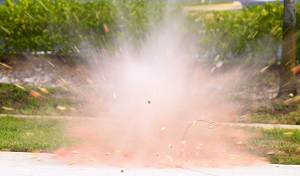
Fort Lauderdale Police Bomb Squad offered live demonstrations using a paint can, a cantaloupe, and a watermelon with explosives similar to an M-80 to simulate the potential damage fireworks can cause. They also did demonstrations with raw chicken and sparklers to show the kind of injuries that can happen to skin, something many kids experience when holding sparklers.
About Fort Lauderdale Fire Rescue
Established in 1912, Fort Lauderdale Fire Rescue (FLFR) provides fire rescue and emergency management services to the neighbors and visitors of Fort Lauderdale, Wilton Manors, and Lazy Lake. Operating out of 12 stations, the department responds to over 54,000 calls for service annually, making it the busiest department in Broward County. FLFR utilizes highly-trained special operations teams, including Hazardous Materials, Technical Rescue, Marine Rescue, SWAT Medics, and Aircraft Rescue Firefighting. It partners with neighboring agencies to provide for closest unit response. The department also provides for Ocean Rescue at Fort Lauderdale’s world-renown beaches.
For more information about Fort Lauderdale Fire Rescue, visit https://www.fortlauderdale.gov/government/departments-a-h/fire-rescue.
About Broward Health
Broward Health, founded in 1938 and headquartered in Fort Lauderdale, Florida, ranks among the 10 largest public healthcare systems in the United States. Nationally recognized for its focus on high-quality care for the residents of Broward County and beyond, Broward Health boasts five hospitals, two trauma centers, a dynamic academic partnership with Florida Atlantic University, was the county’s first statutory teaching hospital and has an ever-growing graduate medical education program. It includes more than 50 health centers and physician practices covering virtually every healthcare specialty.
Broward Health never stops working toward its mission of Exceptional Care, Extraordinary Compassion and Everyday Excellence. Driven by more than 11,000 talented employees and physicians who deliver care to all patients, regardless of their ability to pay, Broward Health is one of the largest employers in Broward County with an operating budget of $1.6 billion and annually provides almost $225 million of charity and uncompensated care.
For more information about Broward Health, visit BrowardHealth.org.