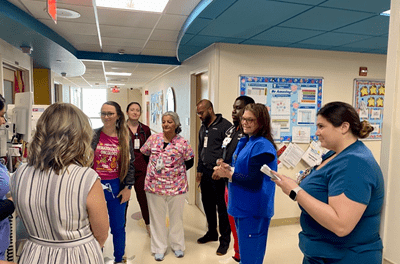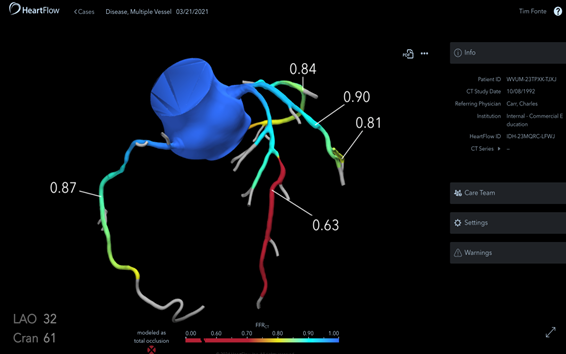
This personalized, color-coded 3-D model of a patient’s coronary arteries provides functional information (or blood pressure measurements) about each blockage utilizing HeartFlow
Incorporating a HeartFlow analysis can help more accurately determine if a person with suspected coronary artery disease (CAD) should be treated for heart disease.
September 5, 2024 – HCA Florida Mercy Hospital, a 488-bed facility, and part of HCA Florida Healthcare, the largest healthcare system in the state, is among the first sites in Miami-Dade County to offer a proven, non-invasive diagnostic option for people with suspected heart disease. The HeartFlow FFRCT (fractional flow reserve computed tomography), a non-invasive clinical pathway for the diagnosis of coronary artery disease (CAD), applies AI algorithms to create an anatomical model of a person’s heart that helps physicians visualize the blood flow and detect stenosis, or plaque that obstructs the blood flow.
Heart disease is the leading cause of death for adults in the United States, and CAD is the most common type of heart disease, affecting nearly half the adult population.1,2 CAD develops when the arteries leading to the heart narrow or become blocked, which may lead to a reduction in blood flow to the heart. This can cause chest pain, heart attacks and death.
“The fractional flow reserve computed tomography analysis completely changes this paradigm, providing essential information that can help us determine the right approach for a patient through a convenient, non-invasive platform,” said Allyssa Tobitt, Chief Executive Officer, HCA Florida Mercy Hospital.
Despite CAD being the most common form of heart disease, studies have shown there is a need to improve how and when CAD is evaluated and diagnosed. According to Dr. Allan Stewart, chairman of surgery and medical director of cardiac surgery at HCA Florida Mercy Hospital:
“Identifying exactly where and how an artery is blocked or clogged can help improve a person’s treatment plan — including whether or not an intervention is needed.
Recognized by professional guidelines; backed by data
Professional guidelines, such as the ACC/AHA chest pain guidelines, recognize the combination of coronary computed tomography angiography (CCTA) with selective FFRCT as a front-line pathway that helps diagnose CAD. This pathway was recently shown to be the superior diagnostic pathway in the PRECISE trial for suspected CAD compared to Traditional Testing.*
The CCTA + HeartFlow FFRCT Pathway:
- Allows for more accurate non-invasive diagnosis, significantly lowering the rates of false negatives and false positives compared to Traditional Testing in patients with coronary artery disease.
- Reduces unnecessary tests, providing a better patient experience, with a 4x reduction in unnecessary invasive catheterization and necessitating fewer initial diagnostic tests overall.
- Provides confidence in treating the right patients – 75% more likely to identify patients in need of intervention.
*Traditional Testing means functional stress testing.