By Daniel Casciato
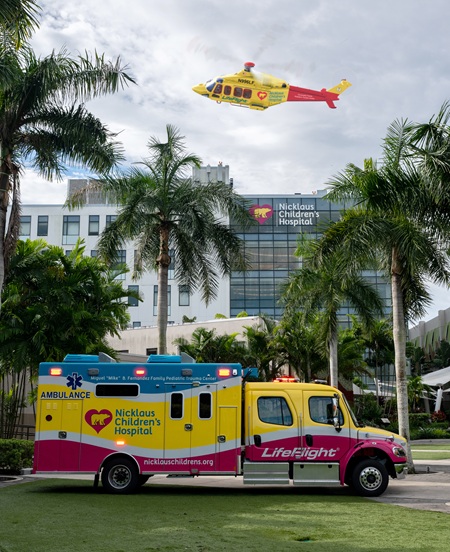
For three decades, Nicklaus Children’s Hospital LifeFlight has played a vital role in some of the most urgent moments in pediatric care, helping transport critically ill newborns, infants, and children to the specialized care they need when every minute matters.
As the program marks its 30th anniversary, LifeFlight has grown far beyond its original role as a pediatric transport service. Today, it functions as a mobile extension of Nicklaus Children’s Hospital’s neonatal and pediatric critical care capabilities, providing advanced care by ground and air across South Florida, the Caribbean, and parts of Central and South America.
“Over the past 30 years, Nicklaus Children’s Hospital LifeFlight has evolved from a specialized pediatric transport service into a highly advanced mobile extension of the hospital’s neonatal and pediatric critical care capabilities,” says Peter Cruz, Executive Director of Emergency Services at Nicklaus Children’s Hospital.
While the program has continued to grow, Cruz says its core purpose remains the same: “bringing expert care to infants and children when time and distance matter most.”
That mission is especially important during high-acuity inter-facility transports, when a child must be moved from one hospital to another for a higher level of specialty care. In those cases, the transport itself can be one of the most vulnerable parts of a child’s care journey. LifeFlight helps ensure that care does not pause between facilities.
“The most important thing for the community to understand is that Nicklaus Children’s Hospital LifeFlight is not simply moving a child from one hospital to another, it is delivering specialized pediatric and neonatal critical care from the moment of the team’s arrival and throughout the transport process,” Cruz says.
That distinction is central to LifeFlight’s role. The team stabilizes, monitors, and manages patients throughout the journey, providing ICU-level support while a child is in the air or on the road. For medically fragile newborns and children whose conditions can change rapidly, that continuity can be critical.
According to Cruz, LifeFlight is part of a broader emergency care continuum that includes referring providers, EMS professionals, communications specialists, transport clinicians, and receiving teams. Each group plays a role in helping children reach the appropriate level of care safely and quickly.
“Referring providers, EMS professionals, communications specialists, transport clinicians, and receiving teams all work together, and LifeFlight helps connect each part of that process so children can reach specialized care safely, quickly, and with expert support every step of the way,” he says.
The scope of that work is significant. LifeFlight transports more than 4,000 infants and children each year across a broad and geographically complex region. The team must be prepared for a wide range of clinical and logistical challenges, from weather and over-water flights to long transport intervals and coordination across multiple facilities.
“Infants and children are not simply smaller adult patients — they have distinct physiology and can deteriorate quickly,” Cruz says. “Transport teams must be prepared to manage highly specialized needs in very small, very fragile patients over long distances and in changing environments.”
In many cases, LifeFlight teams are caring for critically ill newborns in transport incubators or managing children who require advanced respiratory support, medication infusions, close neurologic monitoring or precise temperature management. Those needs require not only advanced equipment, but also close teamwork.
LifeFlight’s multidisciplinary team includes nurses, paramedics, EMTs, communications specialists, and transfer center professionals. From the moment a transport request is received, those professionals work together to assess the patient’s needs, coordinate logistics, determine the appropriate response, and prepare the receiving team.
“LifeFlight’s strength lies in the fact that it operates as one coordinated system from the moment a transport request is received,” Cruz says.
That coordination helps reduce delays when every minute matters. Communications and transfer center teams gather clinical information, connect referring providers with receiving specialists, and manage the details of the transport. Nurses, paramedics, and EMTs provide bedside expertise during the journey, while the receiving hospital team prepares for the child’s arrival based on real-time updates.
For families, the result is a more seamless process during an urgent and stressful time. For the child, it means fewer communication gaps, stronger continuity of care, and faster access to pediatric specialists.
The program’s advanced technology also helps distinguish LifeFlight from traditional transport. The team is equipped with specialized resources, including neonatal ventilators, transport incubators, whole-body hypothermia capability, and phototherapy capability.
“These technologies allow Nicklaus Children’s Hospital LifeFlight to function as a mobile neonatal and pediatric intensive care unit,” Cruz says. “Rather than simply transporting a patient, the team can continue highly specialized treatment during the journey.”
For newborns, transport incubators help maintain a safe and controlled environment while allowing for ongoing monitoring and intervention. Neonatal ventilators provide respiratory support for some of the smallest and most medically fragile patients. Whole-body hypothermia can support time-sensitive neuroprotective treatment for certain newborns, while phototherapy allows needed therapy to continue during transport.
As Nicklaus Children’s continues expanding access to pediatric care across South Florida, LifeFlight’s role is expected to become even more important. The system’s growing footprint includes Nicklaus Children’s Hospital Fort Lauderdale and Nicklaus Children’s Hospital Coral Springs, each located on the campuses of Broward Health.
“The future of Nicklaus Children’s Hospital LifeFlight is centered on expanded reach, advanced technology, and even stronger integration with Nicklaus Children’s growing network of care,” Cruz says.
A major part of that future is the addition of two new AW139 helicopters. One aircraft arrived in May, and a second is expected in June. Cruz says the helicopters represent a major investment in the next generation of pediatric transport, with enhanced mission capability for longer-distance transports, over-water operations, and specialized critical care missions.
As LifeFlight enters its next chapter, the program continues to build on its role as a mobile extension of Nicklaus Children’s pediatric expertise.
“LifeFlight will continue building on its role as a mobile extension of Nicklaus Children’s pediatric expertise,” Cruz says, “bringing advanced neonatal and pediatric critical care beyond hospital walls and helping ensure more children throughout Florida, the Caribbean, and neighboring regions can access specialized treatment when they need it most.”
For more information, visit www.nicklaushealth.org.