
By Michelle Marsh and Richard Klass
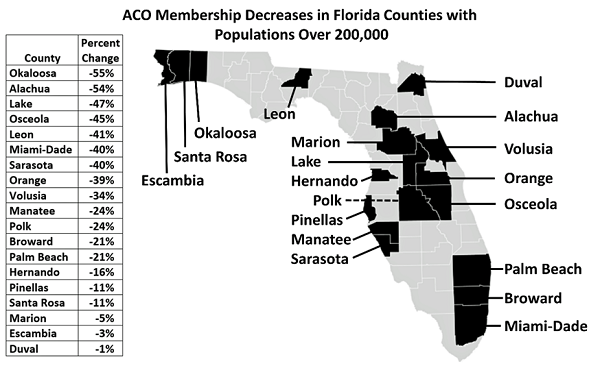
South Florida accountable care organization (ACO) enrollment declined 24% between 2018 and 2021 year-end according to Centers for Medicare & Medicaid Services (CMS) data. Over the same period:
- Miami-Dade County showed the largest decline (40%) from 29,123 enrollees to 17,378.
- Broward County enrollment dropped (21%) from 42,032 to 33,008.
- Plam Beach county enrollment declined (21%) from 85,298 to 67,807.
The loss in ACO enrollment in South Florida is significantly higher than for the state (-5%) overall. Within the state’s remaining two major population centers, Orange County enrollment declined by 39% between 2018 and 2022, but Hillsborough County enrollment grew by 58%.
ACO enrollment comprises only traditional/original Medicare fee-for-service patients. ACOs with service areas heavily penetrated by Medicare Advantage plans face significant growth headwinds. Consider as of July 2023, over three-quarters of Miami-Dade County’s 496,000 Medicare beneficiaries have Advantage Plan health insurance. In contrast, 64% of Medicare eligibles have an Advantage Plan in Broward County and 47% in Palm Beach County.
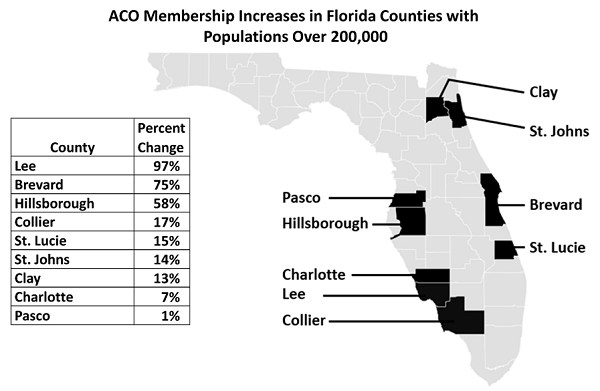
There are about 100,000 Medicare fee-for-service patients in each South Florida county unaffiliated with an ACO. While there are many ACOs with South Florida enrollment, only five to six in each county are serious players; these entities have room to advance their enrollment, but the going is tough and getting harder.
Nationally, about 38% of physicians are associated with a Medicare related ACO.1 Even with widespread physician participation, ACO growth is inhibited by several factors. The major barriers include requirements for organizational transformation such as adapting to a new patient care and financial reward paradigm and implementation of necessary information technology. Also, understanding and dealing with different risk models and accepting unknown downside financial risk is challenging.
There are two ACO risk models – one-sided and two-sided. Organizations enrolled in a one-sided risk model have no downside risk. This option allows new entities to gain experience in managing their patient population’s health and related cost of care. They can receive a portion of savings so long as the ACO meets performance quality standards. In a two-sided arrangement, ACOs share with CMS both potential savings and losses as determined by care costs that are either less or more than expectations.
National data shows more ACOs participate in two-sided risk (~60%) versus one-sided (~40%) risk models. South Florida organizations report a similar participation distribution – about 55% take on two-sided risk versus 45% that participate in the one-sided risk option.2
However, CMS mandates ACOs to convert from one-sided to a two-sided risk option. In 2019, CMS cut the time an ACO may remain in a one-sided model. New physician and low-revenue organizations have three years to convert, down from six years; all other ACOs have only one year.3 CMS rationalizes giving physician-led entities more time in a one-sided program leads to greater competition and “allows more physician practices to remain independents and ensure that all ACOs generate savings.”4 Yet, the mandate to move faster from one-sided to two-sided risk may:
- Give existing ACOs pause in growing enrollment. More assignees mean increased economic loss risk that some entities perceive as not worth the potential gain.
- Inhibit formation of new ACOs.
Michelle Marsh, CEO, Forma Advisors, can be reached at michelle@formaadvisors.com. Richard Klass, CEO, 2CY, Inc., can be reached at rklass@2cy4u.com.
1 American Medical Association Survey
2 CMs, 2021 data, 482 entities
3 Federal Register, 12/31/2018
4 Seema Verma, Administrator, CMS, Blog Post, reported by Revenue Cycle Advisor