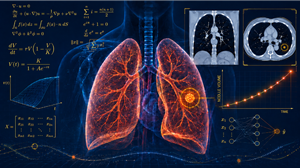
Sept. 9, 2026 — A new model developed by Florida International University researcher Deborah Goldwasser uses mathematical modeling to pinpoint the critical window when an aggressive lung tumor is still curable.
The findings could help refine lung cancer screening strategies and identify cancers before they cross that threshold, leading to more personalized screening schedules. This would allow patients at higher risk of developing fast-growing tumors to be monitored more frequently while reducing unnecessary screenings for others.
Goldwasser’s latest research, published in Cancer Epidemiology, Biomarkers & Prevention, focuses on the point at which an aggressive lung cancer progresses from being curable through surgical removal to becoming inoperable.
That distinction is important because current lung cancer screening guidelines primarily focus on determining whether a lung nodule is likely to be cancerous. While that is an essential finding, it does not account for the cure threshold — the point at which an aggressive cancer progresses beyond the window in which it can still be cured through surgery alone.
“I study the most aggressive lung cancers, those that would lead to death without early detection,” Goldwasser said. “This work informs how frequently high-risk individuals should be screened and how quickly small, aggressive nodules must be managed.”
Answering those questions is at the heart of Goldwasser’s cancer progression modeling, which has become increasingly important as advances in imaging have changed what researchers can observe about lung cancer.
Unlike earlier models of lung cancer progression, which relied largely on chest X-rays and cancer registry data, newer, more sensitive low-dose CT (LDCT) scans are providing researchers with a much clearer picture. Because LDCT can detect very small cancers, researchers are finding some fast-growing, aggressive tumors at smaller sizes than traditional models predicted.
Goldwasser’s work accounts for this, using the data from smaller-sized nodules to provide more accurate estimates of how long these fast-growing cancers may remain curable.
“If every lethal cancer you detect before the cure threshold is contributing to mortality reduction, that’s where you’re getting a benefit of screening,” Goldwasser said. In other words, the goal of screening is not simply to find cancer earlier. It is to find aggressive cancers early enough that treatment can still cure them.
That was not always the case. Earlier studies using chest X-rays failed to demonstrate a survival benefit, leading many physicians to question the effectiveness of routine screening. That changed in 2010, when the National Lung Screening Trial found that low-dose CT (LDCT) screening reduced lung cancer deaths by approximately 20%. In simple terms, screening with LDCT meant that fewer people died from lung cancer because their cancers were more likely to be found early, when treatment had a better chance of working.
Goldwasser is building on those findings by determining which screening regimens provide the greatest benefit. Her mathematical framework could help optimize future screening recommendations.
As a mathematician, Goldwasser brings a unique vantage point to lung cancer research, using mathematical modeling to understand how lung nodules grow over time and how that growth relates to the likelihood of a cure. Ultimately, she hopes the work will help physicians detect cancer not only earlier, but at the moment when treatment is most likely to save a patient’s life.
About FIU:
Florida International University is a Top 50, preeminent public research university with 55,000 students from all 50 states and more than 140 countries, as well as an alumni network of more than 340,000. Located in the global city of Miami, the university offers more than 200 degree programs at the undergraduate, graduate and professional levels, including medicine and law. FIU faculty are leaders in their fields and include National Academy members, Fulbright Scholars, and MacArthur Genius Fellows. A Carnegie R1 institution, FIU drives impactful research in environmental resilience, health, and technology and innovation. Home to the Wall of Wind and Institute of Environment, FIU stands at the forefront of discovery and innovation. With a focus on student success, economic mobility and community engagement, FIU is redefining what it means to be a public research university.