The Comprehensive Aortic Center at UHealth is combining multidisciplinary expertise, 3D fusion imaging and minimally invasive procedures to treat complex aortic aneurysms and dissections.
Sept 24 2026 – The human body can be both sturdy and fragile. The heart beats around 100,000 times per day, vigorously sending blood through the aorta and other major arteries to feed oxygen and nutrients to various organs. Unfortunately, the aorta, which branches up from the heart and descends into the abdomen, bears the brunt of this pressure.
Sometimes it doesn’t hold up. The aortic wall can bubble out (an aneurysm) or even tear (a dissection).
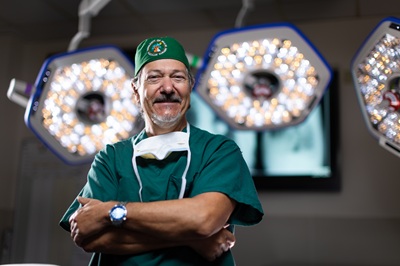
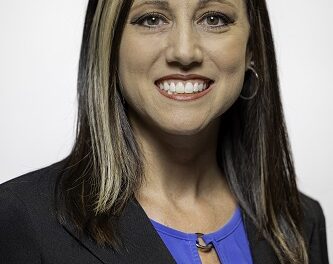
Dr. Jean Panneton
UHealth—University of Miami Health System has recently boosted its ability to treat aortic diseases, recruiting two world-class surgeons to lead its Comprehensive Aortic Center. Co-directed by vascular surgeon Jean Panneton, M.D., and cardiothoracic surgeon Ciro Amodio, M.D., associate professor in the DeWitt Daughtry Family Department of Surgery at the University of Miami Miller School of Medicine, the center unites multiple disciplines to treat aneurysms, dissections and valve issues.
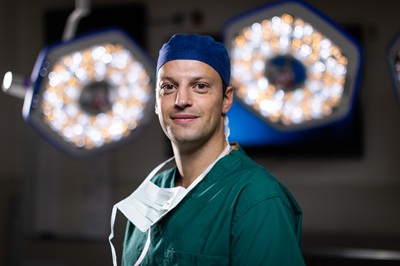
To complement the center, UHealth also opened a hybrid operating room, which leverages advanced imaging and other technologies to handle the most complex procedures. The end result is better care for patients with these urgent and often life-threatening conditions.
How Does a Hybrid Operating Room Improve Aortic Care?
Until relatively recently, catheterization procedures and open surgeries were separate specialties with distinct turfs. Working in catheterization labs, interventionalists or cardiologists leveraged minimally invasive techniques to treat arterial blockages, valve disorders and other issues. Surgeons conducted open procedures to perform bypass surgeries and repair aneurysms, dissections and other conditions.
But over the years, the distinctions between these disciplines have narrowed, creating the need for hybrid procedure rooms, where specialists can work side-by-side to simultaneously perform catheterization procedures and open surgeries. One of the hybrid room’s most important refinements is 3D fusion imaging.
“We take a CT scan of the patient and combine it with the fluoroscopy (moving x-rays), which give us 3D fusion imaging,” said Dr. Panneton, a professor in the DeWitt Daughtry Family Department of Surgery. “The images are so much clearer. It’s like night and day.”
Fusion imaging and other advanced technologies are giving cardiac and vascular teams the necessary tools to perform complex aortic reconstructions and provide care few other facilities can match. Recently, these tools helped surgeons at the Comprehensive Aortic Center perform complex procedures for the first time in South Florida.
New Aortic Procedures Available at UHealth
In April 2026, the U.S. Food & Drug Administration approved the NEXUS aortic arch stent graft, a safer way to repair aortic dissections and other high-risk aortic arch conditions.
“Because of our Comprehensive Aortic Center, we have tremendous expertise to take on these new procedures,” said Dr. Panneton. “This was the first Nexus implant in Florida, and it’s a less invasive way to do a total aortic arch replacement. It gives us a better way to repair aortic arch aneurysms, which tend to occur in elderly patients who are not necessarily good candidates for open heart surgery.”
Around the same time, Dr. Panneton performed another pair of minimally invasive procedures for the first time in Miami. These procedures rely on a technique called in situ laser fenestration, which was pioneered by Dr Panneton.
Using a catheter, a stent-graft is deployed inside the aorta to reline a blood vessel around an aneurysm or dissection. Then, surgeons use a laser to punch holes in the graft and reestablish blood flow to the important arteries that branch out from the aorta. These techniques recently helped two patients, one with a thoracoabdominal aortic aneurysm (a TAAA procedure) and the other an aortic arch aneurysm (a TEVAR procedure).
“We can do a thoracic endograft in the aortic arch, and we can revascularize the arch vessels, such as the subclavian artery (which sends blood to the arms and chest) and the carotid artery (which supplies the brain),” said Dr. Panneton. “We use the laser to revascularize them, and stents to reconnect them. It makes for a faster and more versatile procedure.”
What Could Minimally Invasive Treatment Mean for Recovery?
By combining intensive expertise and sophisticated technology, the Comprehensive Aortic Center is performing life-saving procedures many hospitals simply cannot provide. In addition, as new procedures and technologies come into play, the center will be well-situated to adopt them.
“We used to do open procedures for aneurysms and dissections, and people would spend two, three, four weeks in the hospital,” said Dr. Panneton. “Now people can go home two to four days after their procedures. These approaches are less invasive, safer and much easier on patients.”