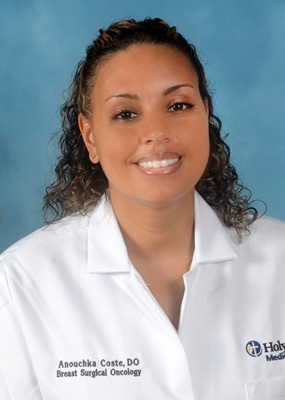
By Anouchka Coste Holt, DO
When discussing surgery with breast cancer patients, the conversation is often about much more than the cancer itself. Patients want to know what their options are, what recovery may look like and what they can expect after surgery.
Over the years, I have seen those questions become a larger part of the surgical discussion. While the goal of surgery remains the same, surgeons now have more ways to approach certain procedures, including techniques that may help address concerns about healing, recovery and scarring. That evolution has created an opportunity to look at procedures differently. Surgeons can consider whether there are ways to achieve the same surgical goals while approaching the procedure in a way that may be less disruptive to the patient. For breast surgery in particular, where changes to the body can have a lasting impact, those considerations can be meaningful.
I believe that is an important part of the progress we continue to see in breast surgery. New techniques should not replace established approaches simply because they are newer. They should give surgeons additional tools to consider when they are appropriate for a particular patient.
One of those options is minimally invasive endoscopic mastectomy. Using a high-definition camera and specialized endoscopic instruments, the procedure allows breast tissue to be removed through small, strategically placed incisions rather than the larger incisions traditionally associated with mastectomy.
For many women, healing and scarring are important parts of the conversation. Traditional mastectomy has often required larger incisions to access the surgical area. Endoscopic techniques take a different approach, using camera technology and specialized instruments to perform the procedure through smaller openings.
When clinically appropriate, endoscopic mastectomy is intended to minimize visible scarring, preserve the natural contour of the chest and reduce tissue disruption during surgery. For some patients, that may mean less postoperative discomfort, a shorter recovery time and improved cosmetic outcomes.
As breast surgery advances, the role of the surgeon continues to change as well. It is not simply about learning a new technique. It is about understanding when that technique can be used, when another approach may be more appropriate, and how to apply it safely and effectively. That requires careful patient evaluation, surgical planning and experience with the procedure.
I see this as an important part of where breast surgery is headed. Advances in technology can give surgeons more options, but good surgical care still comes down to judgment. The goal is to use the right technique for the right patient, rather than choosing an approach simply because it is newer.
Like any surgical procedure, endoscopic mastectomy is not right for everyone. Some women may be good candidates, while others may benefit from a different surgical plan. The right approach depends on the individual patient and the details of her diagnosis and treatment.
At the Michael and Dianne Bienes Comprehensive Cancer Center at Holy Cross Health, endoscopic mastectomy has become part of the conversation for some patients considering breast cancer surgery. It is one more option to discuss when deciding what approach makes the most sense for their treatment plan.
The most important part of the process is not choosing the newest procedure. It is choosing the approach that best treats the cancer while meeting the needs of the person behind the diagnosis.
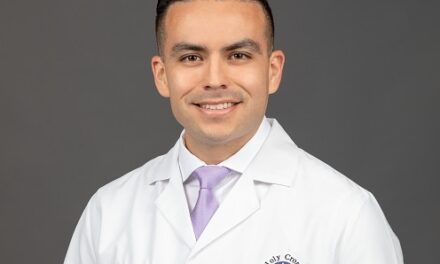
Dr. Anouchka Coste Holt is a Surgical Oncologist at Holy Cross Medical Group.