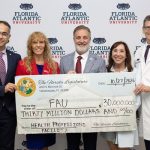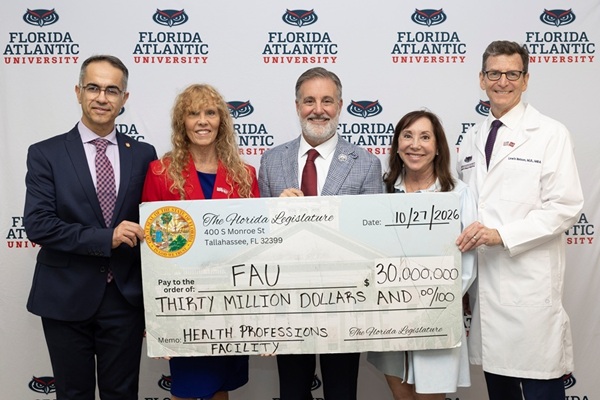
Oct. 29, 2026 – Florida Atlantic University has received $30 million in state funding from the Florida Legislature to advance plans for a 150,000-square-foot Health Professions Clinical Training and Research Facility on its Boca Raton campus. The facility will bring together students, faculty and researchers from FAU’s Charles E. Schmidt College of Medicine, Christine E. Lynn College of Nursing, and College of Social Work and Criminal Justice to expand health professions education, strengthen clinical training and advance patient-oriented research.
The funding includes $10 million secured in 2025 and an additional $20 million in 2026 through the advocacy of Florida Senate Minority Leader Lori Berman and State Rep. Peggy Gossett-Seidman (R-Highland Beach). The $30 million marks the first state funding secured for the project and establishes a significant foundation for the university’s next phase of planning.
“This investment marks an important commitment to Florida Atlantic and the state of Florida. We are deeply grateful for Gov. Ron DeSantis’ support and for the leadership of Sen. Lori Berman and Rep. Peggy Gossett-Seidman in advancing this project,” said FAU President Adam Hasner. “This facility will enhance the education and training of future doctors, nurses and social workers, foster research and clinical collaboration across disciplines, and position Florida Atlantic to meet the state’s growing healthcare needs.”
As the former majority leader of the Florida House of Representatives, Hasner championed the multi-year effort to secure funding and approvals to establish FAU’s independent medical school in 2010, helping lay the foundation to reshape healthcare in the region.
Unlike traditional facilities dedicated to a single academic discipline, FAU’s Health Professions Clinical Training and Research Facility will create an interprofessional environment where future physicians, nurses and social workers learn and train alongside one another. Although these professionals routinely collaborate in hospitals and other clinical settings, their education often takes place separately. By bringing students together before they enter the workforce, FAU aims to strengthen teamwork, improve coordination of care and better prepare graduates for the realities of modern healthcare.
“Bringing together students and faculty from multiple disciplines will create new opportunities for collaboration and discovery,” said Ken Dawson-Scully, Ph.D., FAU provost and executive vice president for academic affairs. “This facility will help prepare students to work across clinical professions to improve health and patient care.”
The facility will integrate experiential learning, patient engagement, clinical education and research, creating opportunities for students and faculty to collaborate across disciplines. Students in engineering, business and the humanities will also have opportunities to contribute to this interdisciplinary environment, connecting healthcare with technology, innovation and other fields.
The project also will expand FAU’s capacity to educate and train students in medicine, nursing and social work, supporting the university’s commitment to increase the number of graduates entering these essential professions. As Florida’s population grows and healthcare needs evolve, the facility will help strengthen the pipeline of qualified professionals available to serve communities throughout the state.
The building also will incorporate critical research infrastructure to support FAU’s work as a Carnegie-designated R1 research institution, reflecting the university’s capacity for high-level research activity. By bringing students, faculty and clinical partners into a shared environment, the facility will create new opportunities to connect research discoveries with clinical practice and patient care.
The project is expected to generate economic benefits beyond the university. Construction will support jobs in Florida, while expanded enrollment and training capacity will help produce more health professionals for the state’s workforce. Many of FAU’s graduates remain in the region to establish their careers, strengthening the university’s role in meeting South Florida’s workforce needs.
FAU will pursue additional state funding as well as philanthropic support by engaging community, business and civic leaders in advancing the project.
With the initial $30 million in state funding secured, FAU can begin planning for a facility designed to unite health professions education, clinical training and research in a collaborative setting. The university estimates that the building could be completed by early 2030, subject to funding and project development.
About Florida Atlantic University:
Florida Atlantic University is one of the nation’s fastest-rising public research universities, serving more than 32,000 students in South Florida. Ranked among the Top 100 Public Universities by U.S. News & World Report, Florida Atlantic is also one of only 13 institutions nationwide to hold Carnegie Foundation designations for R1 research, opportunity and community engagement. Guided by its strategic plan, “2031FAU: Where Tomorrow Begins,” the university is focused on delivering career-ready education and experiential learning, driving scholarly inquiry that creates healthier, safer and more prosperous communities, strengthening institutional excellence, and elevating its impact across South Florida and beyond. Florida Atlantic continues to advance its position as Florida’s first quantum university, integrating research, education and industry partnerships around next-generation computing technologies. Through other signature strengths in neuroscience and healthy aging, environmental, ocean and coastal innovation, and national defense and autonomous systems, Florida Atlantic expands knowledge, fuels economic opportunity and fulfills its mission as South Florida’s hometown university.