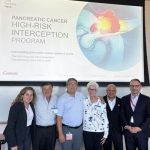
Florencia McAllister, M.D., William Reid, Michael P. Kim, M.D., Zelma Reid, Manoop S. Bhutani, M.D., and Matthew H.G. Katz, M.D., celebrate the Reid’s $10 million gift
Gift supports innovative research and builds on three decades of philanthropic support from the Reids
November 10, 2026 – The University of Texas MD Anderson Cancer Center today announced a $10 million commitment from longtime supporters Zelma and William Reid to establish the Pancreatic Cancer High-Risk Interception Program, which will focus on identifying innovative strategies for detecting and intervening against pancreatic cancer in individuals who are at elevated risk for the disease.
The collaborative program brings together a multidisciplinary team of experts at UT MD Anderson, co-led by Michael P. Kim, M.D., associate professor of Surgical Oncology, Manoop S. Bhutani, M.D., professor of Gastroenterology and Hepatology, and Florencia McAllister, M.D., professor of Gastrointestinal Medical Oncology and Genetics. Kim leads translational efforts focused on pancreatic cyst surveillance and surgical management. Bhutani is a recognized expert in pancreatic endoscopic diagnosis and early detection, and McAllister leads the care of individuals with inherited risk of pancreatic cancer and families with hereditary pancreatic cancer syndromes. Together, their expertise enables a seamless approach, from risk identification and screening to diagnosis, interception and treatment.
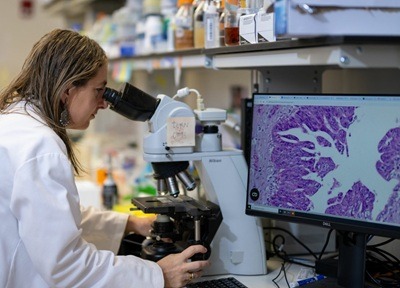
Florencia McAllister, M.D., examines pancreatic cancer cells under microscope.
“Philanthropic investments like this create opportunities to accelerate discoveries and pursue bold approaches to some of the most challenging cancers we face,” said Jeffrey E. Lee, M.D., president ad interim of UT MD Anderson. “We are deeply grateful to Zelma and Bill Reid for their generosity and enduring commitment. Their support will help advance innovative research aimed at intercepting pancreatic cancer earlier, when we have the greatest opportunity to improve outcomes for patients.”
Pancreatic cancer remains one of the deadliest forms of cancer, often because it is diagnosed after the disease has already advanced. Through the new program, Kim and colleagues will work to change that reality through novel approaches that identify individuals at increased risk, allowing physicians to intervene before cancer develops or spreads.
“The ultimate goal is to intercept pancreatic cancer development or to initiate treatment earlier in the disease process, when patients have the best chance for successful outcomes,” Kim said. “This gift will allow us to expand our research efforts, strengthen collaborations across disciplines and accelerate promising strategies to identify and intercept pancreatic cancer before it becomes life-threatening. We are incredibly thankful to the Reids for making this work possible.”
The Pancreatic Cancer High-Risk Interception Program will serve individuals at elevated risk for pancreatic cancer, providing expert evaluation, advanced imaging, molecular diagnostics and coordinated care. By combining artificial intelligence (AI)-driven risk assessment, next-generation DNA testing and personalized surveillance, the aim is to identify pancreatic cancer at its earliest and most treatable stages.
Leveraging world-class imaging technologies, sophisticated laboratory testing and decades of multidisciplinary expertise in pancreatic cancer, the program is designed to provide highly precise risk assessment, monitoring strategies and timely intervention when needed. For example, physicians will be able to accurately assess whether a pancreatic cyst is likely to develop into cancer, allowing them to intervene if necessary or spare patients from unnecessary treatments. Equally important, the program will expand access to specialized screening and prevention services, connecting more high-risk individuals and families to expert care before cancer develops or progresses.
A comprehensive biospecimen and data platform will support groundbreaking research into early detection and disease interception, while a robust training program will help develop future leaders in pancreatic cancer prevention. Together, these integrated capabilities represent a transformative shift toward detecting pancreatic cancer sooner, intercepting disease before it becomes life-threatening and advancing a future where more patients can benefit from precision prevention and early intervention.
For the Reids, the gift represents an investment in a future where fewer families experience the devastating impact of pancreatic cancer.
“For nearly 30 years, we have admired UT MD Anderson’s commitment to advancing research and improving patient care,” Zelma Reid said. “We are inspired by the work being led by Drs. Kim, Bhutani and McAllister, and we are honored to support a program that has the potential to intercept pancreatic cancer earlier and save more lives. We hope this investment helps create new possibilities for patients and families for generations to come.”