The High Stakes Negotiation and a Partnership Dance
By Richard Klass
St. Charles Health, a four-hospital system in central Oregon, is threatening PacificSource, HealthNet, WellCare and Humana with expulsion from its core of accepted third-party payors. Reimbursement rates are only one issue. Increased administrative burden, high denial rates, barriers causing patient transfer delays to appropriate care levels, and unresponsiveness to queries on claims status are all grievances not easily fixed.1

South Florida Market (Miami-Dade, Broward, Palm Beach Counties)
- This begs the question: Can South Florida Hospitals drop Medicare Advantage2 plans?
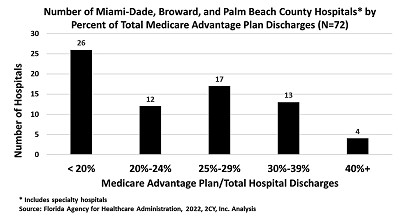
The latest data3 suggests South Florida hospitals overall depend too much on Medicare Advantage reimbursement for sustenance. Consider in Miami-Dade County, Advantage plan reimbursement accounts for 27% of all discharges and in Broward County it’s 24%. Dependence is less in Palm Beach County; 21%.
- Government (25%) and voluntary not-for-profit (23%) health systems are more reliant on Medicare Advantage plan reimbursement than the proprietary corporate owned entities (19%).
Some South Florida hospitals are much more dependent on Medicare Advantage payors than others. Consider four hospitals report 40% or more of their discharges are reimbursed by Medicare Advantage plans; 13 additional hospitals report 30% to 39% of their discharges are covered by Medicare Advantage.
There are hospital systems that enjoy sufficient market power to negotiate better deals with managed care entities.
- Some systems own all hospitals in a narrow geographic region and have strong reputations for quality care; patients prefer staying local and using nearby providers. Hospitals without similar market power face stiff competition from nearby facilities that are eager for more patient volume and managed care contracts.
- Historically, a few local healthcare systems moved to cutout just one specific managed care company.
- One south Florida hospital’s strategy is limiting a skirmish by threatening the elimination of just their physician network from the HMO’s provider panel. This strategy may proliferate in many Florida geographies with growing physician shortages in both primary and specialty care. Hospital systems that employ many physicians have significant market power to negotiate good reimbursement rates because managed care companies attract subscribers seeking a large, nearby, physician panel with reasonable appointment wait times.
– A negotiating limit for this tactic is traditional Medicare reimbursement may anchor the prices paid by Medicare Advantage plans for physician services.
The next wave of power negotiating with managed care entities will emanate from artificial intelligence (AI) solutions. AI in contract management offers opportunities to reduce human analysis requirements and in a fraction of the time:
- Suggest contract language changes to mitigate potential risks and unfavorable terms.
- Identify opportunities for contractual advantage.
- Calculate reimbursement rate trade-off scenarios often required for hospitals to maintain profit margins.
No doubt, managed care companies will also employ AI. This means healthcare systems must invest in this technology to maintain a good position in the negotiation and partnership dance.
1 S. Roig (8/19/23), Possible drop of Medicare Advantage coverage leaves St. Charles patients concerned, confused, The Bulletin.
2 Medicare Advantage, aka Medicare Part C, is an option to original Medicare coverage. Private insurance companies bundled Part A hospital coverage and Part B doctor/outpatient services and usually Part D prescription coverage into one comprehensive health insurance offering.
3 Florida Agency for Healthcare Administration, 2022 hospital discharge data.