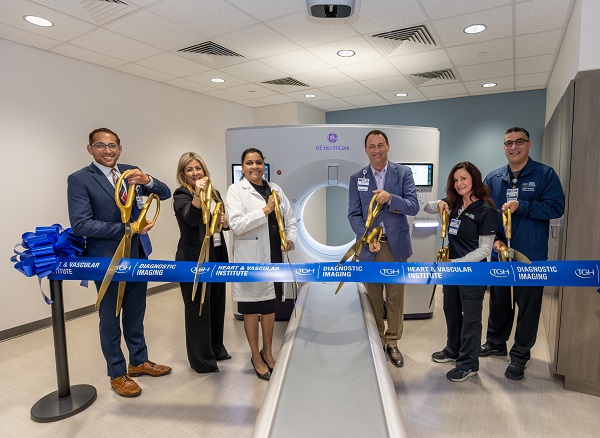
Tampa General Hospital celebrated the addition of two GE Healthcare Revolution APEX 512-Slice computed tomography (CT) scanners which leverage artificial intelligence (AI) and machine learning technologies to deliver faster, clearer and more precise scans.
Tampa General Hospital (TGH) is raising the bar for heart care with the addition of two GE Healthcare Revolution APEX 512-Slice computed tomography (CT) scanners. The advanced scanners leverage artificial intelligence (AI) and machine learning technologies to deliver faster, clearer and more precise scans, refining diagnoses and treatments of cardiovascular diseases.
The purchase of the scanners was made possible thanks to a generous gift by the Ferman family to the TGH Foundation. One is located at the TGH Ferman Family Imaging Center in Tampa General Hospital Diagnostic Imaging on the Davis Islands campus; the other is being used for inpatient examinations within the hospital itself.
“This technology is a game-changer for cardiac imaging at Tampa General,” remarked Dr. Shone Almeida, director of the Cardiac CT program at Tampa General and a faculty member of the USF Health Morsani College of Medicine. “With sharper images and faster scan times, we can diagnose heart disease with greater confidence, allowing cardiologists to make better treatment decisions and improve patient outcomes.”
The 512-slice CT scanner is a cornerstone of the TGH Cardiometabolic Disease Prevention Program, providing highly detailed images of the heart and coronary arteries. The program focuses on early detection, risk assessment and personalized interventions to prevent the progression of cardiovascular and metabolic diseases such as diabetes and obesity-related heart conditions.
The Revolution APEX CT scanner leverages advanced AI to enhance image quality and enable rapid scanning with motion correction — providing exceptional precision for complex cardiac and routine cases. Its ultra-high resolution is ideal for detailed visualization of cerebral blood vessels and musculoskeletal structures. By capturing larger areas of the body in a single rotation, the system helps to reduce the need for multiple scans and improves diagnostic accuracy with sharper, more precise, images. Additionally, faster scan times and dose-reduction technologies enhance patient safety and comfort, contributing to a more positive overall patient experience.