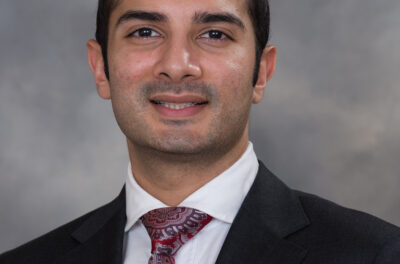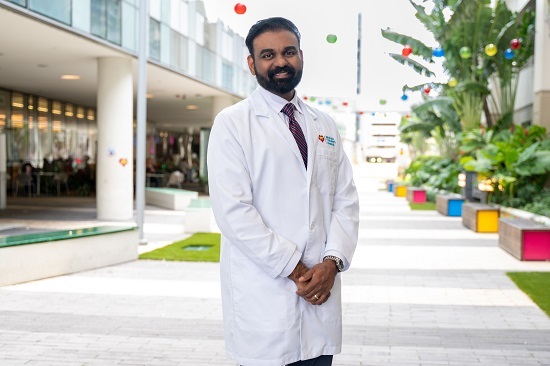
A pioneer in groundbreaking procedures for neonates and premature infants, Dr. Sathanandam is chief of cardiovascular medicine and co-director of the Nicklaus Children’s Heart Institute.
What interested you in specializing in pediatric interventional cardiology?
I began my career as an artist and that has deeply shaped the way I approach my work as a cardiologist. The discipline of art taught me how to work with fine detail and be precise with my hands. Early in my medical training I was captivated by the precision and potential of catheter-based interventions. It wasn’t until I saw the impact these procedures had on critically ill newborns who might not survive a traditional surgery, that I realized the power of this field. The idea that you could navigate the tiniest vessels of a premature infant’s heart and correct a life-threatening defect without ever opening the chest inspiring. Pediatric interventional cardiology is still at its infancy and is one of the most dynamic areas in medicine, driven by constant technological advances and collaborative problem-solving.
How has your research in clinical trials impacted the infant population?
The intersection of medicine and technology has been at the forefront of my work since early in my career. I served as a principal investigator for many clinical trials that resulted in FDA approval of life saving devices for newborns including the Amplatzer Piccolo Occluder, a transformative technology that enables bedside catheter-based closure of patent ductus arteriosus (PDA) in extremely premature infants, eliminating the need for surgery. I’ve also pioneered groundbreaking procedures for pulmonary flow reduction in neonates with complex congenital heart disease, and stent therapies for infants. In 2018, I executed and launched the International PDA Symposium, the first multispecialty global conference dedicated to advancing the management of Patent Ductus Arteriosus (PDA), a heart defect that can develop soon after birth and affects the way blood flows through a newborn’s lungs.
What is your approach to treating neonates and infants with complex congenital heart disease?
Every child is born with their own uniqueness and for the babies born with CHD, we take great pride at the Nicklaus Children’s Heart Institute in creating individualized and innovative treatment plans to ensure our patients live healthy lives beyond their childhood years. With a 97.5% survival rate for our heart surgery program, one of the best in the state, my team and I approach each case with strategic precision, always seeking the safest and most effective solution. Many times, we are able to use the least invasive approach, including many first-in-the-world procedures that were pioneered right here by our own cardiologists.
Most infants born with congenital heart disease require many surgeries in their early days of life. Can this be reduced?
Yes. I was a principal investigator in a clinical trial for specialized stent therapy which is a metal mesh tube that keeps blood vessels open for newborns, infants and children with narrowing in the aorta or pulmonary artery. Because the stent is made of expandable mesh, the device expands as the child grows which reduces surgeries needed. Solutions like stent therapy take into account the child’s growth as they age as well as the improved quality of life that comes from spending less time in a hospital.
Our journey with patients begins in the womb, through advanced fetal diagnosis and fetal cardiac interventions. Early detection allows us to plan for delivery and immediate postnatal care, giving newborns the best possible start. As children grow, we continue to offer minimally invasive catheter-based procedures to complex surgical interventions, tailored to needs. Since CHD is a lifelong condition, we also provide specialized care for adolescents and adults with congenital heart disease (ACHD), ensuring a smooth transition and continuity of care throughout every stage. While not all surgeries can be avoided, especially in the most complex cases, the future is promising. With ongoing clinical trials, evolving technology and a deep commitment to innovation, we are moving closer to a world where babies born with CHD face fewer surgeries, shorter recoveries and healthier lives.
How is virtual and augmented reality integrated in cardiac interventional procedures?
Virtual reality and augmented reality are becoming powerful tools in pediatric interventional cardiology, offering ways to enhance precision, planning, education and outcomes. Here at Nicklaus Children’s, we use VR and AR to aid with all procedural planning. One of the most impactful uses of VR and AR is in visualizing complex congenital heart anatomy before an intervention. These technologies allow our cardiologists and surgeons to create immersive 3D models and walk through the anatomy virtually, gaining a spatial understanding of structural abnormalities and simulate procedures, to determine the safest and most effective approach. We also utilize AR for real-time guidance during catheter-based interventions, including overlaying 3D anatomical structures onto the patient in the cath lab using AR headsets or displays.