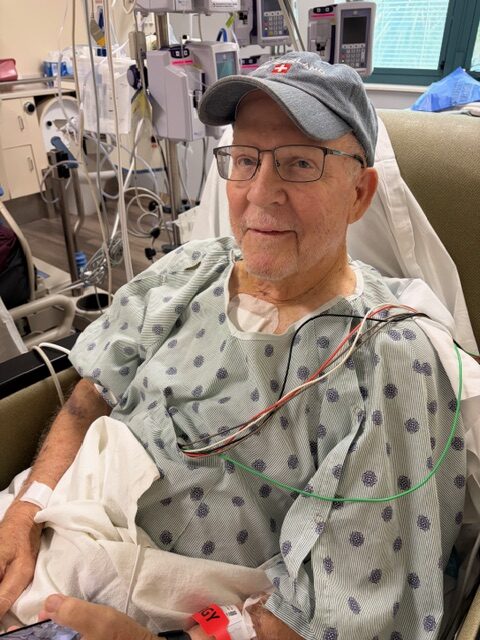
Active 81-year-old Broward Health cardiac patient receives life-saving care
March 25, 2026 – At 81, Parkland resident Larry Dorety is always active, playing tennis several times a week. A retired Silicon Valley computer industry executive who left the workforce at 51, Larry likes to joke that he has “more years of retirement than work, and I’m very good at it.” These days, his schedule revolves around travel with his wife and visits with children and grandchildren across the country.
But last December, Larry began noticing something seemed a little off.
“I found myself running out of breath and unable to continue playing tennis,” Larry recalled. “I’d tell my friends, ‘I’m sorry, I can’t do a second set.’ That’s not like me.”
The shortness of breath had been creeping up slowly until it became impossible to ignore. There was no dramatic chest pain or moment of collapse, just a steady loss of stamina that didn’t make sense for someone as active as he was.
A Diagnosis That Couldn’t Wait
Larry had been seeing a cardiologist at a nearby hospital and underwent a treadmill stress test and echocardiogram on January 2. The results weren’t reassuring, and the next step was a CT angiogram, but the earliest available appointment was mid-March.
“That didn’t feel right,” he says. “It felt more urgent than that.”
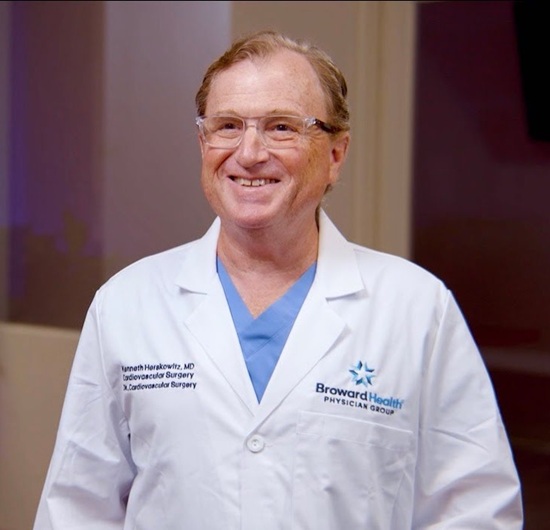
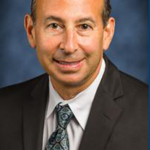
Kenneth Herskowitz, M.D.
Larry’s wife, a retired nurse, agreed. So did his stepdaughter, who works within the Broward Health system. His tennis buddies encouraged him not to wait.
Larry was soon undergoing a CT angiogram at Broward Health North under the care of Andre Landau, M.D., a Broward Health Physician Group cardiologist.
The scan revealed significant blockages, and on January 12 Larry returned for a cardiac catheterization procedure. The hope was that balloon angioplasty and stent could resolve the issue, but the blockages were too severe.
“Dr. Landau would not let me go home,” Larry said.
Within hours, Larry was transferred to Broward Health Medical Center, where Broward Health’s medical director of cardiovascular surgery, Kenneth Herskowitz, M.D., scheduled his procedure for January 14.
“Larry’s symptoms were subtle, but the blockages we discovered were significant,” said Dr. Herskowitz. “Cases like this are a reminder that heart disease doesn’t always present with dramatic warning signs. Paying attention to changes in stamina or breathing can lead to earlier diagnosis and better outcomes.”
A Complex Cardiac Procedure
Larry underwent quadruple bypass surgery, which reroutes blood flow around blocked coronary arteries to restore circulation to the heart. During the same operation, surgeons also performed an ablation to treat an abnormal heart rhythm and removed the left atrial appendage, a small pouch where blood clots can form and increase the risk of stroke. He jokingly refers to it as “a three-way tune-up.”
Larry spent eight days in the hospital before being discharged, and seven weeks after surgery, he is steadily regaining his strength. He has completed in-home physical therapy and is doing limited cardio and leg workouts while waiting a bit longer before resuming upper-body training.
“Dr. Herskowitz said I can do anything I want after eight weeks,” Larry said with a smile. “I’m not going to be quite so bold as to hit tennis balls on the 57th day — but I’ll be back.”
Doctors told Larry his heart muscle remains strong. The problem had been extensive calcified plaque buildup that created dangerous blockages in his coronary arteries.
“The team in the Cardiovascular Intensive Care Unit kept me on my toes, literally,” he said. “They helped me get up, walk the halls and do the things that are important early in the recovery process. I was well cared for in both hospitals.”
Larry was also impressed by the physicians who came by to check on him, including the electrophysiology team that evaluated whether he would need a pacemaker.
“They were at the top of their game,” Larry says. “They knew what they were talking about and could explain it to me.”
Now back home in Parkland with his wife, Larry is looking ahead to the future. He’s focused on resuming the life he enjoys most, which includes regular tennis matches with friends, travel and time with family.
Larry’s advice to others: “Listen to your body. If something feels different, don’t ignore it and don’t wait.”