June 11, 2026 – Health plans are projecting the highest medical cost trend in nearly two decades, with commercial healthcare cost trend expected to rise to 9% in 2027. The increase reflects the convergence of several powerful forces reshaping the healthcare landscape. These inflators include provider adoption of AI-enabled revenue optimization tools, growing provider reimbursement pressure, rising pharmacy spending, sustained growth in behavioral health utilization, and escalating out-of-network payment disputes under the No Surprises Act. Without macro health cost deflators, payers and employers face mounting pressure to act.
The challenge now is not simply understanding what is driving healthcare costs higher, but whether health plans can deploy cost-of-care strategies quickly and effectively enough to slow the trajectory before affordability, coverage, and access come under greater strain across the healthcare system.
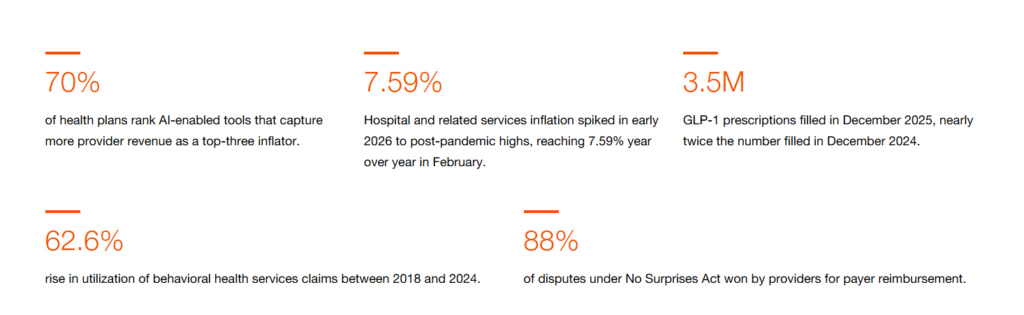
Health plans expect the cost of treating patients to climb in 2027 as five inflators increase medical cost trend to 9%:
- AI-enabled tools help providers capture more revenue.
- Inflation and provider consolidation drive up reimbursement rates.
- Pharmacy costs continue to increase.
- Behavioral health utilization keeps growing as mental health claims rise.
- The No Surprises Act arbitration process adds a new source of out-of-network reimbursement.
Together, these dynamics signal the urgency to find counterbalances to medical cost inflators in a healthcare system under constant affordability pressure.
For the fifth year, health plan actuaries we surveyed anticipate medical cost trends for the Group and Individual markets to remain elevated. Based on their input and our analysis, the Group medical cost trend is projected to be 9% in 2027. The Individual market trend is projected to be 8.5%. The study also supports a restatement of the Group and Individual trends up for 2026 from 8.5% and 7.5% to 9.0% and 8.5%, respectively.
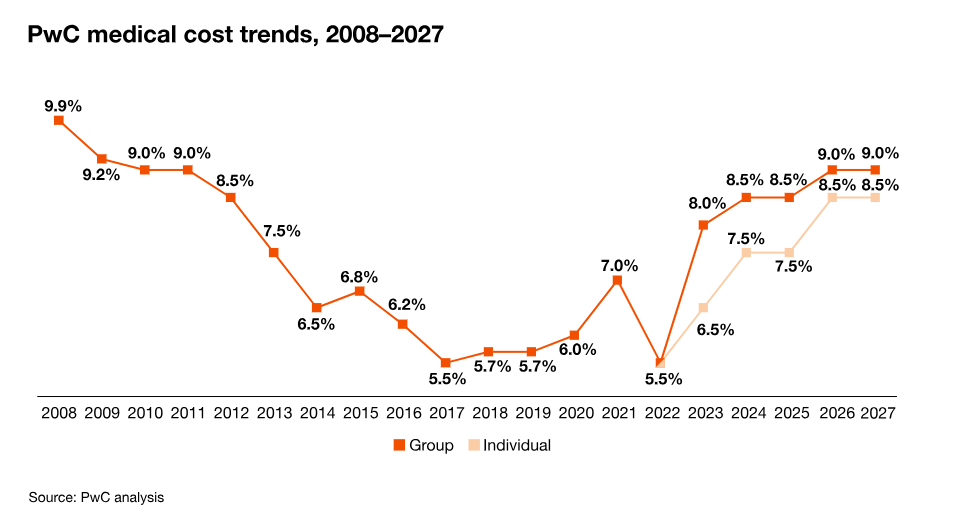
This trend is without the impact of expiration of enhanced subsidies in the ACA Individual market
Many of the forces driving the trend, including pharmaceutical innovation, expanded behavioral health access, and improved clinical documentation, can improve patient outcomes. The challenge for healthcare leaders is establishing that spending growth is matched by measurable value and affordability.
With medical cost trend nearing double digits, payers face the big squeeze.
Historical cost trend deflators—biosimilars, generic drugs, and site-of-care optimization—continue to play a role, but health plans are already incorporating those into their baseline cost assumptions. The external deflators are not enough to materially impact the rising cost trend.
Health plan claims and payment integrity, along with utilization management, can deliver near-term savings by reducing spending on services delivered outside the plan’s contracted network or care setting. Meanwhile, Rx management should prioritize governance of high-cost drug classes and medical-benefit therapies within the next plan year.
Over the longer term, network design and reimbursement remain the most critical levers for resetting the cost baseline. Quality and care management, in turn, can achieve the greatest impact when focused on areas where intervention impacts utilization, outcomes, or adherence.
For self-funded employers, this same framework holds. Large employers can drive greater discipline by linking vendor oversight, carrier performance, and benefit strategy directly to claims experience, trend reduction, and total cost of care.
See complete Report : CLICK HERE