By Barbara R. Fallon
Anyone who has ever channel surfed has caught a made-for-TV medical drama where ER doctors do everything from open heart surgery to handling security incidents to curing exotic diseases in a single episode.
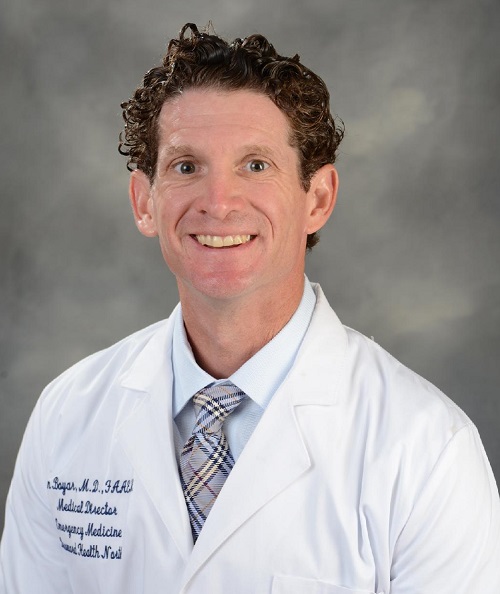
Evan Boyar, M.D., MSE, FAAEM
Evan Boyar, M.D., MSE, FAAEM, Chief of Staff for Broward Health North and District Chief of Emergency Medicine at Broward Health, describes a more accurate account of what it’s like in a high capacity hospital Emergency Department that from minute to minute may involve life-threatening trauma care, pandemic medicine protocols, emergency planning, weather and environmental related awareness, clinical teamwork, safety education; and, of course round-the-clock compassionate high-tech care for anyone from infants to seniors who needs sophisticated, immediate expertise after suffering a trauma. It’s the stuff that can make the TV storyline seem tame.
Response to Unique Locale and Demographics
For example, because of its unique location Broward Health North, near Port Everglades in Fort Lauderdale and Fort Lauderdale-Hollywood International Airport, is the receiving facility for trauma or other tertiary care needs for major illness from the islands where advanced lifesaving technology is not available.
“International Medicine requires technology that provides clear communications and readiness to handle severe injuries and illness even while the patient may still be airborne,” Dr. Boyar explained. “Also, our location which is close to highways and waterways, frequently provides scenarios for severe trauma from auto and air accidents and boating incidents,” he said.
Leisure living in the Fort Lauderdale area undeniably includes the dangers of children and pools and near drowning or heat-related construction worker emergencies along with typical on-the-job falls, cuts and mishaps.
Additionally due to the demographics which include significant senior, tourist, and immigrant populations, there can be age and cultural barriers that need to be addressed even when dealing with life-threatening illness and injury such as heart attacks, strokes, broken bones, and blunt trauma.
Dr. Boyar explained, “Older, frail patients who often suffer from several ailments and take a pharmacy of medications can present complex health hurdles and that may complicate a course of care when seconds count.”
Also, language and cultural barriers can present serious consequences to a seemingly straight-forward care plan. Broward Health has considered the consequences of miscommunications and has a solution.
“Since we live and work in a melting pot of Haitian Creole, Eastern European and French-Canadian influences we use a robust audio/visual program at our fingertips to translate degrees of symptom severity, share stat consults on iPads and accelerate pre-hospital knowledge in order to understand patients and translate to them and their families and the first responder pre-hospital caretakers regarding the appropriate treatment,” according to Dr. Boyar.
Health Watch for Caregivers
Naturally, all the above—and more—require a clinical readiness above the gold standard. However, maintaining that level of expertise and care delivery 24/7 can take a toll on the front-line heroes who can suffer from a type of combat fatigue. To avoid this, Dr. Boyar describes comprehensive safety protocols to protect staff while on-shift and intense behavioral checklists to gauge their wellbeing in the aftermath of tragedies like mass shooting incidents, domestic, child and sexual abuse cases, and other societal ills that often present in the Emergency Department as causal diagnoses.
“Opportunities for recuperative time off, staggered shifts, counseling, therapy, professional intervention and coaching is practiced which encourages nurses, doctors, residents and all ancillary caregivers including our first responders in the field to follow wellness guidelines,” Dr. Boyar said. “We coach our staff regarding mental health tips to check their own well-being for tell-tale signs of fatigue or clues of burnout and offer other opportunities to continue emergency careers without endangering their own mental or physical health,” he explained.
According to Dr. Boyar, the field of emergency medicine is popular because it offers work schedules amenable to providers, minus the need to get entangled in the business side of a medical practice. However, when burnout threatens there are still vital hands-on administrative input roles for emergency medical planning such as preparation for weather related catastrophes, active shooter incidents and unexpected work calamities. An annual hazard vulnerability check is mandatory and regular drills followed by analysis and a sharing of best practices help formulate process improvements and improved readiness. Broward Health has frequently participated in collegial conferences with other hospitals regarding lessons learned in the aftermath of tragic incidents.
A Look Forward
Looking toward the future, Dr. Boyar predicts an accelerated trend to marry all the stages of emergency and trauma care delivery. “Using diagnostic and monitoring technology during pre-hospital care to ED and intensive care through post hospital at-home care will enable us to elevate trauma and emergency care to a higher lifesaving level and improve patient outcomes. We will be able to diagnose earlier, treat immediately – often in the field – and monitor follow-up care with remote communications, advanced imaging, bio markers and telehealth options. We already converse with stakeholders to enable specialists on-call to evaluate rapidly, advance treatments and stimulate speed to care that saves lives,” he concluded.
To learn more about Broward Health’s Emergency Services, visit BrowardHealth.org/Emergency, call (954) 759-7500 or email eboyar@browardhealth.org.