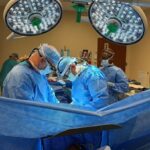


Dr. Michael Marsh
By Sue MacDonald
A flurry of advances in identifying suspicious lesions in the lungs and treating lung cancer early in the disease process are giving hope to patients who are risk of dying from the most common cause of cancer-related death among U.S. men and women.
Available at Jupiter Medical Center, these advancements in screening, diagnostics and treatment include robotic technologies that identify lung cancer much earlier in the disease process, and imaging and tissue-sampling technologies that provide important details about the nature of the cancerous tissue.
Combined, they allow lung specialists to fine-tune effective treatments that can lengthen the lives of cancer patients.
“In the past 10-15 years we have seen a lot more advances in pulmonology,” says Dr. Michael Marsh, a lung specialist who joined to the Jupiter Medical Center pulmonology team in late 2024 after serving as a cancer liaison physician and lung nodule clinic director at other Florida hospitals. “The paradigm has significantly shifted over the past decade because of these technologies. Today, we are finding smaller lung lesions, detecting them earlier and curing people with lung cancer earlier in the disease process.”
Earlier diagnosis, targeted treatments
The specific technologies at Jupiter that support earlier diagnosis and streamlined, state-of-the-art care, include:
- Ion robotic bronchoscopy, a navigational technology that enables precise, minimally invasive access to small, hard-to-reach lesions in the lung, allowing cancer to be detected earlier with fewer complications than legacy methods, such as CT-guided biopsy. “Lung cancer symptoms usually don’t start until the later III or IV stages, and by then you’re looking at managing the cancer rather than curing it,” says Dr. Marsh. The older CT approach involves inserting a tiny needle through the skin, muscles, lining of the lung and lung itself to extract cells for examination, and it remains a valid tool for some types of lung cancer. “The newer ion robotic bronchoscopy helps us find these tiny lesions in the lung early — from millimeters to a centimeter or two — and that’s when cancer’s very treatable and even curable.”
- Cone beam CT imaging, which relies on a computerized arm that rotates around the patient and provides a real-time, three-dimensional image of suspicious lesions in the lung. The benefit? This technology increases the both the accuracy of diagnosis and the safety of sampling suspicious nodules/tissue for further examination. Jupiter Medical Center is one of a handful of Florida hospitals that offer CT cone beam imaging, says Dr. Marsh.
- Cryobiopsy deploys a tiny flexible probe that locates and freezes suspicious lung tissue, which is then removed to be examined for cancer. Cryobiopsy provides larger, higher-quality tissue samples, and it also helps improve diagnostic accuracy and inform targeted treatments, notes Dr. Marsh.
“Game-changing” technology
The benefit for patients with lung cancer are many, says Dr. Marsh, who chose pulmonology as his specialty because his grandparents — both of whom were smokers — died from lung cancer within a year of each other while he was in medical school. He is now an experienced lung cancer specialist.
“The robotic bronchoscopy platform is a game changer, allowing us to reach lesions in the lung that we previously could not access, and it offers a minimally invasive approach,” says Dr. Marsh. “It also carries a significantly lower chance of complication compared to legacy forms of biopsy, such as CT-guided peripheral needle biopsies. Those approaches have a relatively high occurrence — up to 20%, in some cases — of a collapsed lung or bleeding.
“By comparison, the chance of complications with the ion robotic bronchoscope is 4% or less,” he adds, “and my personal rate of complication is less than 1.6%.”
For information about lung cancer diagnosis and treatment, or to schedule a next-day oncology appointment for a newly diagnosed cancer, contact the Jupiter Medical Center Lung Center of Excellence at The Anderson Family Cancer Institute at (561) 263-4400.