

Delray Medical Center is the first hospital in Florida to treat an Alzheimer’s disease patient using non-invasive focused ultrasound technology as part of a groundbreaking study being conducted in collaboration with Florida Atlantic University’s (FAU) Institute for Human Health and Disease Intervention.
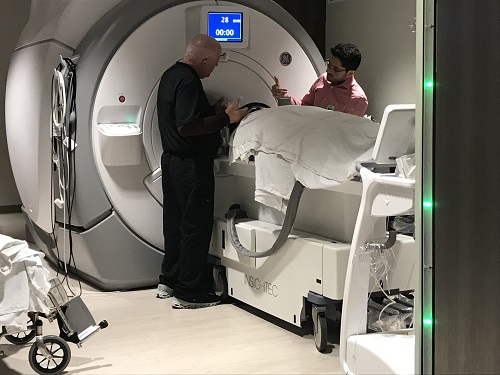
In the FDA-approved clinical trial, focused ultrasound technology is used to disrupt the blood-brain barrier in participating Alzheimer’s patients. Alzheimer’s may be caused by a buildup of certain proteins in the brain. Precisely guided by magnetic-resonance imaging, ultrasound waves are directed at specific areas of the patient’s brain to create a temporary opening in the blood-brain barrier where the protein buildup may be reduced. The Delray Medical Center patient enrolled in the clinical trial received the first of three treatments at the hospital on Feb. 15.
“Delray Medical Center is proud and excited to be a leader in this effort to determine the safety and efficacy of this potentially revolutionary treatment for Alzheimer’s patients,” said Lloyd Zucker, M.D., FAANS, a board-certified neurosurgeon and Medical Director of Neurosurgery at Delray Medical Center. “The study will help determine whether the use of this non-invasive focused ultrasound technology can lead to cognitive improvement in patients with Alzheimer’s disease.”
“Drug passage through the blood-brain barrier is perhaps one of the greatest challenges in neurology,” said Gregg Fields, PhD, Executive Director, Florida Atlantic University’s Institute for Human Health and Disease Intervention (I-Health), a professor of chemistry and biochemistry in FAU’s Charles E. Schmidt College of Science, and the program director for the project. “The treatment of the first patient in Florida with the non-invasive focused ultrasound technology represents a significant advancement for potential drug delivery and treatment of Alzheimer’s disease and other neurological disorders. In tandem, we are also working on non-invasive, blood-based monitoring to determine if treatments are effective.”
The clinical trial, called ExAblate Blood-Brain Barrier (BBB) Disruption for the Treatment of Alzheimer’s Disease, is designed to evaluate the safety and efficacy of Insightec’s ExAblate Model 4000 Type 2.0 System as a tool for disrupting the blood-brain barrier in probable Alzheimer’s patients. The study, part of Florida’s Brain State initiative, is being conducted at up to eight sites in the country. Patients who meet the specific study criteria receive three focused ultrasound treatments, two weeks apart, and will be followed for five years after the final procedure.
The Insightec technology has already been shown to be effective in treating patients with Parkinson’s Disease and essential tremor, a neurological disorder that causes involuntary trembling of the head and hands, preventing people with the condition from performing simple tasks, such as drinking from a glass or tying shoelaces.