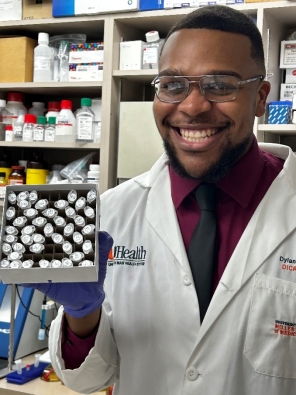
Dylan Thompson is used to feeling out of place. In his hometown of Brandon, MS, he was one of the only Black students in his advanced high school classes. When he started at the University of Miami in 2021 with dreams of becoming a doctor, he again found himself as one of the only Black students in his pre-med classes.
“I feel like every person I talk to that is white, they’re like, ‘My mom is a surgeon, my dad is this, my grandfather is that,’” Thompson said. “To them it’s almost like a birthright, whereas I don’t know any of this stuff. I’m trying to figure this out day by day, I’m trying to get as much help as I can from people who look like me who are older than me and have done this.”
Relief came for Thompson in the form of the Diversity in Cancer Research (DICR) Internship Program, which is funded by the American Cancer Society (ACS) and run by Sylvester Comprehensive Cancer Center, part of the University of Miami Miller School of Medicine. Launched in 2023, the program is designed to give undergraduate college students from under-represented communities exposure and experience in the hopes of increasing diversity among cancer researchers.
Diverse Interns
Sylvester received funding from the ACS to train eight interns from institutions throughout Florida. At first, Sylvester officials wondered if they’d get enough applicants to fill those slots. Then they received so many – more than 80 – that the center decided to fund four additional interns, bringing the inaugural class of DICR interns to 12.
“Our experience with this first application cycle demonstrated the incredible need and demand for this type of program,” said Sophia George, Ph.D., an associate professor of obstetrics, gynecology, and reproductive services and the first associate director of diversity, equity and inclusion (DEI) at Sylvester. “Until health equity is achieved, there will always be a need for more programs like this.”
Joseph Rosenblatt, M.D., professor of medicine and microbiology and immunology and the principal investigator overseeing the DICR program, hopes the program will push more minority students into cancer specialties because they can most directly help their communities. “Physicians and researchers from underrepresented groups are more likely to practice in and investigate issues that affect underserved communities,” he said.
Thompson is proof of that. The 20-year-old rising junior at UM said his goal is to become a urologist after seeing so many Black men and women in Mississippi suffer from urinary tract diseases but not seeking out medical care due to fear or financial limitations.
“They’re scared to go in because nobody looks like them,” Thompson said. “If I can be that face and treat these things that could easily be fixed, I feel like it’ll make a good impact on my community.”
The DICR program is the latest addition to the summer programs offered by the Sylvester Office of Education and Training. To learn more about DICR and other programs, visit https://umiamihealth.org/en/sylvester-comprehensive-cancer-center/research/education-and-training/high-school-students-and-undergraduates.