The long-time Miller School gastroenterologist says she’s ready to lead her specialty into the future by addressing physicians’ quality of life issues, patient access to quality care and much more.
By Lisette Hilton
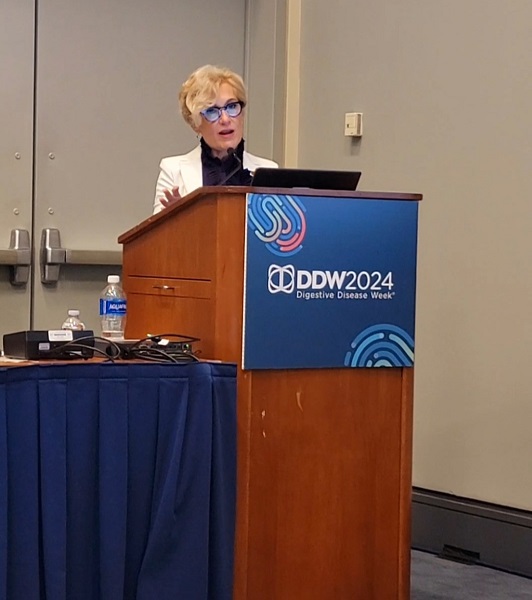
Maria T. Abreu, M.D., director of the Crohn’s and Colitis Center and professor of medicine, microbiology and immunology at the University of Miami Miller School of Medicine, assumes the role of president of the American Gastroenterological Association (AGA) soon after the May 18-21 DDW (Digestive Disease Week) in Washington, D.C. The official announcement of her year-long presidency will be May 30.
While Dr. Abreu, the first Latina to take the AGA’s helm, has worked her way to this pinnacle position in the specialty, becoming the Association’s president is no small accomplishment. Founded in 1897, today’s AGA has more than 16,000 members worldwide who engage in the science, practice and advancement of gastroenterology. And with more than 13,000 attendees, 4,300 oral abstract and poster presentations and 400 original lecture sessions, DDW is the world’s premier gathering of gastroenterology clinicians, researchers and industry.
Still, Dr. Abreu says she’s ready to tackle the job at hand and colleagues agree.
“I am thrilled to pass on the baton to Maria. She is witty, caring and innovative. Whether on the dance floor or in the board room, she is sure to mix things up,” said immediate-past AGA President Barbara Jung, M.D., professor and Robert G. Petersdorf Endowed Chair in Medicine at University of Washington Medicine. “I feel privileged to be her colleague and friend.”
Top of Mind: Breathing Life into the GI Specialty
Dr. Abreu said she’s always thinking of how to make things better.
“I’ve given a lot of thought to the things that are highly important to our GI society for its continued success. Success is measured by the success of our members and the ability of members to be productive, successful–not burned out but excited to be gastroenterologists,” she said.
Challenging workforce issues to overcome include an epidemic of gastroenterologists and other physicians who are leaving medicine because they’re unhappy.
“Professional societies—especially ours—have an opportunity to try to alleviate that burden by helping fight some battles, smooth some surfaces, so that everyone can have a better life. The solutions are multipronged,” Dr. Abreu said.
One of those prongs is to address the significant increase in women gastroenterologists, which Dr. Abreu said calls for being thoughtful about how to help private and academic practices have adequate parental leaves and flexible schedules for gastroenterologists with young families.
Pay and leadership are other issues.
Making pay scales standard or transparent, whether people join private, hospital or academic practices is important.
AGA is well underway with annual programming for women to develop leadership skills to help them run large practices, Dr. Abreu said.
In a world more defined by working for private equity firms than privately owned GI practices, Dr. Abreu’s interest is to make sure women and men in the specialty are armed with what they need to maintain private practices that they control.
“A model that has surged in the last several years in medicine in general has been to have advanced practice providers (APPs)–nurse practitioners or physician assistants working in a field,” Dr. Abreu said. “When they graduate, by and large, they are undifferentiated. They have a base of knowledge but not specific knowledge of a field, which in this case is gastroenterology or hepatology.”
Most APPs today are women, so the theme of making the GI world a better place for women applies, as well as how to standardize their training in the specialty.
“The way it stands right now, most GI practices even in academia have no particular training plan in place. We need to focus on how to train and get these APPs ready to take care of GI patients as quickly and effectively as possible,” Dr. Abreu said.
The AGA is working on developing onboarding processes to help the APPs and doctors, she said.
The APP workforce, in turn, can help alleviate backlogs in the office-based care of GI patients, leaving gastroenterologists to focus more on procedures, such as colonoscopies. One particularly critical area of GI that’s in short supply is long-term care for chronic illnesses, like Crohn’s and colitis.
“These are patients that have the disease for a lifetime. In the absence of a cure, they need good care and monitoring, with someone they can reach out to if they have a problem, so we can react proactively. That’s a great use of APPs and a great opportunity for the AGA to provide the best training,” Dr. Abreu said.
Another focus during her year as AGA president will be to improve DDW, to better serve attendees and those who participate.
“DDW is a meeting that we share with other partner GI societies that also participate. We want to make it a more streamlined, dynamic experience for the participant,” she said. “After COVID, anyone could watch something on Zoom and get CME credits. This isn’t about that. This is about the full experience. It’s about having the time for the human interaction yet also making it purposeful busy gastroenterologists to learn and not be stressed about attending.”
The Big Picture
Advocating for the specialty at the congressional level is among Dr. Abreu’s passions.
AGA is the only GI society that has a political action committee (PAC). AGA also has an active government affairs group that tries to support, generally in a bipartisan way, those representatives and senators that have an interest in the crushing administrative burden of prior authorization with medication and screening colonoscopy coverage, she said.
“These are long-lived projects on which we need to work methodically over years,” Dr. Abreu said. “AGA led the success in eliminating copays for screening colonoscopy.”
Inspiring Others
Dr. Abreu says her strength as a leader—whether to lead an academic department or the largest gastroenterology society in the nation—is her ability to connect with people.
“I am able to work collaboratively to get something done. It isn’t ever about what I want for me but rather what is best for the group and finding alignment among people,” Dr. Abreu said. ”I also have been accused of having a lot of energy. I do need to narrow the focus of what I need to get accomplished in order to be effective, but I also don’t want to lowball it because I know I can get things done.”
Sandra Quezada, M.D., M.S., professor of medicine in the division of gastroenterology and hepatology at University of Maryland School of Medicine, experienced this firsthand as a GI fellow about 15 years ago.
“Dr. Abreu was the first and only Latina gastroenterology attending I had ever met, and frankly, there haven’t been many others since then,” said Dr. Quezada, whose roles with AGA include cochair of the AGA Equity Project. “Her energy, enthusiasm, and authenticity as a strong Latina woman in the field was and remains absolutely inspiring and validating. She is paving the way for all of us and setting new standards for leadership in our profession. I can’t wait for her to leave her mark as President of AGA!”