
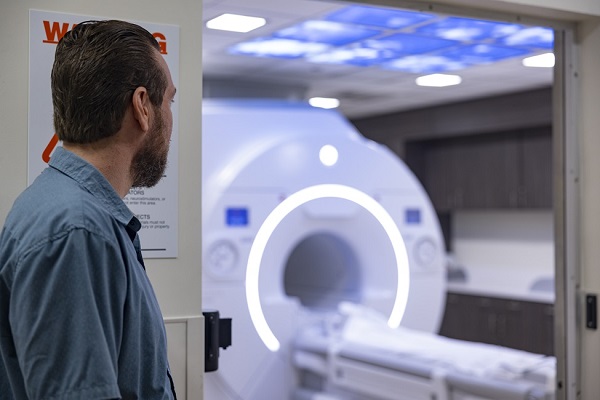


Florida Atlantic University has added a new state-of-the-art Magnetic Resonance Imaging (MRI) system to its research infrastructure. This cutting-edge technology marks a transformative step forward for FAU’s research capabilities, enabling groundbreaking studies in neuroscience, clinical health and medical advancements.
“We are thrilled to introduce this advanced MRI system at Florida Atlantic,” said Gregg Fields, Ph.D., FAU vice president for research. “This technology positions our institution at the forefront of interdisciplinary research, enabling us to explore the complexities of the human brain and body with unprecedented precision. MRI supports research into the effects of therapies and pharmacological agents, enabling the evaluation of treatment efficacy, prognosis, and therapeutic planning. This combination of structural and functional capabilities makes brain MRI an indispensable tool in modern neuroscience and clinical practice.”
FAU has acquired the SIGNA™ Premier 3.0T MRI from GE Healthcare, offering advanced imaging technology and patient-focused design. With a 3 Tesla magnet, it provides high-resolution imaging for complex diagnoses. Its SuperG gradients ensure precise imaging across various clinical applications. The 70-centimeter-wide bore enhances patient comfort, reducing claustrophobia, while Quiet Technology minimizes scan noise. The SIGNA Premier supports a wide range of imaging needs, from neurological to musculoskeletal scans, with advanced modes like fMRI, MRA and Diffusion-Weighted Imaging.
FAU researchers also can take advantage of the NordicNeuroLab fMRI System, a sophisticated, all-in-one solution designed to simplify the integration of functional MRI (fMRI) into clinical and research environments. By incorporating advanced tools for audio-visual stimulation, eye tracking and patient response collection, the system supports precise and efficient neuroimaging analysis. The MRI system also includes an in-scanner BrainVision electroencephalography (EEG), as well as a Biopac system for electrocardiography (ECG), electromyography (EMG) and electrodermal activity (EDA).
This new research facility is designed to foster interdisciplinary collaboration among FAU’s faculty and students, offering researchers the ability to integrate MRI technology with other techniques. The integration of EEG and fMRI will allow researchers to explore neural dynamics in conditions such as epilepsy, sleep disorders and cognitive impairments.
“The new MRI system will empower FAU researchers to investigate a broad range of physiological and neurological processes. With its ability to provide both high-resolution structural and functional imaging, the system will support diverse research areas, including mental health disorders such as depression, anxiety, chronic pain and fatigue, as well as physiological conditions related to cardiac, gastrointestinal and musculoskeletal health,” said Andrew Newberg, M.D., a neuroscientist and FAU MRI medical director.
The addition of the new MRI system also plays a crucial role in evaluating the efficacy of therapies and understanding the mechanisms underlying various diseases and treatments.























