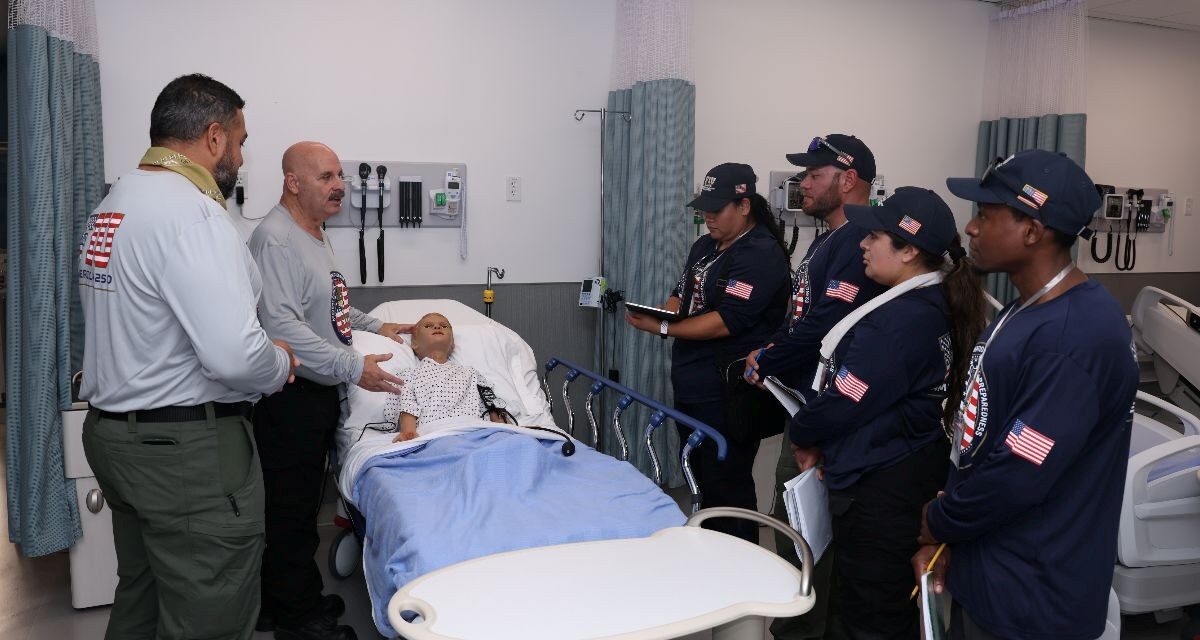
Instructors Jose Perdomo from Nicklaus Children’s Health System and Jonathan Urtecho from Baptist Health lead graduate students through a hospital emergency management scenario at the Diane Ramy Faulconer STAR Center on FIU’s Biscayne Bay Campus during the Academy for International Disaster Preparedness disaster field exercise. (Photographer: Cristina Sullivan)
This year’s simulation explores how disaster response lessons could apply to Cuba during a future transition environment
May 14, 2026 – Florida International University kicked off its annual Disaster Field Operations Exercise today at the Biscayne Bay Campus, bringing together graduate students, emergency responders and community partners for a full-scale simulation focused on disaster response in domestic and international environments.
Led by FIU’s Academy for International Disaster Preparedness, part of the Robert Stempel College of Public Health & Social Work, the two-day exercise gives approximately 50 students the opportunity to move from classroom theory to field operations. They were joined by 50 volunteers and representatives from over 25 participating agencies and organizations.
“Disasters are unpredictable, and emergency managers must be ready to respond wherever their expertise is needed,” said Javier I. Marques, senior vice president, chief of staff and executive director for FIU’s Academy for International Disaster Preparedness.
Students are being tested on their ability to assess needs, coordinate resources, manage logistics and support response and recovery efforts. On Thursday, students responded to a simulated disaster in the United States. On Friday, the exercise shifts to an international scenario involving a major hurricane striking Cuba, a situation that could have implications for disaster response teams supporting the island during a theoretical period of government transition.
“For South Florida, Cuba is not an abstract international scenario. It is a neighboring island with deep cultural, family and humanitarian ties to our region,” said Dulce M. Suarez, assistant director of FIU’s Academy for International Disaster Preparedness. “By including this type of scenario, we are helping students understand how disaster response could unfold in a complex environment where coordination, cultural awareness and humanitarian principles are essential.”
The Cuba scenario is designed to prepare students for operational challenges that could arise in a post-communist Cuba, when disaster response could require coordination among local, state, federal and international partners. Given South Florida’s proximity to Cuba and its ties to the Cuban people, the simulation asks students to consider how emergency response could unfold in a Caribbean disaster requiring international coordination.
Throughout the exercise, students are practicing international disaster management standards, needs assessments, civil-military coordination, humanitarian logistics, ethical aid distribution, public health response and recovery planning. The scenario also emphasizes respect for culture, sovereignty, humanitarian principles and the needs of affected populations.
“As someone working in law enforcement, I see how often local response connects to international situations,” said Nubia Azrak, a student in the program and a lieutenant with the Miami-Dade Sheriff’s Office. “The hands-on nature of this exercise is what makes it so valuable. You are physically and mentally immersed in the crisis, working alongside others, learning from their expertise and understanding how every role contributes to the larger response.”
This year’s exercise also places FIU’s work in disaster preparedness, public service and community resilience within the context of America 250. Florida’s experience with hurricanes, flooding and public health emergencies has made the state an important part of the country’s preparedness and resilience efforts. Through this exercise, FIU reinforces the importance of readiness, coordination and service while training the next generation of disaster management leaders.
“Preparing students for disaster response is part of FIU’s responsibility as a public university serving Florida and the region,” said Tomás R. Guilarte, dean of FIU Robert Stempel College of Public Health & Social Work. “This exercise reflects the connection between public health, public service and applied training, and how those areas come together to strengthen communities and prepare future leaders to respond when they are needed most.”
Representatives from participating agencies and organizations include FIU Operations and Safety, FIU Parking, Sustainability and Transportation, FIU Facilities, FIU Police Department, FIU Board of Trustees, Miami-Dade Fire Rescue Marine Operations, Miami-Dade County Department of Emergency Management, Miami-Dade Sheriff’s Office, AT&T, Nicklaus Children’s Hospital, Florida Division of Emergency Management (FDEM), University of Miami Global Institute for Community Health and Development, HOPE Animal-Assisted Crisis Response, Florida Fish and Wildlife Conservation Commission (FWC), Miami Beach Fire Department, Baptist Health South Florida, Global Empowerment Mission (GEM), Coral Gables Fire Department, U.S. Army, Florida State Guard, Team Rubicon, Guy Fieri Foundation, Florida Highway Patrol (FHP), Broward Sheriff’s Office (BSO), City of Miami Police Department, Federal Bureau of Investigation (FBI), United States Marine Corps 4th Civil Affairs Group, U.S. Southern Command (SOUTHCOM), City of Miami Department of Fire-Rescue, and Tiger Dam.
About FIU’s Academy for International Disaster Preparedness:
The Academy for International Disaster Preparedness (AIDP) at the FIU Robert Stempel College of Public Health & Social Work focuses on a comprehensive educational foundation in disaster management and emergency medical services. The disaster field course is offered by AIDP through its intensive graduate degree program, which equips future disaster responders with practical skills. Since the program’s inception in 2015, AIDP has graduated over 300 students, many of whom hold key emergency management roles across local, state, and federal agencies, non-governmental organizations and the private sector. AIDP ranks No. 9 for best program in emergency management by U.S. News & World Report. For more information about Florida International University’s Academy for International Disaster Preparedness, visit: aidp.fiu.edu.
About FIU:
Florida International University is a Top 50, preeminent public research university with 55,000 students from all 50 states and more than 140 countries, as well as an alumni network of more than 340,000. Located in the global city of Miami, the university offers more than 200 degree programs at the undergraduate, graduate and professional levels, including medicine and law. FIU faculty are leaders in their fields and include National Academy members, Fulbright Scholars, and MacArthur Genius Fellows. A Carnegie R1 institution, FIU drives impactful research in environmental resilience, health, and technology and innovation. Home to the Wall of Wind and Institute of Environment, FIU stands at the forefront of discovery and innovation. With a focus on student success, economic mobility and community engagement, FIU is redefining what it means to be a public research university.