By Michelle Marsh
Federal regulations governing hospital Price Transparency started January 1, 2021. The regulations mandate hospitals publish consumer-friendly displays of shoppable services in a comprehensive machine-readable format.
Research shows patient engagement with related hospital portals is remarkably low. At best, 12% of the eligible population use available data to shop for care.1 Low utilization of hospital pricing portals stems from lack of consumer awareness, difficulty in finding and accessing information, inconsistency in data presentation between providers, consumer indifference because their hospital stay is totally or mostly covered by insurance, unwillingness to change physician or hospital of first choice based on price, and likely many other reasons.
Users of hospital price transparency data other than consumers are benefiting at hospital expense. Consider:
- Companies like Turquoise Health developed online cost-estimators and raised $30 million in funding.2
- Self-funded employers are increasingly leveraging public payer-negotiated rate data to scrutinize insurance company charges. A Rand Report highlights how these employers use price transparency data to evaluate whether the rates negotiated on their behalf are truly competitive with broader market averages.3
- Policy makers like RAND and the Kaiser Family Foundation use price transparency data to understand price variations, and market dynamics as they work to promote effective healthcare policies.
- Any entity interested in conducting competitive intelligence.
CMS Enforcement
Yet, hospitals are forced to comply with CMS requirements. CMS is enforcing the price transparency rule!
- Depending on bed count, penalties for non-compliance can range from $300 to $5,500 per day, which can total anywhere from $109,500 to over $2,007,500 annually per hospital.4
Outcomes from CMS investigations yield one of several notifications:
- Met requirements and no deficiencies were cited.
- Deficiencies were found and submission of a corrective action plan (CAP) is required.
- Closure notice indicating deficiencies were corrected.
- Civil monetary penalty was levied (CMP).
- Administrative closure – termination of compliance review for one of serval reasons.
CMS Activity – South Florida Hospitals
2025 was a peak year for CMS activity. Fourteen South Florida hospitals received requests for a corrective action plan and 12 got warning notices. Somewhere in the CMS review process, 25 hospitals received notice they met compliance requirements.
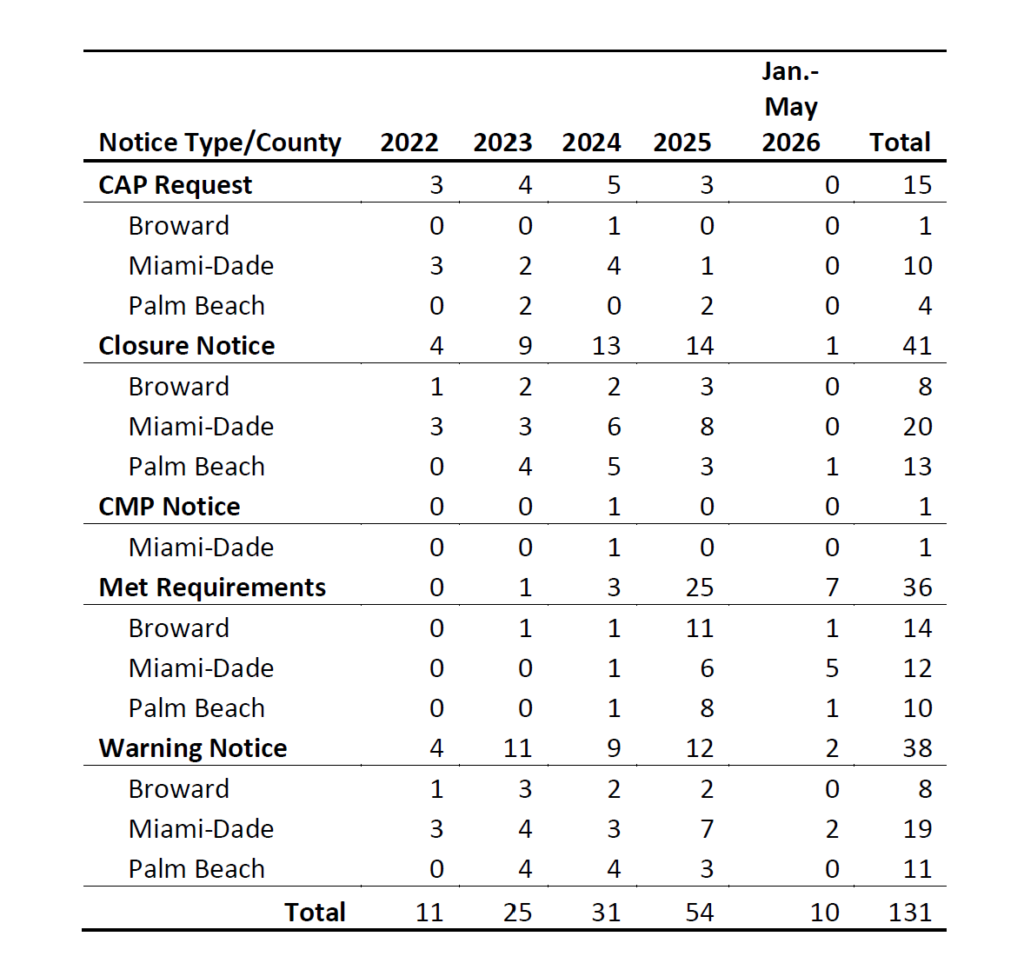
CMS is fining hospitals – some twice. An Indiana hospital, which has fewer than 30 beds, was issued its first fine Feb. 4th. The $51,615 fine covered 155 days of noncompliance with federal price transparency rules. Then the hospital was issued a second fine of $40,356 on June 3rd. CMS stated that the hospital has remained out of compliance with federal rules, stating “specifically, no consumer-friendly list of standard charges was found.”6
Michelle Marsh, President, Forma Advisors, is a Strategic Planning Executive specializing in Hospitals and Healthcare Systems. You can contact her via email at michelle@formaadvisors.com.
1 Maleki N, Padmanabhan B, Dutta K, Usability of Health Care Price Transparency Data in the United States: Mixed Methods Study, J Med Internet Res 2024;26:e50629, doi: 10.2196/50629; PMID: 38442238 PMCID: 11015359
2 Healthcare IT Today (1/31/24), Turquoise Health Raises $30M Series B Financing, Expanding Healthcare Pricing Platform Offerings
3 Whaley, C. M. (2024). Prices paid to hospitals by private health plans: Findings from Round 5 of an employer-led transparency initiative. RAND Corporation / Wisconsin Manufacturers & Commerce Briefing.
4 Code of Federal Regulations at 45 CFR Part 180
5 CMS, Hospital Price-Transparency Enforcement Activities and Outcomes. Data analysis by 2CY, Inc.
6 Beckers Hospital Review (6/15/26), Indiana Hospital Hit with 2nd Price Transparency Fine