

By Kai T. Hill
The University of Miami Comprehensive Hypertension Center (UMCHC), part of UHealth – University of Miami Health System and the University of Miami Miller School of Medicine, has received the Gold Plus distinction from the American Heart Association (AHA).
AHA awarded the distinction as part of its Target: BP™ initiative, a collaboration with the American Medical Association in response to the high prevalence of uncontrolled blood pressure. Gold Plus distinction is awarded to health care organizations that attest to at least four of six evidence-based blood pressure activities in the categories of equipment calibration and validation, staff knowledge and skills and systems of care.
A Critical Need for Blood Pressure Care
Nearly half of the adults in the U.S. are grappling with high blood pressure, or hypertension. Less than half have their blood pressure under control, underlining the urgency of both diagnosis and effective management.
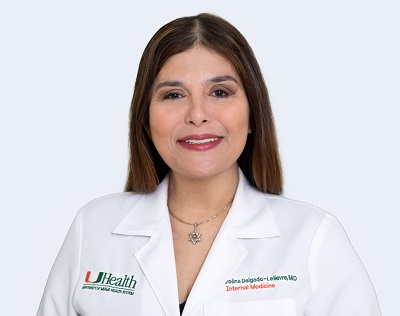
Maria Delgado-Lelievre, M.D.
Maria Delgado-Lelievre, M.D., assistant professor of medicine for the Miller School and founding director of UMCHC, emphasizes the pivotal role of blood pressure management in achieving superior cardiovascular health.
“High blood pressure is a leading risk factor for heart disease and stroke that can often be prevented or managed if diagnosed and treated properly,” she said.
While the Gold Plus recognition is a testament to the level of comprehensive, evidence-based care at the UMCHC, Dr. Delgado-Lelievre says the achievement reflects the dedication and collaboration of the entire organization.
The Pillars of Effective Care
Dr. Delgado-Lelievre shed light on the four pillars that underpin UMCHC’s innovative approach:
- Genetic and family history assessment: UMCHC delves deep into a patient’s genetic and family history, recognizing the significance of inherited risk factors.
- Risk factors and epigenetic factors: Understanding how environment and behavior affects genes is vital in determining a patient’s cardiovascular risk.
- Biochemical analysis: Salt sensitivity and abnormal potassium level identification provides a holistic view of a patient’s biochemistry.
- Physiological study of blood pressure variability: UMCHC’s understanding of the physiological aspects of blood pressure variation is key to a comprehensive assessment of cardiovascular health.
AI, Computer Simulations and Extended Reality in Cardiovascular Care
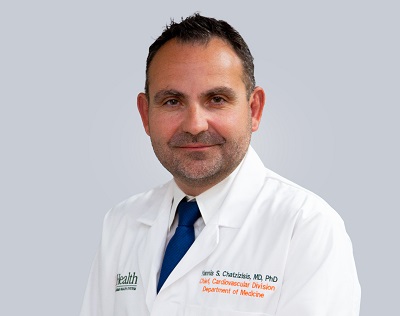
Yiannis S. Chatzizisis, M.D., Ph.D.
In a comprehensive review published in the Journal of the American College of Cardiology: Cardiovascular Interventions, Yiannis S. Chatzizisis, M.D., Ph.D., professor and chief of cardiovascular medicine at the University of Miami Miller School of Medicine, and colleagues show how artificial intelligence (AI), computational simulations and extended reality – collectively called AISER – are providing new tools to improve cardiovascular care.
“AI, simulations and virtual reality are changing the landscape of cardiovascular interventions,” said Dr. Chatzizisis, senior author of the review.
The paper, “Artificial Intelligence, Computational Simulations, and Extended Reality in Cardiovascular Interventions,” published online on October 23rd, 2023.
AI to Improve Cardiovascular Diagnosis and Therapy
While it would be easy to separate each technology into a separate bucket, the review makes the case that AISER tools are intertwined into the continuum of care. The first step is leveraging AI to assist with diagnosis.
“AI tools such as machine learning and deep learning can rapidly, precisely and accurately analyze imaging data to guide care,” said Dr. Chatzizisis. “Experts perform a similar function, but experts are not available in every hospital. Also, experts can have different opinions. These technologies can take some of the subjectivity out of diagnosis.”
Post-diagnosis treatment also benefits from advanced technology.
Digital Twins Mimic a Patient’s Anatomy
Having captured digital imaging information, cardiovascular teams can then create computer simulations of each patient’s unique anatomy—digital twins.
“Having done the stent procedure planning with the AI, we can then practice it through computer simulations on the digital twin, which is particularly helpful for complex procedures,” said Dr. Chatzizisis.
Extended Reality and Medical Education
The next step is extended reality, which allows physicians and students to immerse themselves in the digital twin. Augmented reality allows participants to scrutinize anatomical structures while retaining real-world visual cues.
These powerful new tools help train medical students, residents, fellows and other early-career clinicians by allowing them to visualize the blood vessels, the blockage and the stent, including how it is deployed and interacts with the blood vessel.
A New Center Focused on Technology
Dr. Chatzizisis recently opened the Center for Digital Cardiovascular Innovations to help advance these technologies at the Miller School of Medicine. This multidisciplinary center unites biomedical engineers, computer scientists, physicians, and biologists in a hub that collaborates with industry and other research centers and attracts philanthropy and federal funding.