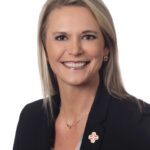
Southeast Regional Vice President, Materials Management
Holy Cross/Mercy Hospitals
 Proudest Accomplishment: Election to the president of the national Association for Healthcare Resource and Materials Management (AHRMM)
First Job: Washed pots and pans and transported patients while in college; first full-time job was a Store Room Supervisor at a 300-bed Hospital in Ohio
Education: BA in Business Administration, Northeastern, Chicago, IL; MBA, Baldwin Wallace College; MHA, Ohio State University.
What skills do you need to succeed in your job: You need to be intuitive, analytical, action- and results-oriented as well as possess excellent people skills.
Work habit you possess that you are most proud of: I consider myself visionary, with an innate ability to anticipate problems and lead others.
Most valuable lesson you learned in your career: People are different some assertive, some compassionate, some reserved, and some down right impossible. There are a number of ways to get something done. Your way is not always the only way.
The toughest part of your job: Striking the delicate balance between high quality and low cost; and delivering a consistently high level of service.
Your philosophy of success: Work hard, respect others, and above all, do what is right.
One of your goals: I have a compassion for Healthcare Supply Chain and a desire for innovation. I have been active in AHRMM in facilitating the adoption of bar code scanning for healthcare products and hope to see this come to fruition within the next 3 years.
Person You Most Admire: Paul Balcom, the former CEO of Catholic Health Partners (Lorain, OH) & my mentor, for his honesty, integrity, compassion for people, and ability to get things done.
Favorite Book: Good to Great: Why Some Companies Make the Leap… and Others Don’t by Jim Collins
Biggest Challenge Confronting Healthcare: To provide a high level of quality care and service to all in a declining and restrictive reimbursement arena.
Suggestions on how you would solve a particular problem in healthcare: Although hospitals are largely information-based systems, most can not afford all the information software upgrades they need. If the government would subsidize some of these requirements they would eventually receive a return in more efficient healthcare, improved billing, etc.
Your predictions on the future of health care: Computer software will provide additional opportunities to screen and rule out diseases and symptoms. This will affect change in our entry-level patient care and potentially compete with similar clinical services offered by practitioners.
Best Thing About Healthcare in South Florida: Patient volume is much more desirable than that in the nations Rust Belt.
Worst Thing about Healthcare in South Florida: The cost of living and the access to sufficiently trained personnel.
What advice would you offer young people considering a career in Health Care: To align your education with your ultimate career goal. Ideally, earn an undergraduate degree in a clinical area and a graduate degree in either business and/or your clinical concentration.
Proudest Accomplishment: Election to the president of the national Association for Healthcare Resource and Materials Management (AHRMM)
First Job: Washed pots and pans and transported patients while in college; first full-time job was a Store Room Supervisor at a 300-bed Hospital in Ohio
Education: BA in Business Administration, Northeastern, Chicago, IL; MBA, Baldwin Wallace College; MHA, Ohio State University.
What skills do you need to succeed in your job: You need to be intuitive, analytical, action- and results-oriented as well as possess excellent people skills.
Work habit you possess that you are most proud of: I consider myself visionary, with an innate ability to anticipate problems and lead others.
Most valuable lesson you learned in your career: People are different some assertive, some compassionate, some reserved, and some down right impossible. There are a number of ways to get something done. Your way is not always the only way.
The toughest part of your job: Striking the delicate balance between high quality and low cost; and delivering a consistently high level of service.
Your philosophy of success: Work hard, respect others, and above all, do what is right.
One of your goals: I have a compassion for Healthcare Supply Chain and a desire for innovation. I have been active in AHRMM in facilitating the adoption of bar code scanning for healthcare products and hope to see this come to fruition within the next 3 years.
Person You Most Admire: Paul Balcom, the former CEO of Catholic Health Partners (Lorain, OH) & my mentor, for his honesty, integrity, compassion for people, and ability to get things done.
Favorite Book: Good to Great: Why Some Companies Make the Leap… and Others Don’t by Jim Collins
Biggest Challenge Confronting Healthcare: To provide a high level of quality care and service to all in a declining and restrictive reimbursement arena.
Suggestions on how you would solve a particular problem in healthcare: Although hospitals are largely information-based systems, most can not afford all the information software upgrades they need. If the government would subsidize some of these requirements they would eventually receive a return in more efficient healthcare, improved billing, etc.
Your predictions on the future of health care: Computer software will provide additional opportunities to screen and rule out diseases and symptoms. This will affect change in our entry-level patient care and potentially compete with similar clinical services offered by practitioners.
Best Thing About Healthcare in South Florida: Patient volume is much more desirable than that in the nations Rust Belt.
Worst Thing about Healthcare in South Florida: The cost of living and the access to sufficiently trained personnel.
What advice would you offer young people considering a career in Health Care: To align your education with your ultimate career goal. Ideally, earn an undergraduate degree in a clinical area and a graduate degree in either business and/or your clinical concentration.