Since establishing the Miami Dade College Simulation Hospital in 2019, the MDC medical campus has continued to add new features to train the more than 4,000 students that use it each semester. The college has also added a number of new certificate programs to help students advance in their careers and to provide new entry points for those considering a career in healthcare.
“Though it opened a few years ago, our simulation hospital is still a hot topic, with people including the governor of Brazil requesting a tour,” explains Bryan Stewart, Ph.D., NREMT, campus president, Miami Dade College Medical Campus. “And we’ve continued to add features that provide more support for our students, including a new artificial intelligence (AI) mannequin.”
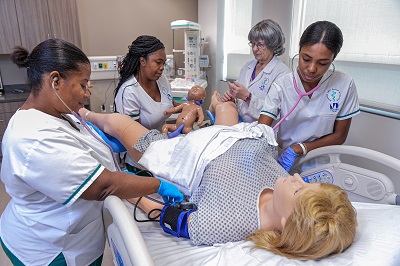
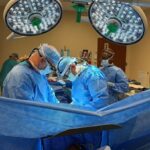
Medical Campus, Center for Learning, Innovation and Simulation building Photoshoot on February 26, 2020.
The simulation hospital features eight medical surgical rooms, two OB rooms, two pediatric rooms, nine debriefing rooms, one operating room, one simulated ambulance, 10 exam rooms and one apartment, as well as 17 high-fidelity human patient simulators. Faculty are able to launch more than 100 different scenarios, giving students the opportunity to solve real-world issues, learn to handle stressful situations and develop the necessary critical thinking skills required in a medical setting before working with actual patients.
All of the students in the Miami Dade College’s LPN, associate’s in nursing and bachelor’s in nursing programs use the simulation hospital at some point during their tenure, and often work in tandem with students in some of MDC’s 28 Health Sciences programs as well. For example, nursing students may work with respiratory therapy, EMS or physician assistant students, just as they would in their careers.
During the pandemic, the simulation hospital also enabled MDC, which has the largest nursing program in the state of Florida and one of the largest nursing programs in the country, to continue to train students when hospitals were not able to offer clinical rotations.
New Certificates and Degrees
According to Stewart, the medical college has recently added new programs, including some with stackable credentials, in order to provide students with more entry points to a healthcare career as well as a chance to advance in their fields. These include a Central Sterile Processing program to serve as a prerequisite to the Surgical Tech program established last year.
“We are about to add an endoscopy program, which will act as another stackable certificate for surgical tech,” says Stewart. “This will give students another advantage in the job market.”
The college is also adding a Dental Assistant Technology Management certificate program in conjunction with its dental assisting program that provides students with the opportunity to enter the dental profession as something other than a dental hygienist. A new Healthcare Service Specialist certificate, which includes a series of courses that prepare students to become proficient on the latest software used in medical offices, will provide students with a new entry point and the opportunity to gain direct employment as a health services specialist.
“We’ve also added a Health Service Management degree because we noticed that a lot of our previous graduates were looking for additional leadership and management skills to move up in the hospital setting,” said Stewart. “What’s great about that is that once you’re employed at a hospital, they often have tuition reimbursement plans to help pay for advanced degrees.”
All of the MDC’s new programs are currently recruiting for fall enrollment. To learn more, visit www.mdc.edu/medical.