BY:
Paul R. DeMuro, PhD, JD, MBA,
and
Richard M. Klass, MBA
The Work/Qualifying Activities Requirement
The implementation of Medicaid reform under the “One Big Beautiful Bill Act” (OBBA) is expected to increase the number of uninsured individuals in Florida. This expectation is supported by data from Arkansas, where approximately 18,000 out of 955,000 Medicaid enrollees lost coverage between 2018 and 2019 following similar policy changes. Both the Arkansas initiative and OBBA mandate that recipients engage in work, volunteerism, or other qualifying activities; however, the federal initiative targets a wider age range, placing a larger segment of Florida’s population at risk for loss of Medicaid coverage.
- Arkansas Program: Adults ages 30–49 (80 hours/month).
- OBBA: Adults aged 19–64 (80 hours/month).
Florida is among ten states that chose not to expand Medicaid coverage for individuals up to the federal poverty level (FPL). In states opting for Medicaid coverage expansion, adults under 65 may be eligible if their income is up to 138% of the FPL (which is about $21,597 for a single adult and $44,367 for a family of four in 2025).
- Proportionately more people are likely to get disenrolled from Medicaid in expansion states versus non-expansion states.
- Further, the time limit to apply for retroactive Medicaid/CHIP coverage is more onerous in expansion states (one month) than in non-expansion states (two months).
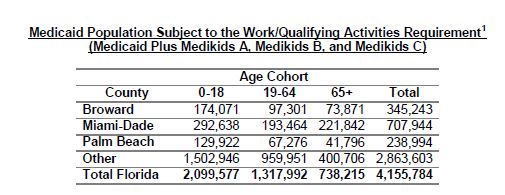
The Florida Agency for Health Care Administration (AHCA) reports over 4.1 million Medicaid eligibles state-wide, with 32% subject to the new work or qualifying activity requirements.
- In South Florida, counties exhibit a lower proportion of individuals required to comply: Broward (28%), Miami-Dade (27%), and Palm Beach (28%).
Risk of Hospital Admissions Moving from Medicaid to Uninsured Payor Class
There is currently insufficient data to determine precisely how many individuals will lose Medicaid coverage and what percentage of these people may require hospitalization. Topical literature indicates:
- Most adult Medicaid beneficiaries are employed, typically in low-wage positions without access to employer-sponsored health insurance.
- Non-working recipients may include caregivers, students, or individuals with health conditions that prevent employment.
- The extent to which vulnerable populations may lose coverage due to administrative barriers, as opposed to lack of compliance or need, remains uncertain.
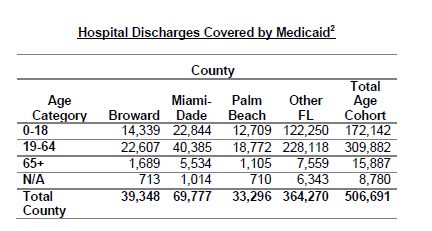
- A portion of adults aged 19–64 who are presently covered will transition to an uninsured payor status. Within the South Florida tri-county region and the 19–64-year-old cohort:
– Miami-Dade County experiences the highest number of discharges (40,385), followed by
– Broward County (22,607), and
– Palm Beach County (18,722).
- Hospitalization rates within the 19-64 adult cohort exceed those observed in the 0–18 age group.
Undocumented Immigrant Exclusion
Florida regulations largely preclude undocumented immigrants from traditional Medicaid coverage. The OBBA provisions by itself for undocumented immigrants will likely not materially impact providers beyond their current experience. Currently, Medicaid coverage for undocumented individuals in Florida is limited to emergency care, prenatal services, labor and delivery, and postpartum care.
Undocumented residents in Florida are already excluded from the “children’s Health Insurance Program (CHIP). This further begs the question:
- Will forthcoming federal policies override Florida’s current rules that allow restricted Medicaid benefits for undocumented individuals, including newborns, expectant mothers, and children?
- Will fear of deportation cause undocumented individuals to delay seeking prenatal, preventive, and diagnostic care, potentially resulting in more severe health outcomes and increased long-term costs.
Paul R. DeMuro, Counsel, Katten Muchin Rosenman LLP, can be reached at paul.demuro@katten.com.
Richard Klass, President, 2CY, Inc., can be reached at rklass@2cy4u.com.
1 AHCA, Medicaid Data Analytics, Age By County, 6/20/2025
2 Florida AHCA Hospital Discharge Database, 2022