Ask any doctor who works at Miami Cardiac & Vascular Institute if the $120 million expansion has made a difference one year later, and the answer will be a resounding yes.
“The expansion allows us to treat more patients with more efficiency and to offer more effective therapies,” said Constantino Peña, M.D., medical director of vascular imaging and an interventional radiologist at the Institute. “The Institute has always been a leader in offering the best and most advanced technology and procedures. We just outgrew the space.”
Since the Institute was founded in 1987 within the walls of Baptist Hospital, its 76 physician members have been recognized as pioneers of less-invasive techniques to treat heart disease, stroke and aneurysms. Their names are regularly seen as authors of academic papers detailing research outcomes of physician driven studies.
.jpg) “The improvements and expansion of the laboratories gave us a better place to treat our complex patients with structural heart disease,” said Ramon Quesada, M.D., medical director of the structural heart and complex percutaneous coronary intervention programs at the Institute.
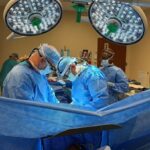
“The improvements and expansion of the laboratories gave us a better place to treat our complex patients with structural heart disease,” said Ramon Quesada, M.D., medical director of the structural heart and complex percutaneous coronary intervention programs at the Institute.A centerpiece of the expansion is four large hybrid operating rooms that easily accommodate any type of image-guided procedure and allow physicians of various disciplines to work together to create unique solutions for patients’ problems in the treatment of aortic and other aneurysms and complex vascular disease.
“It’s an environment where you feel comfortable to ask, ‘Hey, what else can we do?’ We cross the lines of different specialties to come up with the best solution,” Dr. Peña said.
The hybrid operating rooms are separate from conventional interventional suites to meet a growing demand for structural heart cases that require extreme sterility, including valve implants, trans catheter aortic valve replacements and mitral valve repairs.
“When everything is done in one place with the right tools and technology, the process goes smoother and it simplifies the overall procedure. At the end of the day, the true beneficiaries of the improvements in space and rooms are the patients,” Dr. Quesada said.
 Physicians and staff members contributed to planning the renovation and expansion, which totals 150,000 square feet. Physician leaders traveled to The Netherlands to talk with catheter lab designers about the most advanced way a lab should be set up, from the lighting to the overall environment to the imaging technology. Engineers and designers also came to the Institute to meet with physicians on site.
“We all had significant input, and that was important for us. As a result, the labs are a first of their kind in the world,” Dr. Quesada said.
Research is critical to the mission of the Institute. Doctors are involved in multiple areas at multiple levels, which allows them to be on top of what’s coming next and determining therapies before they are considered a standard treatment.
“The expansion is another step in the evolution of our philosophy of innovation at Miami Cardiac & Vascular Institute. It’s been an incredible journey to start at a small community hospital and build a patient-care driven sophisticated center,” Dr. Quesada said.
“What I really like about the expansion is the state-of-the-art environment that it has created. A lot of people would say, ‘Yes, but the Institute before the expansion was state-of-the-art.’ And it’s true. Even though it was 30 years old, it was still cutting edge. To be able to take something like that and make it even better, even more cutting edge, taking it and giving it a futuristic side, preparing us for the next 15 years – that’s what’s exciting for me,” Dr. Peña said.
“It’s a beautiful place to work with really incredible comradery,” Dr. Peña said.