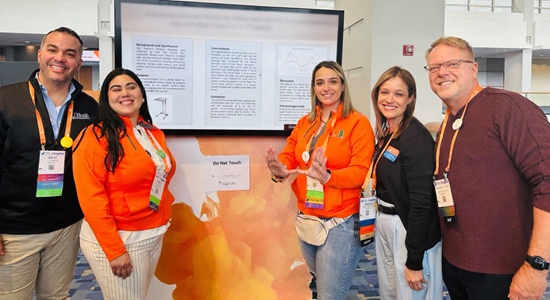
The University of Miami Health System nurse research team at the 50th Annual ONS Congress in Denver, April 2025. (l-r) Julio Garcia, MSN, RN, NE-BC, PMQ; Anely Campo, BSN, RN; Gina Martinez, BSN, RN; Jessica MacIntyre, DNP, MBA, APRN, AOCNP; Michael Mocoski, BSN, RN, OCN
By Sylvester Comprehensive Cancer Center, part of the University of Miami Health System
Improving patient outcomes doesn’t always require new technology—sometimes it comes down to rethinking how care is organized and delivered, and a team of nurses at the University of Miami Health System did just that with the development of the Admission, Discharge, Transfer (ADT) staffing model.
Initially launched in 2019 at the UHealth Tower, the ADT model was designed to address challenges like low patient satisfaction and high readmission rates—particularly among oncology patients from Sylvester Comprehensive Cancer Center, who often require complex, coordinated care—all while creating a more supportive, efficient environment for nursing staff.
Leaders recognized that patient discharge is not a single event, but rather a critical transition point—one where miscommunication or gaps in planning can lead directly to complications and readmissions. To strengthen this phase, the team implemented a series of coordinated interventions. Regular committee meetings and structured communication channels ensured that executives remained closely connected to frontline challenges and performance data; nurses and care teams were trained in quality improvement frameworks such as the Lean and Plan-Do-Check-Act (PDCA) methodologies; and additional full-time ADT nursing positions supported staffing needs. Another impactful change was the introduction of a standardized discharge planning process. To support these efforts, the hospital developed an ADT dashboard that tracked discharge-related metrics and flagged potential issues. This real-time visibility allowed teams to intervene quickly when problems arose. In addition, follow-up phone calls were conducted at multiple intervals after discharge, providing a safety net for patients navigating recovery at home. These calls helped reinforce instructions, answer questions, and identify early warning signs of complications.
The results were striking. In oncology units, readmission rates dropped significantly—from 23.23% to 15.6%—suggesting that patients were better prepared to manage their care after leaving the hospital. Patient satisfaction scores also improved, including the likelihood of recommending the facility and perceptions of discharge communication. These gains reflect not just better clinical outcomes, but a more positive patient experience.
The success of the ADT model highlights several important lessons. First, effective discharge planning requires both structure and flexibility—standardized processes supported by continuous feedback. Second, leadership engagement and staff education are essential for sustaining change. And finally, patient care does not end at discharge; proactive follow-up is critical for ensuring continuity and safety.
Given these outcomes, the team at UHealth Tower has successfully expanded the ADT model beyond oncology to all inpatient units—an initiative that contributed to the University of Miami Health System becoming Florida’s first health system to receive the Magnet with Distinction from the American Nurses Credentialing Center’s (ANCC) Magnet with Distinction Recognition Program.
This broader implementation reflects a shift toward more integrated, patient-centered care, one that recognizes transitions as opportunities for improvement rather than points of risk. As healthcare systems continue to grapple with rising complexity and expectations, models like ADT offer a practical, evidence-informed pathway forward.
For more information, visit umiamihealth.org/healthcare-professionals/nursing.