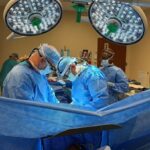
Recently, second-year Nova Southeastern University College of Osteopathic Medicine students spent a week in the Simulation Clinic doing hands-on training by working with simulated burn victims.
Heather McCarthy, D.O., assistant professor of medical education and director of the Simulation/Standardized Patient Lab, said while the burn case was part of last year’s curriculum, “This year we took the simulation to a whole other level.”
As part of the second-year students’ procedures and clinical skills week, Jeff Golomb, the lab’s simulation clinic technician, worked with other colleagues to create burn wounds—raw, dark, and, crusty patches—all over a mannequin that could manifest distress by wheezing and moaning. Starting with a kit containing generic prefabricated wounds, Golomb and his coworkers created specialized burns for the mannequins.
|
Dr. John Pellosie, assistant professor in both the Departments of Family Medicine and Public Health at Nova Southeastern University leads a simulated burn situation that allows students to see learn about caring for burn patients. |

The burns were brought to life with moulage—the French word for theatrical makeup. “The mannequins are expensive, so I had to come up with ways to create that look and have it easily removed after a week of observation and study,” Golomb explained. “With a protective plastic layer underneath, we used liquid latex and tissue to create the texture and added the color with a variety of makeup techniques.” With a moisture effect added by using a facial peel donated by Dr. McCarthy, the simulated burn patients were ready for a week of treatment.
“It was research,” Golomb said. “There is a ton of theatrical effect information available, so my only contribution was combining different techniques for our specific simulation application.” According to Dr. McCarthy, “It’s like taking five cookbooks and making your own recipe.”
The simulation is used to “engage students and immerse them into a simulated situation so when they see human burn victims, they feel comfortable with seeing and working on them,” Golomb said. “That is what we are trying to do with the simulation and why we try to make it as real as possible.”
Sometimes the realism of simulation learning is intense. “We had two students faint last year when drawing fake blood,” Dr. McCarthy said. “This year we had the same thing happen,” Golomb responded, remembering a student who swooned in a side room.
Students are actively engaged in utilizing several skills while treating the case. Students have the opportunity to apply concepts learned in lecture, such as the rule of nines used to assess the amount of body surface that has been burned, and the Parkland formula—a starting point for fluid resuscitation while working in the Simulation Clinic.
“We teach them basic procedures like drawing blood, starting an IV, and intubating,” Dr. McCarthy said. “Burn victims can lose a lot of blood and fluids, so an IV needs to be started. They place the IV into the mannequin, and if they want to draw blood, they can also do that. They can also assess how much fluid to give and calculate the percent of the body that is burned. There are different degrees of burns, ranging from first to fourth degree, and the students can estimate the type of burns thanks to the moulage.”
The ultimate goal, said Dr. McCarthy, is “to get students to be more comfortable with these procedures by learning through a hands-on approach that allows them to realize, ‘Oh wow, I can take care of a patient by using these skills.’”
According to Dr. McCarthy, the students enjoyed the dynamism of managing the mannequins’ breathing or fluid-loss problems on the spot. “Students serving on the Curriculum Committee told us how much they loved it,” she said. “In fact, I had multiple students tell me this was their favorite week of medical school so far.”