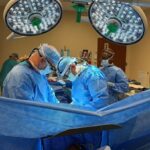
Richard Button shouldnt have made it to his 76th birthday.
In October, just a few days before he was ready to blow out candles on a cake, the Martin County resident suffered cardiac arrest and was rushed to Martin Memorial Medical Center. Button coded in the emergency department about 20 times, but managed to pull through. Because cardiac arrest can cut off the flow of oxygen, brain damage can occur in these patients. So to help reduce the risk of damage to Buttons brain, a specially trained team of physicians and nurses at Martin Memorial used non-invasive technology called the Arctic Sun System, which rapidly reduces the core body temperature. “The goal is to try to preserve brain function following cardiac arrest,” says Cynthia Silva, director of the cardiovascular intensive care unit at the Frances Langford Heart Center. “By inducing mild hypothermia you slow the bodys function down and prevent swelling that could lead to damage to the brain.” Button had gel packs placed on him and the Arctic Sun directed cool water to circulate through them, reducing his temperature by approximately six degrees. After 24 hours his temperature was gradually brought back up by having warm water circulate through the pads. Button remained in a coma-like state for four days after his cardiac arrest. But when his wife, Mary, went to visit him at the hospital on the fifth day his 76th birthday she found him sitting up and alert. “I went to my cardiologist for a follow-up visit and she looked at all of my records and told me, According to what Im seeing, you should not have survived this,” Button says. Not every heart patient who comes to Martin Memorial is a candidate for the Arctic Sun. There are a number of criteria that must be met, including the amount of time since the onset of cardiac arrest. Other patients may have specific medical conditions that dont allow them to be a candidate for the treatment. But for patients such as Richard Button, the Arctic Sun has proven to be a lifesaver. “Its really amazing. He had no brain damage as a result (of the cardiac arrest), no motor damage,” Mary Button says. “Its like a miracle.”