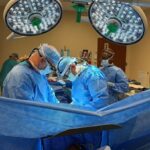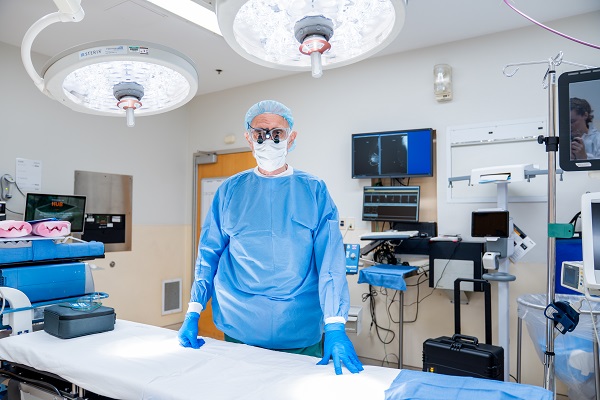


Dr. Eli Avisar at the operating table
Sylvester Comprehensive Cancer Center, part of the University of Miami Health System and Miller School of Medicine – South Florida’s only National Cancer Institute (NCI)-designated cancer center – is at the leading edge of breast cancer treatment and research. The following highlights showcase how Sylvester’s experts are shaping the future of breast cancer care.
For the roughly 30% of breast cancer patients who develop lymphedema, for example, Sylvester breast cancer surgeon Eli Avisar, M.D., has pioneered a surgical procedure that reconnects lymphatic vessels with a vein in the armpit to restore drainage. The procedure has been shown to reduce the rate of this serious complication by about two-thirds. Dr. Avisar has so far completed about 500 of these Simplified Lymphatic Microsurgical Preventing Healing Approach (SLYMPHA) procedures, offered through Sylvester’s Comprehensive Lymphatic Center, the only South Florida Center of Excellence in lymphedema care. Today, surgeons worldwide are performing Dr. Avisar’s technique.
But breast cancer treatment isn’t just about procedures – it’s also about understanding how lifestyle and biology interact to influence outcomes. As part of the FastER trial, Sylvester and Dana Farber Cancer Institute researchers are collaborating to study the impact of circadian alignment in breast cancer patients who recently started cyclin-dependent kinase 4 and 6 (CDK4/6) inhibitor therapy. This NCI-funded study, led by Tracy Crane, Ph.D., RDN, principal investigator and director of lifestyle medicine, prevention and digital health at Sylvester, is exploring how to reduce treatment-related fatigue in people with advanced or metastatic breast cancer by aligning patients’ internal body clocks with their meals and exercise routines.
While aligning treatment with patients’ biological rhythms may help reduce fatigue, researchers are also tackling the physical side effects of therapy – like hair loss – that impact patients’ confidence and well-being. Xiangxi “Mike” Xu, Ph.D., a radiation oncologist at Sylvester and assistant professor of radiation oncology at the University of Miami Miller School of Medicine, is studying how non-invasive ultrasound may help restore division among the non-cancerous cells in our hair that are affected by chemotherapy drugs like taxanes. Preclinical studies have demonstrated his technique’s effectiveness, and more work is underway to test it on a larger scale.
Sylvester surgeons are also learning and testing advanced reconstruction techniques for patients post-mastectomy that result in more natural and long-lasting outcomes. Juan Mella-Catinchi, M.D., M.P.H., a plastic surgeon at Sylvester and an assistant professor of surgery in the Miller School’s Division of Plastic Surgery, performs breast reconstruction using a patient’s own tissue, including fat, skin and blood vessels. The technique requires specialized microscopes and sutures finer than a strand of hair to sew tiny blood vessels together – and ultimately provides patients with a reconstruction option that does not involve implants.
What’s more, Dr. Mella-Catinchi, together with Devinder Singh, M.D., chief and program director of plastic surgery at Sylvester, is exploring new techniques to restore nipple and areola sensation for patients who undergo nipple-sparing mastectomies. The surgeons reconnect the nerve that’s cut in the patient’s chest during their mastectomy via nerve autografts or allografts; the pair expect to learn how well this technique works in a couple of years once the nerves they’ve operated on have had time to grow through the graft.
These innovations are just a few of the many that make up the comprehensive breast cancer care at Sylvester, which is recognized by U.S. News & World Report as one of the nation’s top 50 cancer centers for cancer care.