
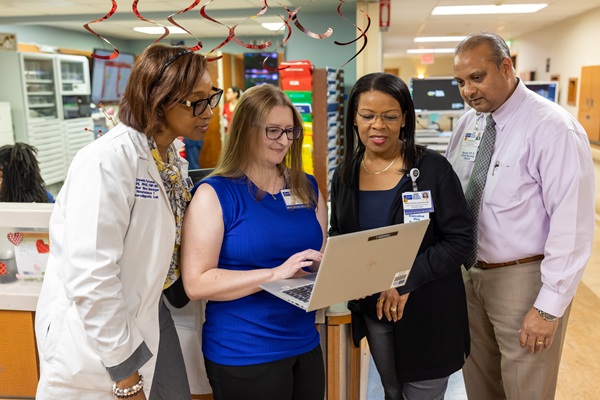


Tampa General is a beta site that is helping Microsoft develop ambient-listening technology for nurses. It allows head-to-toe assessments to be spoken aloud and recorded into a patient’s medical chart in real time.
Artificial intelligence (AI) continues to play a significant role in health care. But a very human element, the voice, has been central to the groundbreaking AI technologies Tampa General Hospital is helping to develop with key partners.
Voice biomarkers diagnose illness, predict decline
Advanced heart failure cardiologist Dr. Debbie Rinde-Hoffman is vice chief of business development and physician networks at the TGH Heart & Vascular Institute. When she learned of a company launching an international study for an app to analyze patients’ voices to predict worsening congestive heart failure, she knew Tampa General needed to be a part of it.
The app, named HearO, is a proprietary voice analysis technology developed by Cordio, a company based near Tel Aviv, Israel.
“About six million people live with congestive heart failure in the United States,” said Dr. Rinde-Hoffman. “Not only is it costly to the system when patients require hospitalizations, but it also increases the morbidity and mortality associated with the disease process.”
When the heart cannot pump as it is supposed to — for reasons that can include coronary artery disease, high blood pressure and valvular disease — fluid builds up in the lungs.
To predict worsening heart failure, a patient speaks five sentences into HearO each morning to detect voice changes caused by increased fluid. The app then notifies medical professionals. These changes typically begin two to four weeks prior to the appearance of clinical symptoms. If it proves to be effective, “the physicians can change medications proactively before the patient gets worse,” Dr. Rinde-Hoffman said.
Tampa General participated in the HearO study in 2025. Cordio’s next step is analysis, with a goal of making the app available for patients to download to their smartphones.
Dr. Rinde-Hoffman said HearO could prove to be a huge benefit over the current process for managing congestive heart failure, which requires implanting a monitor into the patient’s pulmonary artery to track pulmonary pressures.
With the app, patients “don’t have to have anything implanted,” Dr. Rinde-Hoffman said. “This is an easier, less expensive way to be able to prevent re-admitting patients with heart failure and improves their quality of life.”
Ambient listening: An improved focus on patients
In addition to serving as a test site for HearO, Tampa General is one of eight beta sites nationwide to help develop Microsoft’s ambient-listening technology for nurses.
According to Amit Patel, chief nursing informatics officer and senior director of informatics at Tampa General, Dragon Copilot for nursing is being used first on a neuroscience medical-surgical floor during nurses’ head-to-toe patient assessments, and by patient care technicians. The program is similar to, but more complex than, DAX Copilot, which transcribes physicians’ patient notes. Tampa General launched DAX Copilot for use in physician offices both in Tampa and in those serving patients in Palm Beach and Martin counties in 2024.
Instead of manually entering data into the hospital’s Epic electronic medical record system at the nurses’ station or at a mobile computer, the nurse or tech simply opens the app on their company-issued iPhone, pulls up the patient’s record and clicks to begin audio recording.
Wendi Goodson-Celerin, executive vice president and chief nursing executive at Tampa General, relayed how nurses speak their assessments while interacting with patients. However, if the assessment includes sensitive information and the patient is in a semiprivate room, the nurse completes the dictation in a private setting.
Patel said the most difficult transition for nurses is adapting to expressing their assessments aloud. The benefits include having more natural conversations with patients and being more attentive to their needs.
Patients are asked if they consent to the recording at each shift change, and there has been wide acceptance. “They like it because the nurses and patient care technicians are spending more time with them and being more attentive to their needs,” according to Patel.
Tampa General is expanding Dragon Copilot for nursing to other floors in phases, with the goal of providing it to respiratory therapists, physical therapists, case managers and more.
Patel’s team meets weekly with Microsoft developers to provide feedback on the electronic medical record app. “Microsoft has been wonderful about listening to the team about little tweaks they can make and adjusting in real time,” Goodson-Celerin said.
Patel sees a future where the technology doesn’t just listen but provides helpful feedback. For example, if the AI agent hears a discussion about medications, it could remind the nurse to consider delaying meds for the patient’s upcoming procedure or flagging possible side effects.
For more information about how Tampa General is helping to bring a more human touch to AI-driven patient care, visit TGH.org.























