
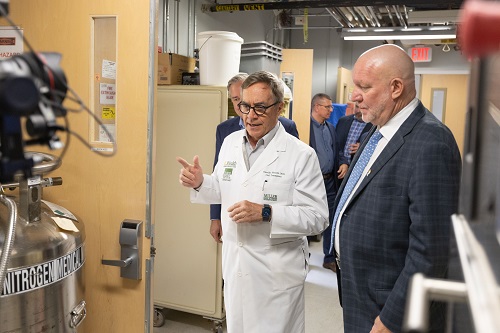


Dr. Camillo Ricordi, Chief of the Division of Cellular Transplantation & Director Emeritus of the DRI at the University of Miami Miller School of Medicine, gives Sean McGarvey, President of North America’s Building Trades Unions, a tour of the NABTU Regenerative Medicine and CGMP Center.
The Diabetes Research Institute (DRI), a world leader in research focused on finding a cure for type 1 diabetes, and North America’s Building Trades Unions (NABTU), a long-standing and sustaining partner of the DRI, have joined forces to unveil the NABTU Regenerative Medicine and CGMP Center at the DRI headquarters in Miami.
NABTU, a consortium of more than three million tradesmen and women across 330 local organizations, has been a steadfast supporter of the DRI since 1984 when, together with DRI leadership, they launched the Blueprint for a Cure initiative, an effort aimed at creating pathways of scale across local organizations to raise funds for a cure for type 1 diabetes.
“Through our enduring partnership with the Diabetes Research Institute, we have had the privilege of supporting remarkable progress in the fight against type 1 diabetes,” said Sean McGarvey, President, North America’s Building Trades Unions. “The dedication of this new laboratory is an honor that underscores NABTU’s commitment to advancing vital cutting-edge research and finding a cure.”
The building that houses the DRI today was made possible by the generous support of NABTU and its local organizations. Since its inception, the Blueprint for a Cure initiative has facilitated annual fundraising drives, including the Highway Holdup, Dollars Against Diabetes (D.A.D.s Day), and Labor of Love. Collectively, these efforts have raised more than $75 million to support diabetes research and innovation.
“We are deeply grateful for the unwavering dedication and generosity of North America’s Building Trades Unions,” said Michael Burton, CEO, Diabetes Research Institute Foundation. “Their continued support has been instrumental in advancing our mission to find a cure for type 1 diabetes, now, and improve the lives of millions worldwide.”























