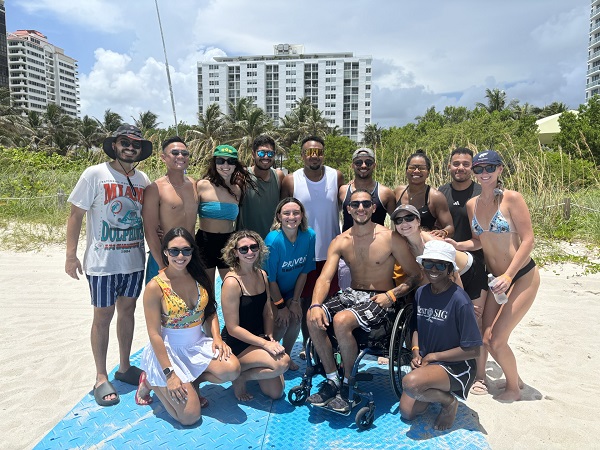
As Floridians, we take a day at the beach for granted, but for individuals with disabilities, it’s an elusive pastime that becomes a reality only through a special program on Miami Beach.
“It’s challenging trying to get the beach wheelchairs in and out of the water and then fighting with the waves. It takes a lot of muscle!” says volunteer Olivia D’Auria, a seventh-term student at University of St. Augustine for Health Sciences (USAHS) in Miami. D’Auria and others in the USAHS Miami Student Physical Therapy Association volunteered for this summers’ Adaptive Beach Days, held monthly on Miami Beach by the Sabrina Cohen Foundation.
Professor Caprice Quinones, PT, DPT, introduces students in her Neuro classes to individuals with spinal cord injuries and Sabrina’s Adaptive Beach Days to expose them to what she calls one of PT’s niche practices.
“There are so many areas to explore in physical therapy. The majority of students start out saying they want to work as a sport PT, and by the end they want to go a totally different route,” says Dr. Quinones, who has worked with patients with neurological disease in inpatient, outpatient, and home health settings. Her quest to “expand students’ horizons” paid off with D’Auria.
A former dancer, D’Auria says she’s always been “an ortho girl” but the Adaptive Beach Days were an eye-opening experience and introduced her to the possibilities in neuro.
Dr. Quinones also invites spinal cord patients to speak to her classes so students can appreciate the value of a holistic approach to PT.
“You get a different perspective when you hear someone speak about their condition from a psycho-social vantage point,” says Dr. Quinones, who feels a responsibility, as an educator, to train PTs who are empathetic and versatile enough to work with a variety of patient populations.
“There is such a great need for PT’s in outpatient and inpatient settings. I want to prepare students for as many options as possible. We would be doing our community a disservice if we did not build a pipeline of qualified PTs who graduate ready to go where there’s the greatest need,” says Dr. Quinones.