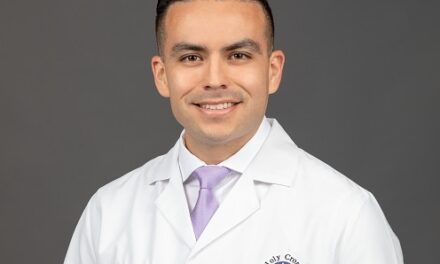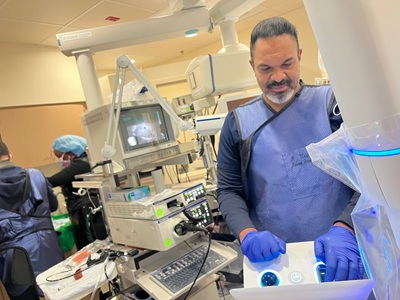
Dr. Sajive Aleyas performing the first case with the Ion Endoluminal System.
Cancer care is evolving as researchers and physicians gain a deeper understanding of how cancer develops, progresses and responds to treatment. Advances in molecular testing, imaging, minimally invasive procedures and targeted therapies are giving physicians more information to guide decisions and patients access to an expanding range of treatment options.
At Broward Health, these advances are reflected across pancreatic, breast, gynecologic and lung cancers. Traditional treatments like surgery, chemotherapy and radiation remain important, while newer approaches increasingly focus on the biological characteristics of each cancer and the individual needs of patients.
New Approaches for Difficult-to-Treat Cancers
Pancreatic cancer remains challenging to diagnose and treat because it is often identified after the disease has spread, limiting treatment options.
One emerging advancement is daraxonrasib, a daily, at-home oral therapy designed to block a mutated protein that fuels tumor growth and occurs in more than 90% of pancreatic cancers. Broward Health was among the first health systems in South Florida to gain access to the drug before FDA approval.
For patients receiving the treatment, their care plan includes regular imaging, laboratory testing and circulating tumor DNA monitoring to evaluate how the cancer is responding to the pill.
“Targeting a specific mutation that drives tumor growth allows us to approach treatment with greater precision and gives patients another option when their disease has progressed,” said Simon Blanc, M.D., medical director of hematology-oncology at Broward Health Medical Center.
The Rise of Precision Medicine
Precision medicine, such as genetic and molecular testing, can provide information about the characteristics of a tumor and help identify inherited mutations that may affect a patient’s risk or treatment options.
In breast cancer care, therapies targeting HER2, CDK4/6 inhibitors and antibody-drug conjugates have expanded the treatment landscape. Molecular information can help physicians determine which therapies may be appropriate for a specific patient.
Clinical Trials Expand Treatment Options
Clinical research is another important component of modern cancer care, allowing physicians and researchers to study emerging therapies and evaluate how they perform in specific patient populations.
Broward Health currently has 10 gynecologic oncology clinical trials open, with additional studies in development. The trials are available to eligible patients regardless of whether they currently receive their care at Broward Health.
One of the studies, the FRAME trial (3133), is evaluating new approaches to ovarian cancer treatment through three cohorts. The international study aims to enroll approximately 1,500 participants, and the first patient at Broward Health has already begun treatment.
“Clinical trials are an essential part of advancing cancer care because they allow us to expand our therapeutic options for patients beyond traditional chemotherapy, enabling cancer patients not just to live longer, but to have better quality of life,” said Scott Jordan, M.D., a gynecologic oncologist with the Broward Health Physician Group.
Technology Is Advancing Cancer Diagnoses
Earlier detection can significantly influence the course of lung cancer care. Advances in diagnostic technology are helping physicians evaluate suspicious lung nodules with greater precision, including nodules that are small or located in difficult-to-reach areas.
Broward Health Medical Center is the first hospital in Broward County to offer interventional pulmonology and thoracic surgery in one location. Its pulmonary program uses the Ion Endoluminal System, which combines a flexible robotic catheter with 3D navigation technology to help physicians reach deeper lung nodules.
“If a lung nodule is detected during the procedure, a biopsy can be analyzed immediately in collaboration with the pathology team,” said Sajive Aleyas, M.D., pulmonary critical care surgeon with the Broward Health Physician Group. “When cancer is confirmed, patients may proceed to surgical removal with an in-house thoracic surgeon, often while still sedated. In some cases, patients learn in recovery that the cancer has already been removed and can move directly to the recovery phase of care.”
Broward Health also offers low-dose CT lung cancer screening at all hospital locations and Broward Health Weston for eligible high-risk patients.
Advances in breast imaging are also improving the information available to physicians, such as 3D mammography, which provides more detailed images of breast tissue.
“Advances in breast cancer screening allow us to see tissue in greater detail and from multiple angles,” said Mehmet Hepgur, M.D., a hematologist-oncologist with the Broward Health Physician Group. “This can help us identify abnormalities that may otherwise be hidden and detect cancer earlier when it can be more treatable.”
Looking Toward the Next Generation of Cancer Care
Cancer care is moving toward individualized treatment informed by the biology of the disease and the needs of the patient. As research continues, the goal remains to identify cancer as early as possible and provide patients with the best treatment options.