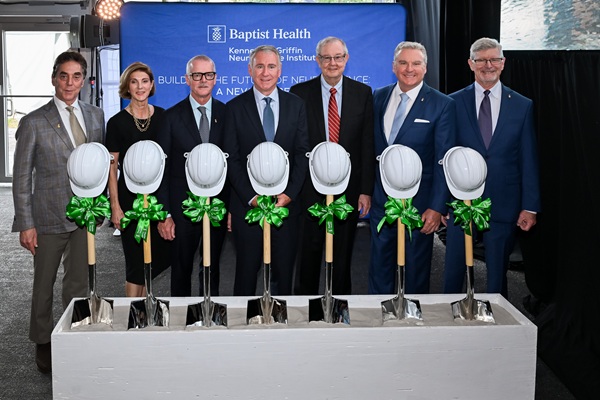
Baptist Health recently broke ground on the new home of Baptist Health Kenneth C. Griffin Neuroscience Institute, part of Baptist Health Brain & Spine Care. During the ceremony, Baptist Health also announced an additional $25 million gift from Kenneth C. Griffin, bringing his total philanthropic support for neuroscience at Baptist Health to $75 million. In recognition of this transformational investment, Miami Neuroscience Institute will now be known as Baptist Health Kenneth C. Griffin Neuroscience Institute.
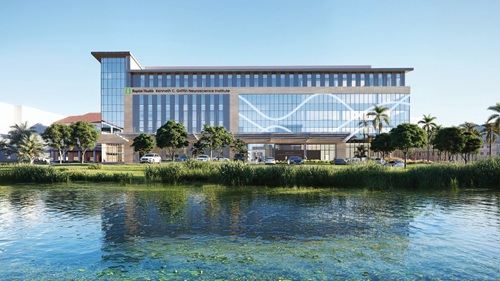
Spanning 197,000 square feet, the state-of-the-art facility will be located on the Baptist Health Baptist Hospital main campus and is slated to open in early 2029. Once complete, the new facility will significantly expand access to advanced brain and spine care; provide additional clinical space to accommodate current and future providers; strengthen interdisciplinary care, research and innovation; and further enhance the patient experience and care delivery.
Baptist Health Kenneth C. Griffin Neuroscience Institute is named in honor of Kenneth C. Griffin, founder and CEO of Citadel and founder of Griffin Catalyst, his civic engagement initiative. In 2024, Mr. Griffin made a $50 million transformational gift in support of Miami Neuroscience Institute. His additional $25 million gift will also establish the Kenneth C. Griffin Neuroscience Institute Transformational Impact Fund, which will provide resources to advance key priorities across neuroscience, including research, innovation, education and prevention. Together, his gifts represent $75 million in support for advancing neuroscience research, treatment, and care at Baptist Health.
The new facility will enable the Institute to add 16 sub-specialty providers, expand its number of exam rooms and build Baptist Health’s first academic lecture theater. It will also provide an array of services under one roof, including outpatient physical, speech and occupational therapy and rehabilitation; neuroinfusion services and more. In addition, the facility will expand opportunities for clinical trials and support the use of cutting-edge technologies to treat complex neurological conditions.
Designed to foster collaboration, the building will house clinical care and research under one roof, allowing physicians and researchers to work side by side. This integrated approach is expected to accelerate discoveries and advance care across neuroscience and its sub-disciplines.