
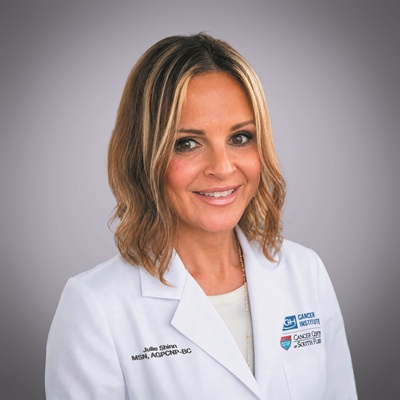
Julie Shinn, MSN, AGPCNP-BC
By Daniel Casciato
For decades, breast cancer prevention largely centered on routine screening based on a woman’s age and family history. Advances in genetic testing are making that approach considerably more individualized.
Today, clinicians can identify inherited cancer risks, combine that information with other factors and, in some cases, develop prevention and screening strategies years before cancer develops.
Julie Shinn, MSN, AGPCNP-BC, with the Hereditary Cancer Prevention & Risk Program at the Tampa General Hospital Cancer Institute in Palm Beach County, says understanding a patient’s family history remains an important starting point.
“Hereditary cancer risk assessment examines a patient’s family history of cancer – usually across three generations – and looks for patterns that could indicate a hereditary cancer predisposition,” Shinn says. “Those patterns do not always involve a cluster of cancers; we also consider certain benign findings that may be associated with an inherited genetic condition.”
By determining an individual’s risk factors, clinicians can make evidence-based recommendations for screening and prevention. Genetic counseling and testing may be appropriate when a patient’s personal or family history raises concerns about an inherited cancer predisposition.
Potential indicators include breast cancer diagnosed at a young age, triple-negative breast cancer, male breast cancer, multiple primary breast cancers and multiple relatives with breast, ovarian, pancreatic or prostate cancers. Certain ancestry-associated risks or a known pathogenic variant in the family, including BRCA1, BRCA2, TP53, PALB2, CHEK2 or ATM, may also warrant consideration.
Beyond BRCA1 and BRCA2
Public awareness of hereditary breast cancer has long centered on BRCA1 and BRCA2. The science, however, has expanded considerably.
“BRCA1 and BRCA2 were linked to hereditary breast and ovarian cancer in the 1990s, and since then, an explosion of genetic testing and research has identified many additional genes associated with breast cancer – some conveying very high risk and others more moderate risk,” Shinn says.
The changing science also means clinicians are less likely to look at a genetic test result by itself.
“We have also moved away from viewing genetic test results in isolation,” Shinn says. “A pathogenic variant is an important piece of information, but it is only part of a patient’s overall risk profile.”
Personal and family cancer history, age, breast density, reproductive and hormonal factors, previous breast biopsies and other clinical factors can all influence a patient’s overall risk.
For higher-risk patients, that assessment can lead to additional screening with breast MRI, medications designed to reduce cancer risk or, in certain cases, risk-reducing surgery.
“Ultimately, advances in genetics have allowed us to move from simply identifying inherited cancer risk to using that information proactively – often years before cancer develops,” Shinn says.
Increased Risk Does Not Mean Inevitable Cancer
One of the challenges surrounding genetic testing is helping patients understand what a positive result actually means.
“One of the most important parts of my role is helping patients put risk into perspective,” Shinn says. “Learning you are at increased risk can feel overwhelming, but it does not mean that cancer is inevitable.”
For many patients, increased surveillance may be the most appropriate course. Individuals with certain high-risk inherited genetic variants may also consider risk-reducing surgery.
There is no single approach for everyone. Different variants carry different levels of risk, making a patient’s personal and family history particularly important when determining what comes next.
The implications can also extend beyond the person being tested.
A woman undergoing testing because of breast cancer, for example, could unexpectedly discover a pathogenic variant associated with increased colon cancer risk. Her children, siblings and other close relatives could then be tested for that same variant.
“Those who test positive may qualify for earlier or more frequent screening, such as colonoscopies, with the goal of preventing cancer or detecting it at an early, more treatable stage,” Shinn says.
The information can be valuable for relatives who test negative as well. Depending on their remaining personal and family history, they may be able to avoid unnecessary high-risk screening or interventions.
Removing Barriers to Testing
Despite advances in the field, misconceptions about hereditary cancer risk remain.
“One of the biggest misconceptions is that a positive genetic result means a person will inevitably develop cancer,” Shinn says. “I encourage patients to look at the information proactively: knowing about an increased risk gives us an opportunity to prevent certain cancers or detect them when they are small and more easily treated.”
Cost is another lingering concern. Genetic testing once could cost thousands of dollars and often focused only on BRCA1 and BRCA2. Shinn says testing has become much more accessible.
“Even when someone does not meet insurance criteria, self-pay options for multigene hereditary cancer panels are often available for around $250,” she says.
Healthcare providers can help close the remaining gaps by recognizing personal and family histories that may warrant further evaluation and referring appropriate patients for hereditary cancer risk assessment, genetic counseling and testing.
Shinn is particularly encouraged by efforts to make genetic testing more accessible among people from a wider range of cultural and ancestral backgrounds. Historically, much of the available genetic data has come from populations of European ancestry. More diverse representation can help researchers identify previously underrecognized variants and better understand their relationship to cancer risk.
“I am especially encouraged to see genetic testing become more accessible to people from diverse cultural and ancestral backgrounds,” Shinn says.
The result could be an increasingly precise approach to breast cancer prevention — one in which clinicians have a clearer understanding of who is at elevated risk and what can be done about it before a cancer diagnosis occurs.
“Looking ahead, I believe hereditary cancer risk assessment will become increasingly precise and inclusive, allowing us to better personalize prevention and early detection for every patient.”
To learn more, visit TGH.org\ThePalmBeaches.



















