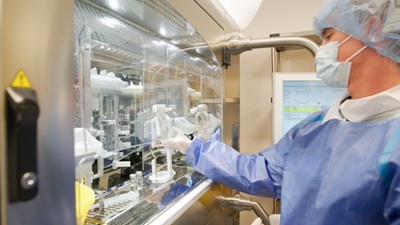
Cleveland Clinic Weston Hospital has added a high-tech team member to its Egil and Pauline Braathen Center/Maroone Cancer Center pharmacy, becoming the first hospital in Florida to implement the Loccioni APOTECAchemo robotic compounding system.
Designed to assist with the sterile compounding of hazardous oncology medications, the robot automates several critical steps in chemotherapy preparation. These include drug and diluent weighing, vial handling, reconstitution of powdered medications, dose withdrawal, final container preparation, and electronic documentation of the entire process.
A New Layer of Safety in Chemotherapy Preparation
One of the biggest advantages of robotic compounding is its use of gravimetric verification. In simple terms, the system weighs ingredients throughout the preparation process to confirm that the correct amount of medication and diluent has been used.
That added verification provides an important safety layer beyond visual inspection alone, helping prevent underdosing or overdosing. The result is stronger support for patient safety by helping ensure the right drug, the right dose, and the right preparation for each individual patient every time.
Supporting Precision, Consistency, and Traceability
The pharmacy robot also helps standardize chemotherapy compounding by automating complex preparation steps and supporting more consistent dose preparation in a high-volume oncology setting.
Each preparation is backed by automated checks, barcode verification, and electronic documentation, giving the pharmacy team greater precision and traceability. Hospital leaders say the technology helps ensure every dose is prepared with consistency and accuracy while creating a clear digital record of the process.
“We are the first cancer center in Florida to bring this innovative tool to serve our patients in the infusion center,” said Zeina Nahleh, M.D., Vice Chief, Cancer Institute and Regional Chair of Hematology/Oncology at Cleveland Clinic in Florida. Dr. Nahleh is also the Medical Director of the Maroone Cancer Center at Cleveland Clinic Weston Hospital.
“Cathey will optimize precision and efficiency of preparing chemotherapy and immunotherapy infusions. Since the pharmacy robot started working in the Maroone Cancer Center in Weston, we have already seen a reduction in the wait time for patients, one of our main goals to improve their quality of life,” Dr. Nahleh added.
Reducing Exposure Risks for Pharmacy Staff
In addition to patient safety benefits, the robotic system is expected to improve safety for pharmacy caregivers.
Because chemotherapy and other hazardous medications can pose occupational exposure risks, reducing direct manual handling during preparation is a major advantage. The robot performs compounding inside a controlled environment, helping limit staff exposure during the highest-risk steps of the process.
The technology also helps improve workflow standardization and efficiency, allowing pharmacists and pharmacy technicians to devote more time to clinical oversight, quality assurance, and patient care support.
A Major Advancement for Oncology Pharmacy
The efficiencies that come with the use of a pharmacy robot are a significant step forward in oncology pharmacy practice. By combining robotic automation, gravimetric precision, barcode verification, and electronic traceability, the system is designed to enhance safety for both patients and caregivers while improving consistency in chemotherapy dose preparation.
The robot has been named “Cathey” in honor of a philanthropist whose donation helped fund improvements in the chemotherapy infusion area at Cleveland Clinic Weston Hospital.
Robot Functions Like “Another Team Member”
Jay Patel, PharmD, CPh, pharmacy manager, said the robot is already making a meaningful difference for the pharmacy team by supporting both efficiency and caregiver and patient safety.
“Cathey, our robot, functions like another team member because of the way the process is integrated into our workflow,” Patel said. “In a high-volume oncology pharmacy, our technicians spend long periods of time performing repetitive and physically demanding compounding tasks, which as you can imagine, can be strenuous particularly for those working in the clean room.”
“It also helps with occupational exposure to hazardous medications for our staff and overall efficiency,” Patel said.
Patel pointed to reconstitution as one area where the robot offers a clear advantage. When powdered drugs must be mixed with a diluent, technicians often have to manually stir vials to fully dissolve the medication.
“The robot actually has a little rotating carousel,” he said. “The vial is placed there, and it’s rotated around in a circle, then it’s also spun around as well. It doesn’t require the technician to sit there and stir, whereas the robot is actually spinning it in multiple different directions to make it fully dissolve.”
While some medications are prepared at about the same speed as a technician would compound them manually, Patel said the robot’s precision is a major benefit.
“Certain preparations may be completed more efficiently by the robot, whereas other items are compounded by the technician with a similar technology platform and safety steps,” he said. “The robot is more consistently precise.”
As demand for oncology services continues to grow, robotic tools that work in tandem with their human counterparts may help hospitals manage increasing volume while giving pharmacy teams more support in delivering safe, consistent chemotherapy treatment to their patients.
“This technology doesn’t replace our pharmacy caregivers,” Patel said. “It supports them. It allows our technicians and pharmacists to pair their expertise with advanced automation so we can continue delivering chemotherapy preparations with a strong focus on safety, quality, and efficiency.”